Robotics teams collect thousands of hours of video showing robots grasping objects, navigating environments, and completing tasks. Finding specific actions and outcomes across those recordings can take considerable time.
Automated data labeling helps teams identify relevant events and generate candidate labels without manually reviewing every frame. However, AI-generated labels may misinterpret incomplete actions or complex behaviors.
CreativAI makes video footage searchable and turns extracted information into structured datasets. Teams can also review and refine the extracted information using its Data Plates feature.
This article explores how CreativAI approaches automated video analysis and where expert human annotation can complement the process.
What Is Automated Data Labeling?
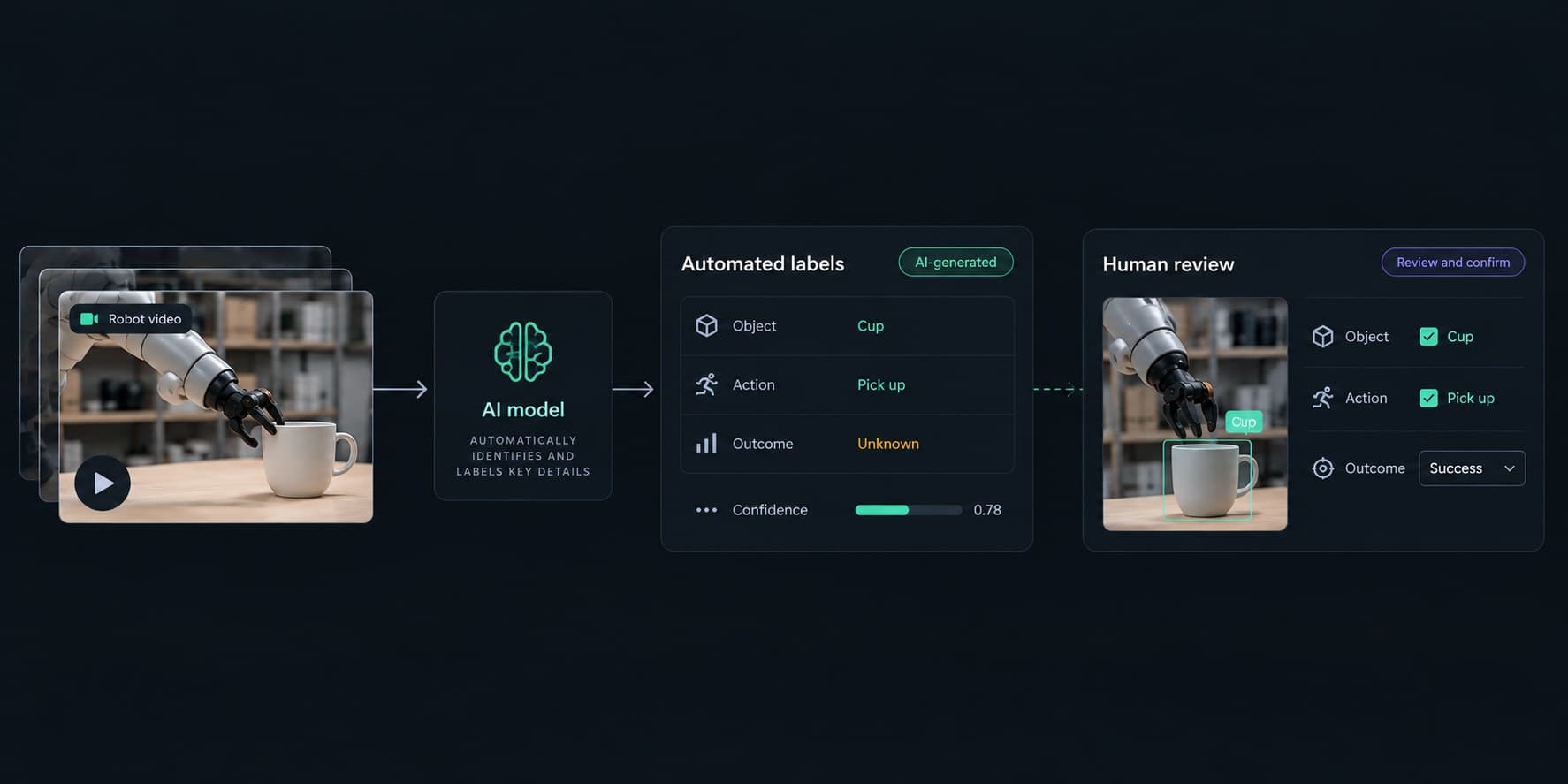
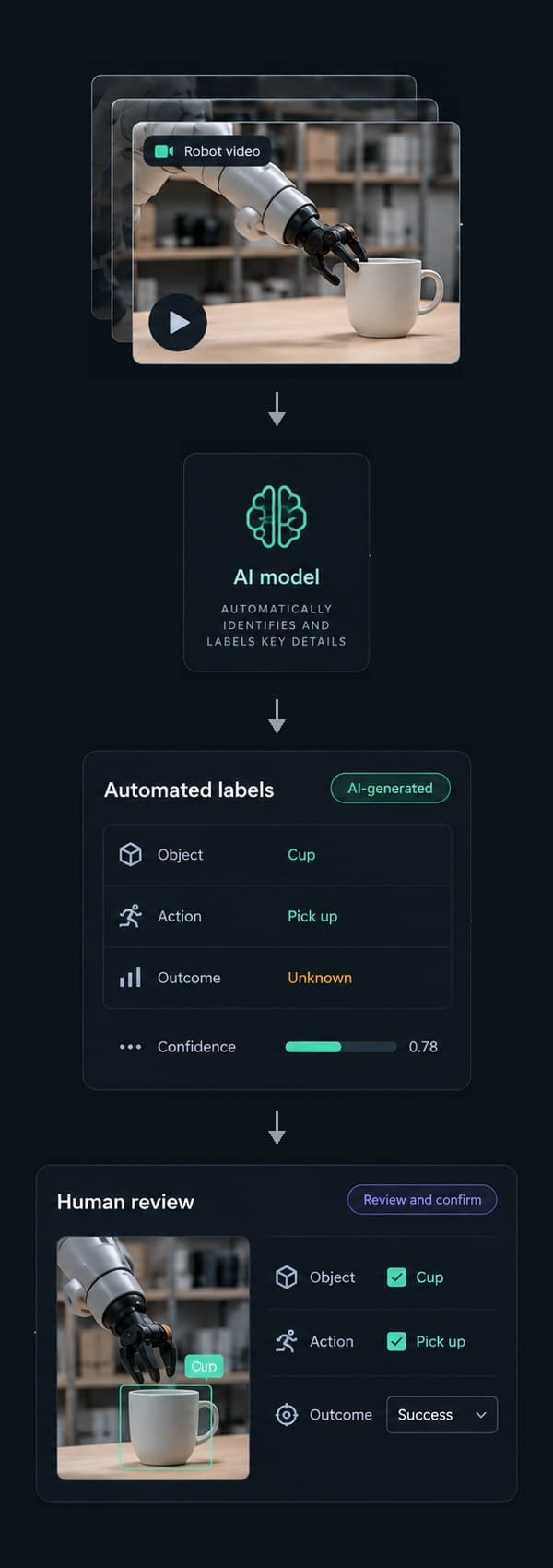
Automated data labeling uses AI models to identify and label information without manually annotating every example. In robotics video, these labels might describe objects, actions, events, or task outcomes.
For example, a model might identify a robot grasping a cup and label the action as a pickup attempt. However, the generated label may not indicate whether the robot successfully completed the task.
This distinction matters because automatically generated labels are not necessarily verified ground truth. Human-in-the-loop annotation introduces human judgment to review, correct, or confirm those labels.
Automated labeling is one part of the broader robotics data annotation process.
How Does CreativAI Turn Robot Video Into Structured Data?
Searching video is only the first step. Robotics teams also need structured records they can compare, analyze, and reuse across different tasks.
CreativAI approaches this through three capabilities: Ingest, Structure, and Act. Together, they turn raw video into searchable, structured information that teams can use for analysis and dataset preparation.
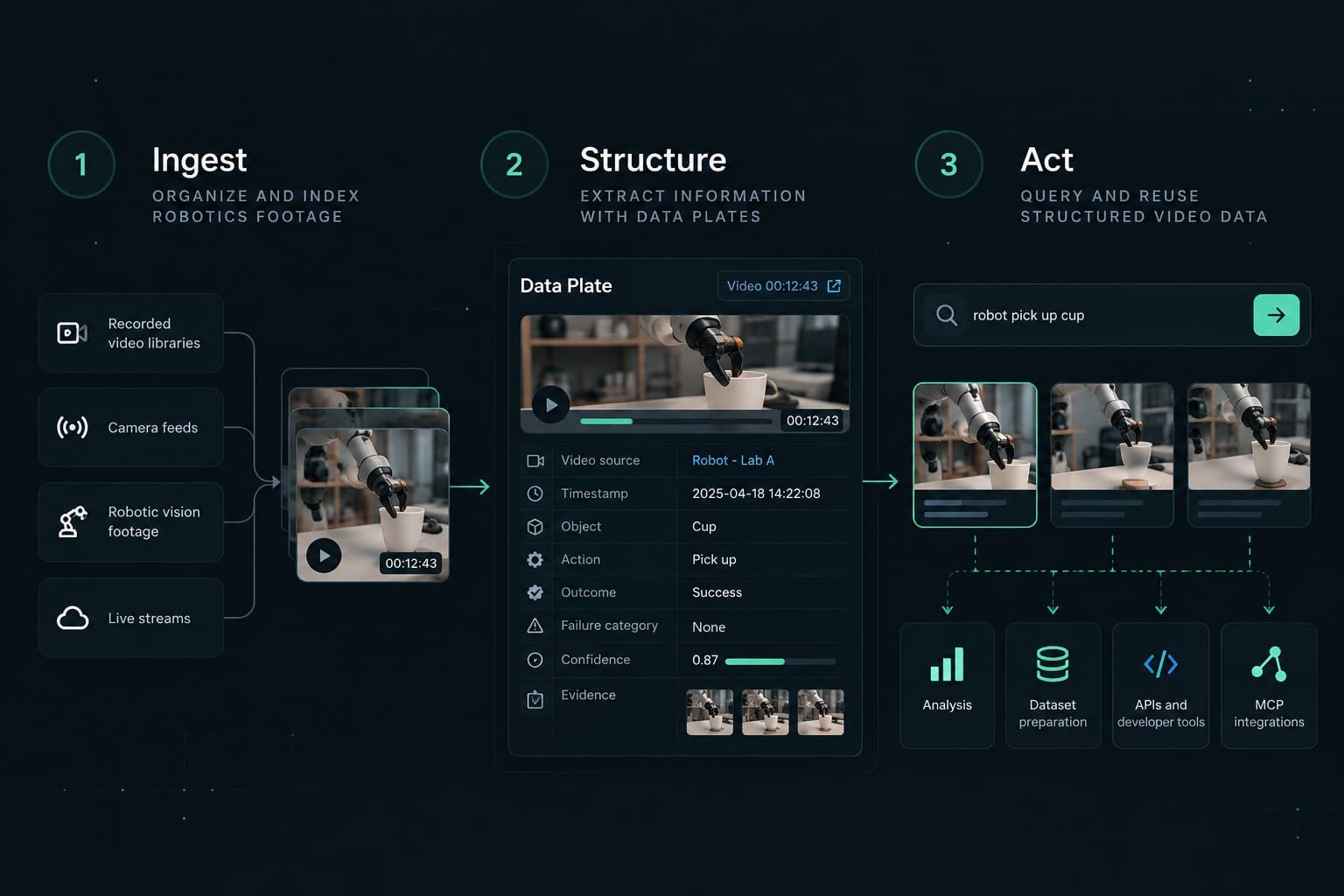
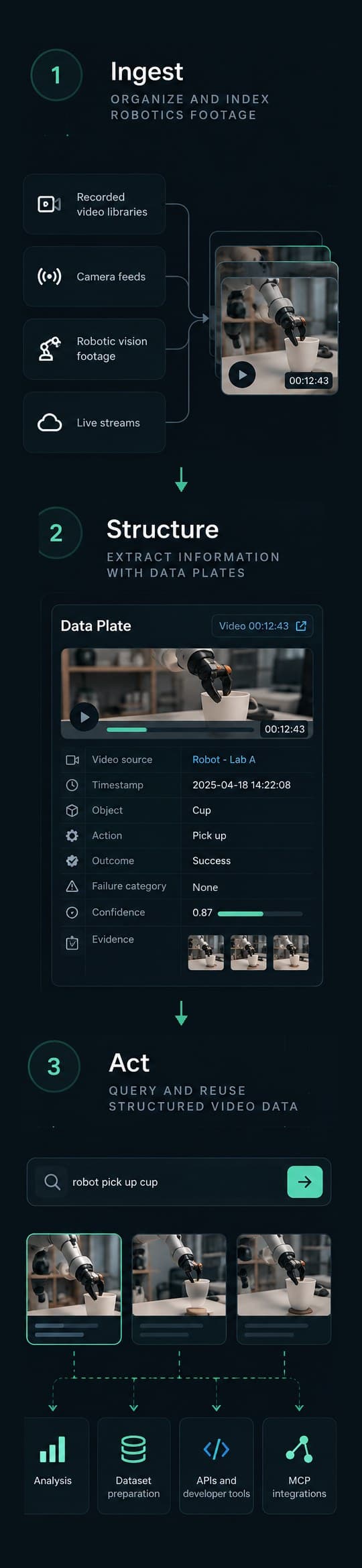
Ingest: Organize and Index Robotics Footage
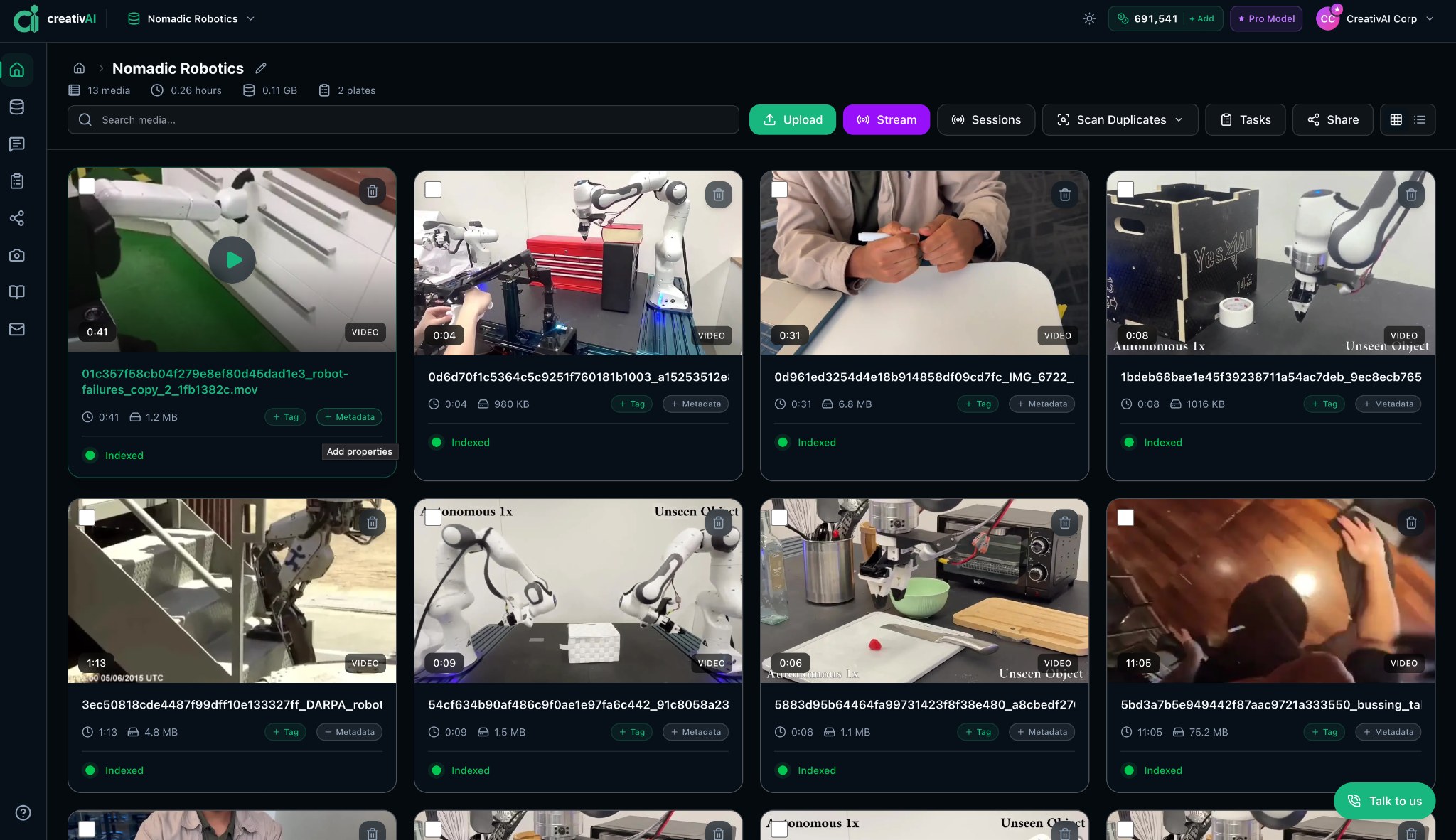
CreativAI supports recorded video libraries, camera feeds, robotic vision footage, and live streams.
Teams can index historical recordings or footage collected from deployed robotic systems. This allows teams to search indexed footage instead of manually inspecting entire recordings to locate relevant events.
For example, a robotics team could search for instances where a robot attempted to pick up a cup.
CreativAI describes this approach as “Index once, query forever.”
Structure: Extract Information With Data Plates
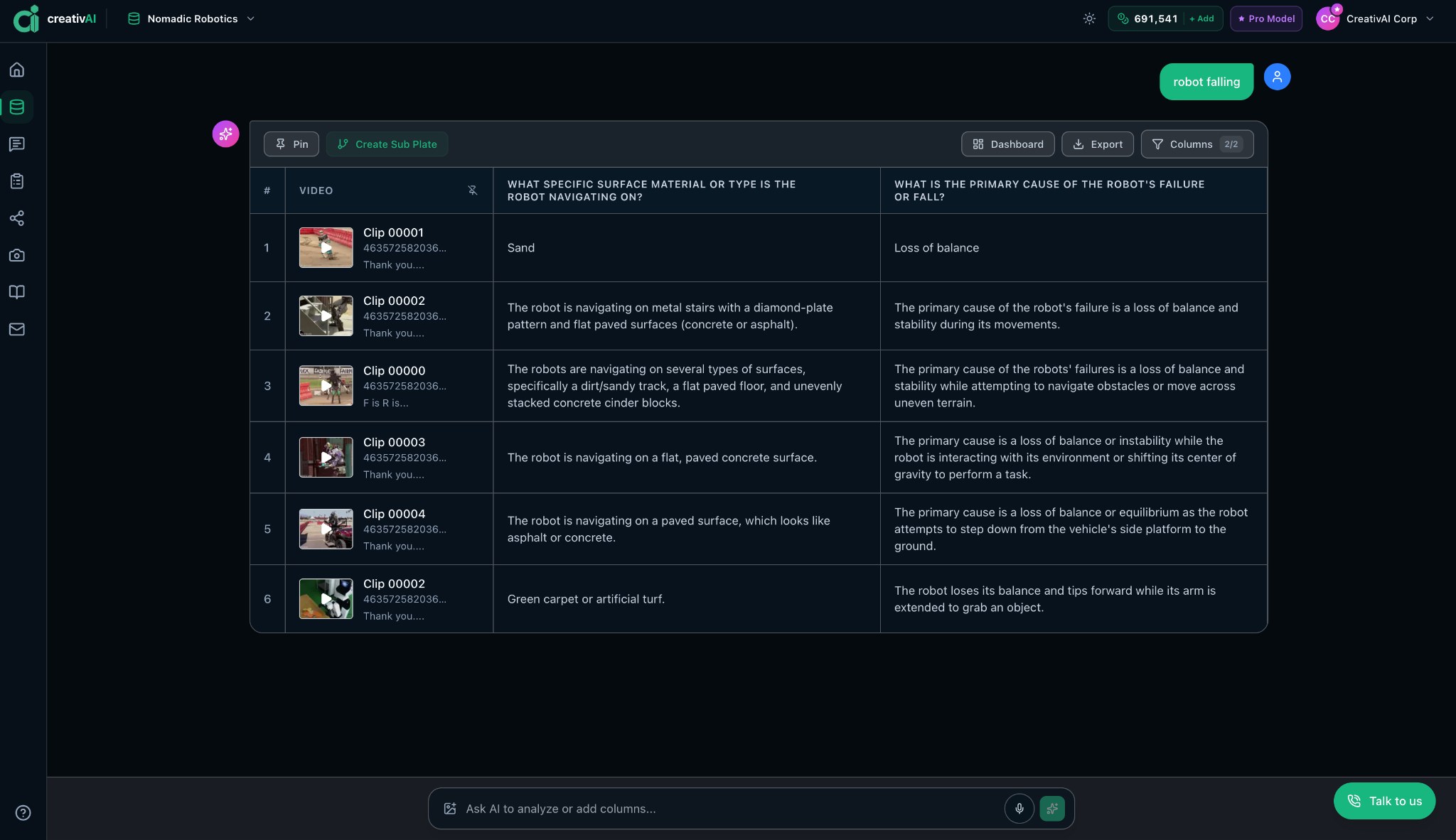
CreativAI goes beyond retrieving matching video clips. Its Data Plates turn extracted information into structured, queryable tables.
For example, a robotics team could create a Data Plate for cup pickup attempts, extracting fields such as:
- Video source and timestamp
- Object being manipulated
- Action or task performed
- Observed outcome
- Potential failure category
- Confidence and supporting video evidence
Teams can filter, analyze, validate, export, and refine these records. They can also ask additional questions to extract more information from the footage.
This produces structured records that teams can revisit instead of starting each analysis from scratch.
Act: Query and Reuse Structured Video Data
Once the information is structured, teams can use it for more than locating individual events.
For example, they could compare pickup attempts across object types or identify recordings for further annotation. They could also organize relevant examples for robotics training or evaluation.
CreativAI provides APIs, developer tools, and Model Context Protocol (MCP) integrations for accessing visual information programmatically.
Where Do Automated Labels Need Human Review?
Not every action in robotics footage is easy to interpret. A robot might complete a task, recover from a mistake, or stop halfway through an attempt.
Waleed Shaarani, Founding CCO & COO at CreativAI, explains why human oversight remains important.
“Human-in-the-loop review remains an important part of automated data labeling, especially when accuracy and quality are critical. At CreativAI, we’ve built our platform with that flexibility in mind, allowing AI to handle the heavy lifting of structuring and labeling massive amounts of visual data, while enabling humans to step in for validation, refinement, and quality assurance when needed. The goal isn’t to eliminate human involvement, but to make it more targeted, efficient, and scalable.”Waleed Shaarani, Founding CCO & COO, CreativAI
Ambiguous Actions and Event Boundaries
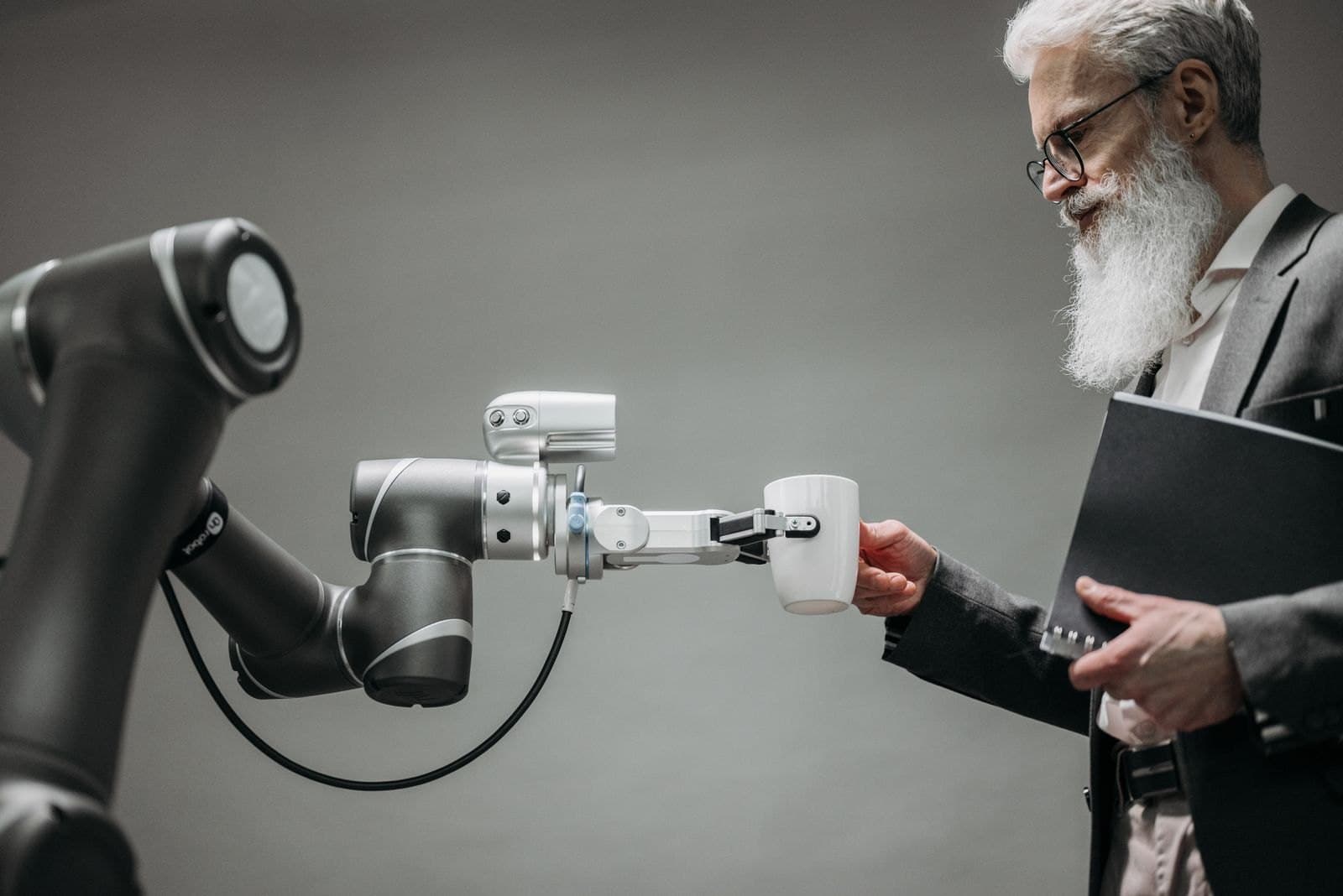
Consider a robot lifting a cup before dropping it. Did the grasp succeed, or should the entire attempt count as a failure?
Reviewers need clear definitions for both the action and its outcome. They must also decide when each action begins and ends.
These decisions can be subjective. A study of continuous-action video found substantial disagreement among five annotators about action boundaries.
Although the study examined human activities, it illustrates why robotics datasets also need explicit labeling criteria.
Unusual Behaviors and Edge Cases
Some robot behaviors don’t fit neatly into predefined categories. A robot might briefly lose its grip, reposition an object, and complete the task on a second attempt.
Should reviewers label this as one successful task or separate attempts with different outcomes?
The answer depends on the dataset’s annotation guidelines and intended use. Reviewers can examine the surrounding footage and flag cases that existing categories don’t adequately describe.
Annotation Consistency and Quality Control
Human review also requires quality checks. Different annotators may apply the same label differently, even when examining identical footage.
The HACS dataset study offers a related example of automated candidate selection followed by human validation.
Researchers used visual classifiers to identify candidate video clips, which human annotators then validated.
For robotics projects, teams can similarly review candidate labels, compare disagreements, and clarify annotation rules.
Dedicated annotation teams can maintain familiarity with project-specific definitions and previous corrections.
Human review cannot eliminate every error. However, it creates opportunities to identify inconsistent labels before they affect downstream training or evaluation.
How Can CreativAI and Human Review Work Together?
CreativAI and Labelix.ai address different parts of robotics data preparation. CreativAI helps teams discover relevant footage and extract structured information. Labelix.ai provides managed annotation teams specializing in data labeling, including video object and action annotation.
These capabilities could complement each other in robotics dataset preparation. For example, CreativAI could generate candidate records for a specialized annotation team to review.
This illustrates a possible workflow, rather than an existing integration between the companies.
Step 1: Generate Candidate Labels and Structured Records
CreativAI can index robotics footage and extract information about objects, actions, and observed outcomes.
Its Data Plates organize this information into structured records linked to the underlying video, giving reviewers access to supporting evidence.
Step 2: Select Records for Human Review
A robotics team could prioritize records involving ambiguous actions, unusual behaviors, or examples important for evaluation.
For instance, the team might select pickup attempts with unclear outcomes rather than reviewing every identified attempt.
This selection would depend on the project’s goals and annotation requirements. Not every automatically generated record needs the same level of review.
Step 3: Verify and Refine Annotations
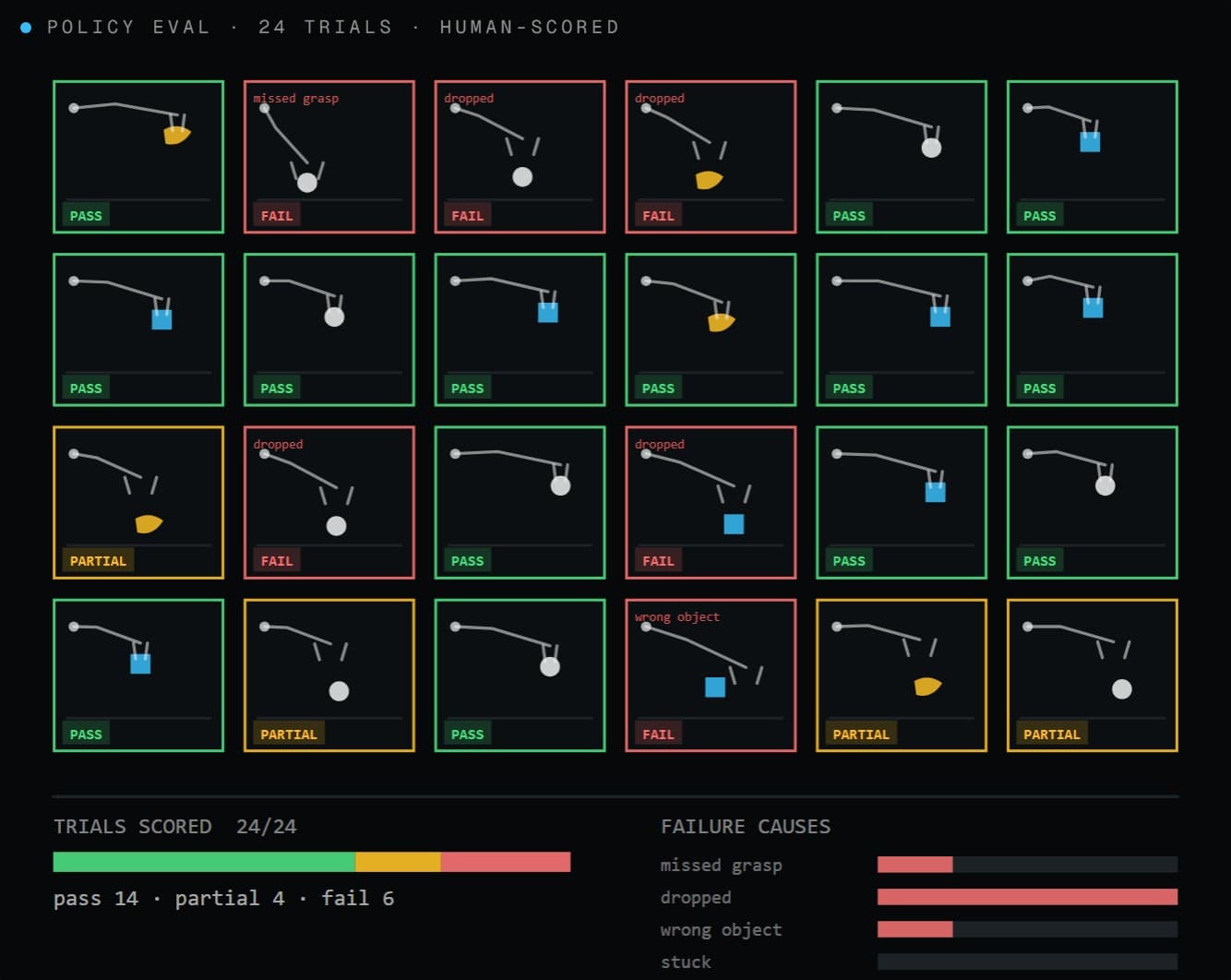
Human reviewers could inspect the original footage and compare candidate labels against the project’s annotation guidelines.
Labelix.ai’s dedicated annotation teams could support this process through video object and action labeling. Reviewers could correct inaccurate classifications, clarify action boundaries, and check labels against project-specific requirements.
This approach would focus human attention on cases requiring additional judgment.
Step 4: Organize Reviewed Data for Downstream Use
After review, teams could organize validated records for dataset curation, robotics evaluation, or training data preparation.
However, verified labels alone do not guarantee a training-ready dataset. Teams must also consider data coverage, completeness, and the requirements of their intended application.
These factors contribute to what makes a robotics dataset usable.
Combining Automated Video Intelligence With Human Expertise
Automated data labeling can reduce the manual effort involved in organizing robotics footage. But teams still need to decide which predictions are reliable enough for their intended use.
Combining CreativAI’s video intelligence with expert annotation can make that review more targeted.
Explore CreativAI’s platform to learn more about its capabilities. For robotics video annotation and data labeling support, contact Labelix.ai.
Have robot video that needs reliable labels?
Start with one task. A dedicated Labelix.ai team learns your labeling guideline and reviews and corrects the labels on your recordings, in a small paid pilot.
FAQs: Automated Data Labeling
What is automated data labeling?
Automated data labeling uses AI models to generate labels for objects, actions, and events. In robotics, it can help organize video footage into candidate annotations for review.
Can automated data labeling replace human annotators?
Not completely. Automated systems can generate candidate labels, but ambiguous actions, unusual behaviors, and project-specific requirements may still require human judgment.
What is human-in-the-loop annotation?
Human-in-the-loop annotation combines automated labeling with human oversight. Reviewers check, correct, or confirm generated labels against project requirements.
How is automated video annotation different from manual annotation?
Automated video annotation uses AI to identify and label video content. Manual annotation relies on people to perform these tasks. Both methods can be combined.
When should robotics teams review automatically generated labels?
Teams should review labels based on their quality requirements, especially ambiguous events and important evaluation examples. Sampling other predictions can also help detect errors in seemingly straightforward cases.

Stephanie writes about robotics, agriculture AI, and the training data behind them, for Labelix.ai, an independent data foundry for robotics and multimodal AI.
Get the next one first
One sharp read a month on Physical AI and the data behind it.