Robots generate a lot of data. A single manipulation attempt might produce video from multiple cameras, robot-state information, force readings, and action commands, all recorded in parallel. But a recording by itself doesn’t tell a learning system what happened.
A video might show a robot arm moving toward a mug. Annotation can identify the mug, mark when the robot begins reaching, flag contact and grasp events, track the robot’s state through the motion, and record whether the final placement succeeded.
This is one part of the broader Physical AI loop: data is curated, annotated, evaluated, and used to improve the next iteration. Robotics data annotation is the step that adds structure and meaning to raw robot data so it can support learning, analysis, and evaluation.
In this article, we’ll look at:
- What robotics data annotation involves
- What gets labeled
- Why timing matters
- How multimodal signals are connected
- Where humans and automation fit into the workflow
What Is Robotics Data Annotation, and Why Is It Different From Traditional Labeling?
Robotics data annotation adds structured labels or metadata to robot data so key elements of an interaction can be identified and analyzed. Depending on the application, annotations may describe:
- Objects and their locations
- Robot actions and behaviors
- Robot states
- Interactions and contact events
- Timestamps and action boundaries
- Task outcomes
- Failures or human interventions
The key distinction: annotation adds meaning to data that already exists. It is not the same as collecting more data or building a more diverse dataset.
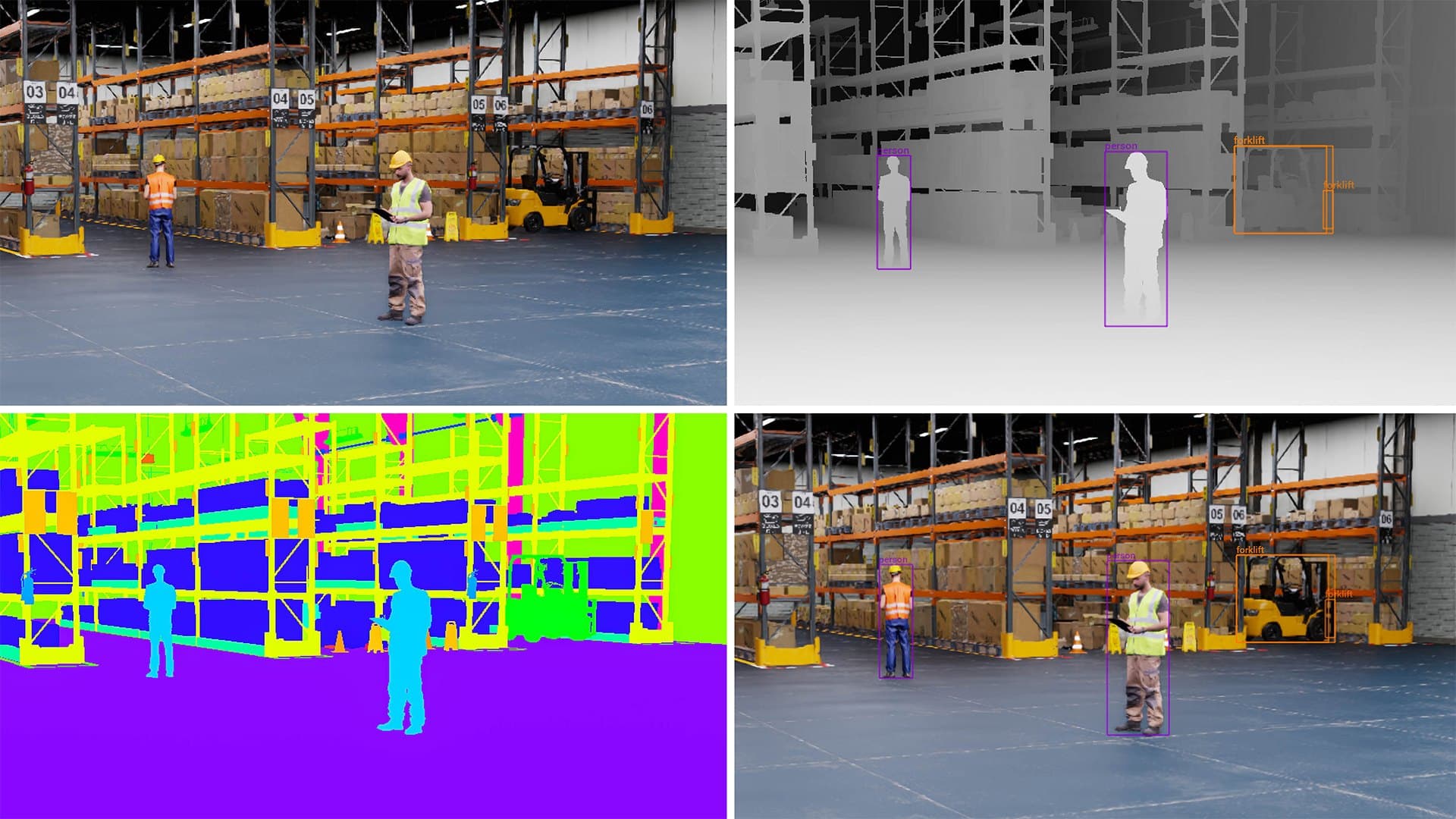
Traditional data labeling, particularly in computer vision, focuses on what’s visible in a single frame: identifying a person, drawing a bounding box around a car, segmenting an object from its background. The question is usually what is this, and where is it?
Robotics annotation often needs to answer a different question: what is happening?
Consider a robot picking up a pen. It’s not enough to identify the pen in a frame. A useful annotation needs to capture that the robot approached it, made contact, grasped it, lifted it, moved it, released it, and successfully placed it, which makes temporal and behavioral information central to robotics data annotation.
What Gets Annotated in Robotics Data?
Objects and Environment Context
Objects such as cups, tools, containers, work surfaces, obstacles, and target locations can all be annotated. But in robotics, an object is more than something the system needs to recognize; its identity, position, and relationship to the robot can influence what action is taking place.
A cup across the table has a different role from a cup positioned directly beneath a robot’s gripper. Annotation needs to capture object identity, location, target position, and relevant relationships between objects and the robot.
Robot Actions and Behaviors
Action labels describe what the robot is doing during a part of a sequence: reach, grasp, lift, move, place, release, push, pull. These labels are especially useful for demonstration data: in imitation learning and teleoperation workflows, a six-second recording isn’t treated as one example but broken into the individual behaviors it contains.
Robot States
Actions and states are related but distinct. An action is something the robot does; a state is a condition it’s in. A robot might perform a grasp action and then remain in a holding state while transporting an object.
Other states include approaching, in contact, transporting, releasing, stationary, or task completed. Keeping these separate preserves information a single label like “grasp” would lose; it doesn’t explain what happens immediately afterward.
Temporal Events and Action Boundaries
Annotation also has to answer a basic question: when did it happen? For example:
| Time | Annotation |
|---|---|
| 0 - 2 seconds | Reach |
| 2.1 seconds | Contact |
| 2.2 - 3 seconds | Grasp |
| 3 - 4 seconds | Lift |
| 4 - 6 seconds | Move |
| 6.1 seconds | Release |
These timestamps and boundaries reconstruct the interaction as a sequence rather than a collection of disconnected labels.
Task Outcomes and Failures
Annotation also captures what happened at the end of an attempt: Was the task successful? Partially completed? Did the robot drop the object, miss the target, hit an obstacle, or need human intervention?
This distinction matters for separating successful and unsuccessful behavior for downstream training, analysis, or evaluation.
Why Does Time Matter in Robotics Annotation?
A robot doesn’t perform a task as a collection of independent images; it performs a sequence (as illustrated in the table above):
reach → contact → grasp → lift → move → release → success
The order and timing of these events carry information a static label can’t capture alone.
Temporal annotation marks when an action starts and ends, identifies key events, and captures transitions between states and when several data streams are involved, it helps align meaningful events across them.
This matters because the same action can mean very different things depending on context: a gripper closing around a mug after contact may indicate a successful grasp, while the same movement without contact may be a failed attempt.
How Does Multimodal Annotation Connect Different Signals?
Robotic interactions often involve multiple synchronized signals: video, robot-state information, action commands, sensor readings. The challenge isn’t labeling each signal independently; it’s connecting meaningful events across them.
A visual annotation might identify the moment a gripper contacts a cup, while robot-state data recorded at roughly the same point adds context about the movement or gripper state.
This becomes more important as robotics models work with diverse data sources. DROID (Distributed Robot Interaction Dataset), for example, brought together 76,000 demonstration trajectories — about 350 hours of interaction data — collected across 564 scenes and 86 tasks by 50 data collectors worldwide, with every episode capturing synchronized camera streams, depth data, robot state, and language instructions in parallel.
Annotation doesn’t replace these signals, it makes the meaningful events within them easier to identify, organize, and use.
How Do Humans and Automation Work Together in Robotics Annotation?
Robotics annotation doesn’t mean a human manually labels every frame from scratch. A practical workflow combines model-assisted pre-labeling with human review, correction, and refinement: automation proposes initial labels, tracks objects, or flags likely action segments, while human annotators handle ambiguous cases and produce the final structured output.
Human judgment matters most when an action is hard to distinguish from a near-miss, object identity is unclear, an action boundary is ambiguous, an unusual failure doesn’t fit an existing pattern, or the robot’s behavior has multiple possible interpretations.
The hardest judgment call in robotics annotation often isn’t “what object is this?”, it’s “did the grasp actually succeed?”
That’s harder to automate because success depends on the relationship between the robot’s action, the object, the environment, and what happens next.
Building a robotics annotation workflow?
The right strategy depends on what the robot needs to learn, which behaviors need to be captured, and how those labels will be used downstream. Labelix.ai helps robotics and Physical AI teams structure and annotate the data behind robot learning workflows.
What Makes a Robotics Annotation Useful?
Useful annotation starts with clear, consistent definitions. If one annotator labels a brief gripper contact as a “grasp” while another reserves “grasp” for confirmed object acquisition, the resulting annotations represent different concepts.
Useful robotics annotation typically requires:
- Consistent label definitions
- Accurate timestamps
- Clear action boundaries
- Correct object identity
- Reliable state labels
- Consistent outcome and failure labels
The goal isn’t more labels; it’s labels that mean the same thing across examples. This connects to a broader question: what makes a robotics dataset usable? Annotation consistency is one input, but it’s a separate question from dataset diversity, sensor coverage, or real-world variation.
Annotation Is the Structure Behind Useful Robot Data
Robotics data contains more than objects to identify; it contains behavior that unfolds over time. Robotics data annotation captures that behavior by representing actions, states, events, interactions, and outcomes in a structured way, and by connecting meaningful events across multiple synchronized signals.
The workflow combines automation with human judgment, using each where it’s most effective. The result isn’t just a collection of labels; it’s a clearer picture of what a robot actually did and what happened as a result. As robots become more capable, the annotation problem becomes less about identifying objects and more about representing behavior.
Turning robot recordings into training-ready data takes more than labeling objects; it takes an annotation framework built around actions, states, events, and outcomes.
Talk to Labelix.ai today to request a pilot.
FAQs
What is robotics data annotation?
The process of labeling and structuring information within robotics data — objects, actions, states, events, and outcomes — so recordings can be used more effectively for robot learning, analysis, and evaluation.
What's the difference between robotics data annotation and data labeling?
The terms are often used interchangeably, but robotics annotation typically involves richer temporal, behavioral, and multimodal information than static labeling. Instead of only identifying what's in a frame, it represents what the robot is doing, when it happens, and what the outcome is.
What types of data are annotated in robotics?
Depending on the workflow: video, robot actions, robot states, timestamped events, objects, environment context, interactions, and task outcomes.
Why is temporal annotation important for robots?
Robot behavior is sequential. Knowing when an action starts, when it ends, and how it relates to other actions represents the interaction as a sequence rather than a set of isolated observations.
How is AI used in robotics data annotation?
AI supports annotation through model-assisted pre-labeling, object tracking, and proposed action or event labels. Human annotators review, correct, and refine those suggestions, especially for ambiguous behaviors and edge cases.
Why does annotation consistency matter for robot training?
Inconsistent labels make it harder for downstream systems to interpret actions, states, and outcomes reliably. Clear definitions and consistent application preserve the intended meaning of the annotations.

Cindy writes about Physical AI, robotics, and the human data that teaches models to perceive and act, for Labelix.ai, an independent data foundry for robotics and multimodal AI.
The Data Brief
One sharp read a month on Physical AI and the data behind it.