Robots can sort packages, assemble products, and even fold laundry, but they don’t pick up these skills on their own. Every new capability starts with a person showing the robot what to do.
Before a robot can perform a task independently, it needs demonstrations that show it what “doing the task well” looks like. Those demonstrations are the training data behind modern Physical AI. In this guide we walk through the two most common ways robots learn, imitation learning and teleoperation, and why both ultimately come down to the quality of the human demonstrations behind them.
- Imitation learning copies success, not motion:a robot studies demonstrations that already worked and learns the pattern, so it can generalize instead of memorizing one sequence.
- Teleoperation puts a person in the driver’s seat:an operator guides the robot directly, capturing rich first-person data like joint positions and force, not just video.
- They are partners, not rivals:teleoperation usually generates the demonstrations, and imitation learning turns them into a skill the robot can generalize.
- The data decides everything:demonstrations still need to be synchronized, segmented, annotated, and quality-checked before a model can learn from them.
How do robots learn new tasks?
Every robot starts out knowing nothing. Unlike traditional software, which follows rules an engineer writes line by line, many modern robots learn from examples instead. Rather than programming every movement by hand, engineers show robots how a task should be done, and that record of “how” becomes the data used to train the underlying model.
This is what lets robots handle tasks that are too messy or variable for hand-coded rules. A robot can learn to grasp objects of different shapes or adjust to a cluttered workspace because it has seen many people do the same task in slightly different ways.
Robots pick up new skills through a few different routes. Reinforcement learning has them improve through trial and error. Simulation lets them rehearse in a virtual environment before touching real hardware. But before a robot can refine a skill on its own, it usually needs a solid starting point, and that is where imitation learning and teleoperation come in. Both are built on human expertise; what differs is how that expertise gets captured.
What is imitation learning?
Think about learning to bake by watching someone make a cake: you watch each step, try it yourself, and get better with repetition. That is roughly the idea behind imitation learning.
Imitation learning: a robot studies demonstrations performed by humans or by already-trained robots and learns the patterns embedded in examples that already worked, instead of discovering the right actions through trial and error.
Those demonstrations can come from:
The goal is not for the robot to memorize one exact sequence of movements. It is to learn the underlying relationship between what it observes and the action it should take next. A warehouse robot might study thousands of picking demonstrations before it can reliably grasp boxes of different sizes. The more varied the demonstrations, the better the robot generalizes to situations it has not seen before.
Why robotics companies use imitation learning
For most robotics teams, imitation learning is a practical shortcut, a way to teach a robot a new skill without building it from first principles. Its main advantages:
- Faster to train than relying on trial and error alone.
- Data-efficient. It makes good use of a limited pool of demonstrations.
- Natural behavior. It learns from how people actually work, not hand-tuned rules.
- Built for the real world. It suits repetitive, physical tasks.
Google’s RT-1 is a well-known example. Trained on roughly 130,000 demonstrations spanning over 700 tasks, it generalized to new objects and environments far better than earlier approaches.
Where imitation learning falls short
A robot can only be as good as the data it learns from. If the demonstrations are incomplete, inconsistent, or only cover a narrow slice of scenarios, the model will likely struggle the moment conditions shift: an object in a new spot, different lighting, or someone doing the task a bit differently than the training examples.
What is teleoperation?
Sometimes, instead of having robots watch people perform a task, engineers put people directly in the driver’s seat. That is teleoperation.
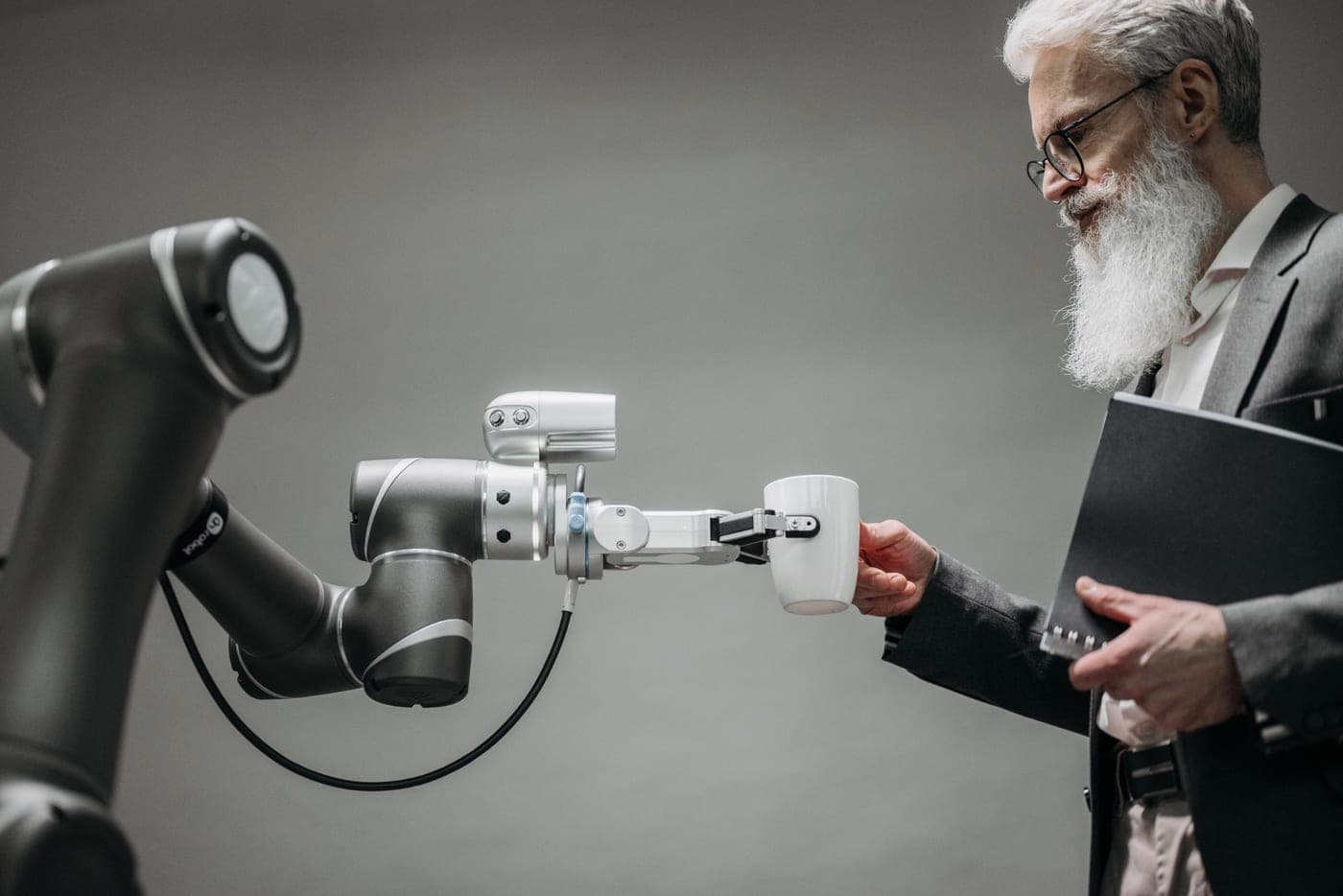
Teleoperation: controlling a robot remotely while it performs a task. A human operator guides the robot through every movement, and the robot records everything it experiences, creating rich demonstrations for training.
Depending on the setup, operators might use:
Unlike a plain video recording, a teleoperation session captures the task from the robot’s own perspective. Alongside camera footage, it logs joint positions, gripper movements, force readings, and other sensor data that help explain not just what happened, but how the task was actually carried out. That combination makes teleoperation one of the most effective ways to generate high-quality demonstrations, and one of the dominant sources of training data for real-world manipulation.
Why teleoperation is valuable
Teleoperation’s biggest advantage is precision. Because a skilled operator controls the robot directly, every demonstration reflects the exact motions needed to complete the task, which matters a lot for delicate work like assembling small components or handling fragile objects. It also lets teams collect demonstrations in situations where hands-on human interaction would be difficult or unsafe. RT-1’s dataset, for example, was built entirely from teleoperated demonstrations collected over 17 months.
The challenge of teleoperation
Teleoperation is powerful, but it does not scale easily. Collecting thousands of demonstrations takes skilled operators, specialized hardware, and a lot of coordination, and recording the sessions is just the starting point. Before the data is usable for training, teams still need to review sessions, synchronize multiple sensor streams, organize the demonstrations, and confirm everything was captured correctly. Skip those steps, and even expertly performed demonstrations can end up unusable for machine learning.
Sitting on demonstrations you can’t train on?
See how a dedicated data team turns raw sessions into trainable datasets. No pitch.
Imitation learning vs. teleoperation: what is the difference?
These two are often framed as competing approaches, but in practice they are complementary. Teleoperation is commonly the way demonstrations get generated; those demonstrations then become the training data used in imitation learning. One captures human expertise, the other teaches the robot to generalize it.
| Imitation learning | Teleoperation | |
|---|---|---|
| How it works | Learns from recorded demonstrations | A person directly controls the robot |
| Primary purpose | Train models to perform tasks | Generate high-quality demonstrations |
| Best for | Scaling repeatable robot behaviors | Capturing expert skills and complex manipulation |
| Advantages | Data-efficient, faster than trial and error | Precise, first-person demonstrations |
| Limitations | Performance depends on demonstration quality | Time-consuming and expensive to scale |
As robots get more capable, most companies lean on both throughout development: teleoperation to create the examples, imitation learning to help the robot generalize them to new situations.
Why do human demonstrations matter so much?
A robot demonstration is a lot more than a video of someone completing a task. Each recording captures multiple, tightly linked streams of information that help a model understand not just what happened, but how and why. A single demonstration might include:
Teleoperation captures human expertise; imitation learning teaches the robot to generalize it.The relationship behind Physical AI
All of it has to stay in sync. Picture a robot learning to insert a plug into a socket: the camera shows where the socket is, the joint positions describe how the arm approaches it, and the force sensors show how much resistance to expect on contact. If those signals fall out of alignment even briefly, the robot learns a distorted version of the task.
That is why preparing robotics data is about more than labeling images. Before training starts, demonstrations typically need to be:
- Organized into structured datasets.
- Synchronized across every sensor stream.
- Segmented into individual actions.
- Annotated with meaningful labels.
- Reviewed for consistency and quality.
As robotics programs scale from hundreds of demonstrations to hundreds of thousands, managing this pipeline becomes a serious operational undertaking in its own right, and it is the foundation every successful Physical AI system is built on.
How Labelix.ai turns human demonstrations into training data
Collecting demonstrations is only one piece of the robot learning pipeline. The harder part is what comes next: keeping every sensor stream in sync, catching gaps before they reach the model, and turning raw recordings into something actually trainable. That is where Labelix.ai comes in.
Rather than operating as a traditional annotation vendor, Labelix.ai works as a managed data foundry for Physical AI teams, helping companies build structured, high-quality datasets that are ready for machine learning. Depending on the project, that can include:
- Organizing multimodal robotics data.
- Synchronizing video and sensor streams.
- Segmenting demonstrations into meaningful tasks.
- Annotating objects, actions, and interactions.
- Running quality assurance across large datasets.
- Managing dedicated data operations at scale.
This matters because robotics datasets look nothing like typical computer vision datasets. Labeling objects in individual photos is one thing; a robotics project might involve synchronized camera feeds, robot kinematics, force measurements, timestamps, and task metadata, all tied to the same demonstration, where even small inconsistencies can throw off model performance. By handling these workflows end to end, Labelix.ai lets robotics teams spend less time wrangling data and more time improving their models.
Whether you are training with imitation learning, teleoperation, or both, the quality of your demonstrations decides how well your robot performs. Request a pilot tailored to your use case.
Frequently asked questions
How do robots learn new tasks?
Robots learn new tasks by training on human demonstrations, sensor data, and feedback. Methods like imitation learning and teleoperation teach robots how to perform actions before they operate independently.
What is imitation learning in robotics?
Imitation learning is a robot learning method where robots study demonstrations from humans or other robots and learn to perform similar tasks without relying entirely on trial and error.
What is teleoperation?
Teleoperation allows a person to remotely control a robot. The robot records every movement and sensor reading, creating demonstrations that can later be used to train AI models.
Can robots learn without human demonstrations?
Yes. Robots can also learn through reinforcement learning and simulation. But human demonstrations remain essential for many real-world tasks because they provide efficient, high-quality training examples.
Why is high-quality robot training data important?
High-quality training data helps robots learn accurate, reliable behaviors. Well-organized demonstrations improve model performance, reduce errors, and help robots adapt to real-world environments.

Cindy writes about Physical AI, robotics, and the human data that teaches models to perceive and act, for Labelix.ai, an independent data foundry for robotics and multimodal AI.
The Data Brief
One sharp read a month on Physical AI and the data behind it.