The sim-to-real gap is the drop in performance when a robot trained in simulation meets real physics, sensor noise and clutter its simulator never modelled. Simulation is still worth it: it generates experience at scale and safely, and domain randomization narrows the gap. It does not close it. Reliable robots are trained on simulated data for breadth and on real-world data for the last, hardest mile.
Training robots in the physical world is expensive, slow, and sometimes risky. Simulation gives robotics teams a way to generate experience at scale before putting a robot on real hardware.
But simulation is only an approximation of reality. What works in a virtual environment can behave very differently once a robot encounters real physics, noisy sensors, unpredictable environments, and unexpected edge cases.
Understanding where simulation helps and where it falls short is critical to building reliable robot-training pipelines. In this article, we’ll look at:
What is sim-to-real in robotics?
Sim-to-real robotics refers to training or developing a robot in a simulated environment and then transferring what it learns to a physical robot.
A simulated robot can interact with virtual objects, navigate environments, and perform tasks without the constraints of physical hardware. This makes robot simulation training particularly useful for reinforcement learning, where an agent may need thousands or millions of trials to learn an effective policy.
Robotics simulation can provide:
The challenge is that simulated experience does not perfectly represent physical experience.
Differences in physics, sensors, materials, environments, and hardware can affect whether a behavior learned in simulation works in the real world. That mismatch is known as the sim-to-real gap in robotics.
For Labelix.ai co-founder Rashid Arif, simulation shouldn’t be viewed as a replacement for real-world data. Its real value is making the overall training process more scalable.
This matters because Physical AI systems ultimately have to operate in environments that are messy, variable, and difficult to predict.
Our earlier look at what makes a robotics dataset usable explores why diversity and real-world variation matter once robots leave controlled environments.
Why is simulation so useful for robot training?
Through simulation, teams can experiment far more extensively than they could with physical hardware alone. Below are some of the advantages of simulation:
Scale
A simulator can generate large amounts of experience without requiring a robot, operator, or physical environment for every trial. This is particularly useful for reinforcement learning, where agents learn through repeated interactions.
Speed
Simulated environments can sometimes run faster than real time. Instead of waiting for a physical robot to complete a task, teams can run many virtual trials in parallel.
Repeatability
Physical experiments can be difficult to reproduce exactly. Simulation makes it easier to reset a scenario and run the same task again under controlled conditions.
Safety
Trial-and-error learning can cause a physical robot to fall, collide with objects, or damage hardware. Simulation allows teams to explore failures without those physical consequences.
Controlled variation
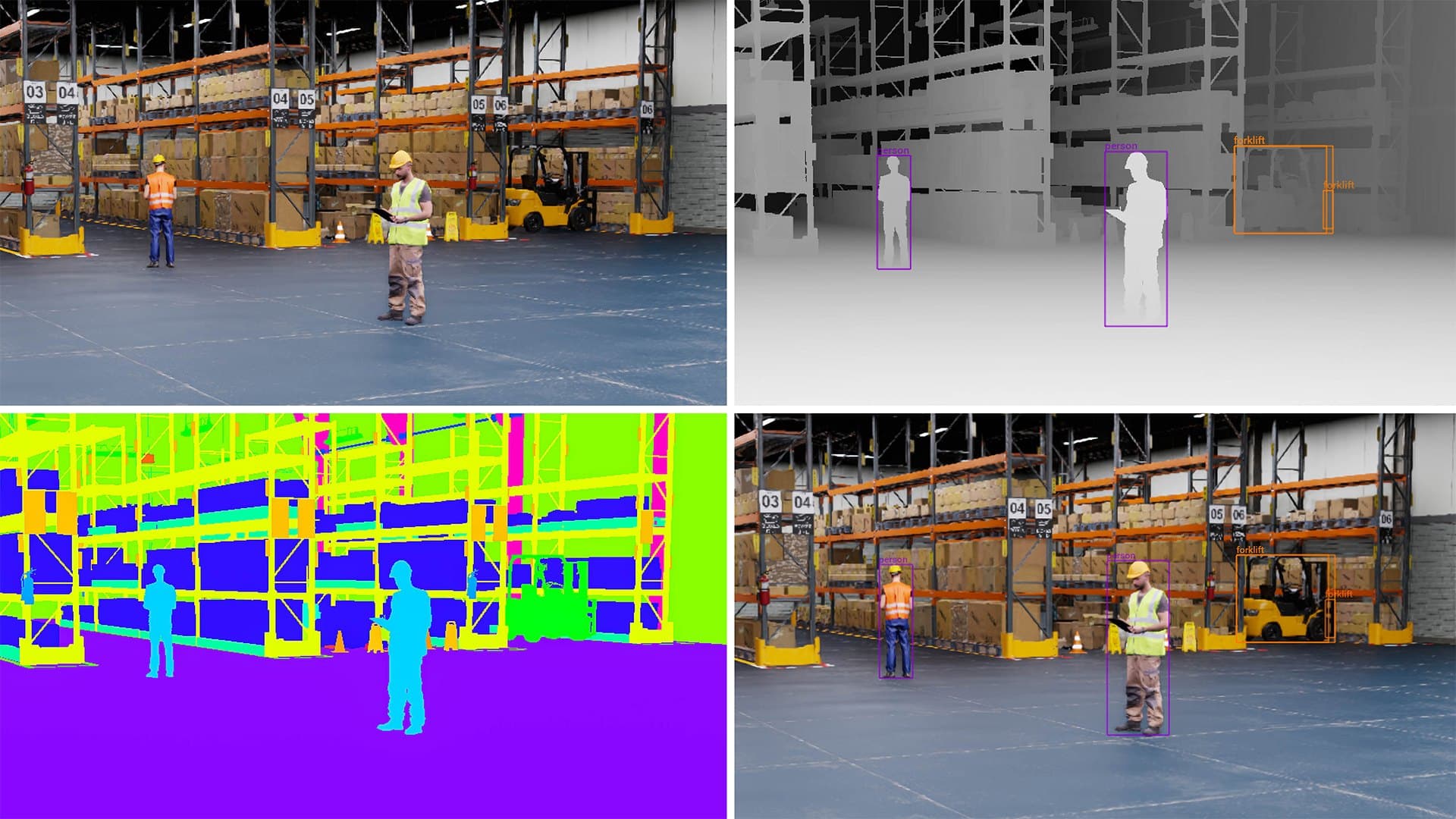
Teams can systematically change variables such as lighting, object positions, textures, camera parameters, and physics settings. This is useful for exposing models to conditions they may encounter later.
Rare scenarios
Some events are difficult to collect naturally because they happen infrequently. Simulation can deliberately create these situations, allowing teams to test how a policy responds.
Research on sim-to-real reinforcement learning has demonstrated the potential of this approach, while also highlighting the challenge of transferring learned behavior to physical systems. Tobin et al.’s work on domain randomization, for example, showed how randomized simulated environments can help models transfer to the real world.
The important point is that more synthetic data does not automatically mean better training. The simulation still needs to represent the problem the robot will actually face.
Where does the sim-to-real gap come from?
The sim-to-real gap in robot learning comes from multiple differences between simulated assumptions and physical conditions.
Physics differences
Physical interactions can be surprisingly difficult to model. A simulator has to approximate things such as:
Consider a robot learning to grasp a cup. In simulation, the grasp might work consistently because the object’s weight, friction, and contact properties are precisely defined.
In the physical world, the cup might be slightly heavier, smoother, or more slippery than expected. A small difference can cause the grasp to fail. For manipulation tasks, these seemingly minor differences can have a major effect on robot behavior.
Sensor differences
Robots experience the world through sensors. A simulated camera can produce clean, predictable images, while a physical camera has to deal with:
A model trained on idealized simulated inputs may therefore behave differently when it encounters noisy real-world observations. This is why sim-to-real transfer in robotics often involves more than simply moving a trained policy from a virtual environment onto physical hardware.
Environmental variation
The physical world also contains variation that is difficult to predict. Objects may not be where the robot expects them to be. People move unpredictably. Environments change. Objects can behave differently from one interaction to another.
A simulator can model many of these conditions, but it cannot perfectly capture every combination of physical and environmental variation.
How can robotics teams reduce the sim-to-real gap?
One common strategy is domain randomization (which we already mentioned above). Instead of training in one highly specific simulated environment, teams deliberately vary conditions such as:
The goal is to prevent a model from relying too heavily on details that only exist in one simulator configuration.
For example, a robot should not learn that an object is always positioned at exactly the same coordinates. Introducing variation can encourage it to learn behaviors that remain useful when conditions change.
How does real-world data improve sim-to-real transfer?
Simulation can show what might happen. Real-world data shows what actually happened.
Physical data can reveal:
Teams can then use that information to validate models, improve simulation assumptions, fine-tune systems, and identify where additional training is needed.
This is where simulation and synthetic data in robotics become part of a larger data strategy. They are not competing sources. Each exposes a different part of the problem.
When should robotics teams use simulation, and when do they need real-world data?
The practical question isn’t whether simulation or real-world data is better. It is which type of data can solve each part of the problem reliably.
Simulation is particularly useful when:
Real-world data becomes especially important when:
Strong robot-training pipelines can use both. Simulation provides scale and controlled experience. Real-world data provides validation, unexpected behaviors, and evidence that a policy actually transfers.
Closing your own sim-to-real gap?
See how a dedicated data team captures and structures the real-world data that validates a policy. No pitch.
What does a sim-to-real training loop look like?
Sim-to-real is not a one-time handoff. It is an iterative feedback loop:
- Define the task. Determine what the robot needs to learn.
- Train in simulation. Generate controlled experience at scale.
- Transfer to physical hardware. Test the behavior in reality.
- Identify the gap. Measure where simulated assumptions fail.
- Collect targeted real-world data. Capture conditions and failures that simulation missed.
- Improve and iterate. Update the model, simulation, or data strategy.
The physical robot becomes a reality check for the simulator. When something fails, teams can ask whether the problem came from the policy, simulation, hardware, environment, or training data. That feedback can then inform the next training cycle.
The value isn’t in getting simulation ‘right’ once, it’s in building a loop where real-world results keep sharpening it.Rashid Arif, co-founder, Labelix.ai
How can better real-world data strengthen sim-to-real training?
Once a simulated behavior reaches physical hardware, teams need reliable data to understand what worked, what failed, and why. Depending on the application, this may include:
Raw recordings aren’t enough on their own. Teams need synchronized, structured, and accurately annotated data to connect what the robot saw with what it did and what happened next.
This data can reveal failures that simulation missed and help teams improve policies, refine simulations, and identify where additional training is needed.
Build a better sim-to-real data pipeline
Sim-to-real only works when teams can learn from what happens on the physical robot. Labelix.ai helps Physical AI teams collect, annotate, structure, and quality-check the real-world data needed to train and improve robotic systems.
Contact us today to request a pilot.
Frequently asked questions
What is sim-to-real robotics?
Sim-to-real is the process of transferring robot behaviors or learned policies from a simulated environment to a physical robot.
What is the sim-to-real gap?
The sim-to-real gap is the mismatch between simulation and real-world physics, sensor inputs, environments, and robot behavior.
Why is sim-to-real difficult?
Physical reality contains variation and interactions that are difficult to model perfectly, from friction and sensor noise to unpredictable environments.
What is domain randomization in robotics?
Domain randomization varies conditions such as lighting, textures, object positions, and physics during simulation to make learned behaviors more robust.
Can robots be trained entirely in simulation?
Some tasks can rely heavily on simulation, but physical validation and real-world data are generally important for reliable deployment.
What is the difference between simulated and real-world robotics data?
Simulated data is generated inside virtual environments. Real-world robotics data comes from physical robots, sensors, environments, and human interactions.

Cindy writes about Physical AI, robotics, and the human data that teaches models to perceive and act, for Labelix.ai, an independent data foundry for robotics and multimodal AI.
The Data Brief
One sharp read a month on Physical AI and the data behind it.