Robotics had a big week. A fully autonomous humanoid sparring match, a $100M warehouse robotics raise, Samsung restructuring to build its own humanoid, and a fresh $33M bet on the infrastructure underneath every robot, all pointing to the same thing: robots taking on harder work, and more data behind every one of them.
Here’s a weekly scan of what moved in Physical AI and robotics, and what it means for the data behind it.
- Unitree’s UnifoLM-X2-1.0 drives the first fully autonomous humanoid combat demo World models
- Maven Robotics raises $100M to scale its general-purpose warehouse robot Warehouse
- Samsung restructures to build humanoid robots faster Humanoids
- Algomatic Dynamics launches with $33M to build the layer beneath the robot Infrastructure
Unitree’s UnifoLM-X2-1.0 drives the first fully autonomous humanoid combat demo
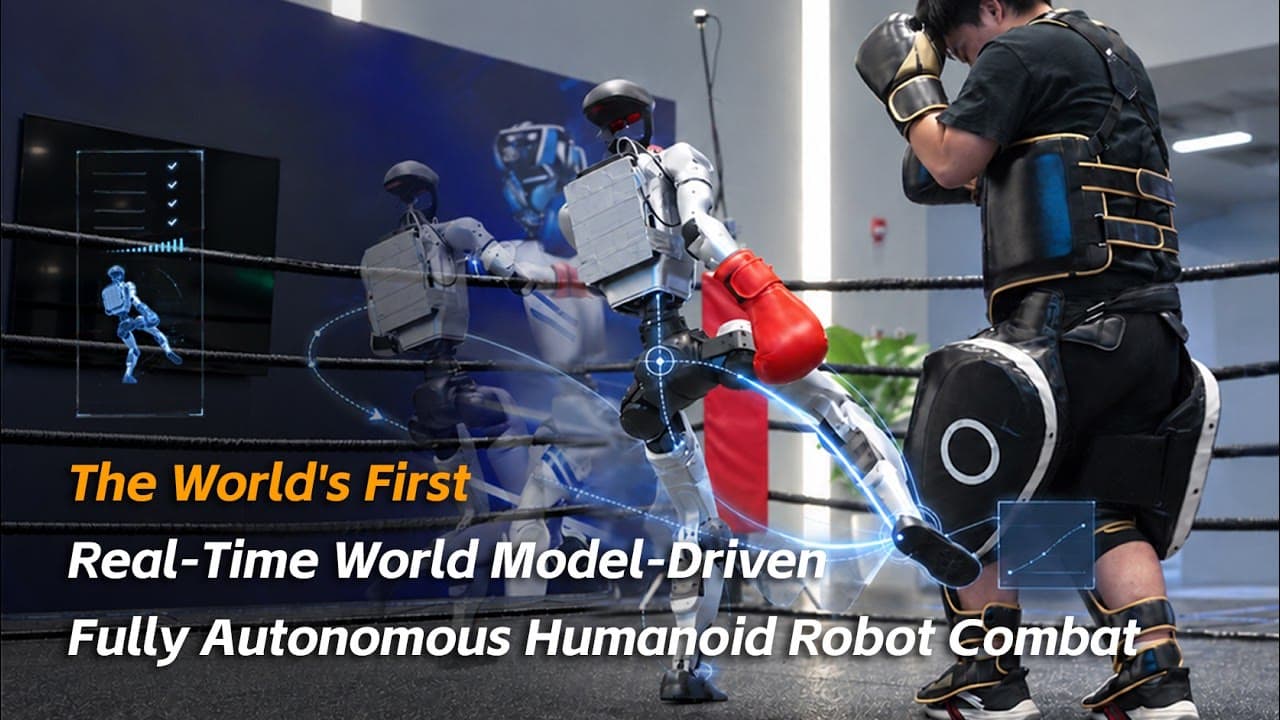
On September 7, Unitree released footage of its G1 humanoid robot sparring with a human trainer with no teleoperation, no scripted choreography, and no human controller in the loop. The system behind it, UnifoLM-X2-1.0, is a real-time world model that predicts how a scene and an opponent are about to change and plans the robot’s next move accordingly. It builds on Unitree’s open-source UnifoLM-WMA-0, a video-diffusion world model with an action head trained on the Open-X dataset plus five of Unitree’s own datasets.
Every humanoid combat demo before this one relied on a person behind the controls, converting joystick or VR-headset input into movement. Swapping that out for a model that perceives, predicts, and acts on its own is a meaningfully different claim; it’s a general predict-then-act loop, not a fighting trick. Unitree frames the demo as validating that world-model-driven humanoids can be deployed at larger scale, and the company enters this release with real momentum, having shipped more than 18,000 humanoids and raised over $900 million in its August 2026 Shanghai listing.
How much of this transfers; a robot trained to read an opponent’s fists is a narrow slice of a much bigger capability. The same predict-then-act loop applied to grasping, lifting, or walking through clutter is the more interesting and more commercially useful test. Unitree hasn’t released a technical paper, latency numbers, or benchmarks yet, and telemetry clues in the video suggest the heavy world-model processing may be running offboard on an external computer. Until the detail lands, it’s fair to treat the footage as a strong signal rather than a finished capability.
A world model is only as good as what it was shown. UnifoLM-WMA-0 was trained on a mix of the Open-X dataset and Unitree’s own captured sequences. The leap from “predicts a punch” to “predicts a grasp” depends entirely on how deep and how well-labeled that underlying footage is across tasks. The demo is the visible 5% and the labeled training data behind it is the 95%.
Maven Robotics raises $100M to scale its general-purpose warehouse robot
On September 10, Maven Robotics launched publicly with $100 million in Series A funding, two years after landing its first customer. The Santa Clara startup builds a wheeled, dual-arm robot for mixed-case palletizing and tote handling, a market it estimates at $80 billion. Fleets are already running autonomously across multiple shifts at a Fortune 250 consumer packaged goods company, with uptime at 99% or better over 16-hour working days. The new funding pays for 250 third-generation robots and early design work on a fourth.
Palletizing has stayed stubbornly manual because the mix changes constantly; a worker is building one store’s pallet from goods shipped in from several factories, and no two pallets look the same. Maven’s pitch is that its system handles that variability today, in production, not in a lab. The company expects its robots to log more than 100,000 hours of autonomous operation by the end of the year and over 1 million by the end of 2027, and it’s positioning the same underlying system for more complex material handling and assembly, a market it sizes at over $1 trillion.
Whether “general-purpose” survives contact with a second customer. Maven built its reputation on one deployment with one large customer; the real test of the Series A is whether the 250 new robots can be dropped into different facilities, different SKUs, and different failure modes without months of re-tuning per site.
Uptime figures like 99% over 16-hour shifts are the output of a system that has already been trained on a huge volume of edge cases: torn boxes, mislabeled totes, oddly stacked pallets. Every one of those edge cases had to be captured and annotated before the robot could shrug it off in production; the uptime number is a data quality number wearing a different name.
Samsung restructures to build humanoid robots faster

On September 8, Samsung Electronics finalized the leadership structure for its new Robotics eXperience (RX) Business Promotion Office. In a highly unusual move for a tech giant, a single executive, DX Division CTO Yoon Jang-hyun, will simultaneously lead both the hardware and AI software development teams. The strategy is “hardware-software co-design,” meaning engineers will build the robot’s physical body and its AI brain together from day one, rather than building a frame first and layering software later. Samsung is already converting its own semiconductor, smartphone, and appliance factories into real-world data collection sites to train the humanoids for a planned CES 2027 debut.
Samsung is entering a market currently locked down by Chinese manufacturers, who accounted for over 97% of global humanoid shipments in the first half of 2026. Samsung’s big bet is that its massive global manufacturing footprint provides a proprietary data advantage that software-only startups cannot replicate. Additionally, tightening Western trade restrictions on Chinese robotics open a massive window for South Korean and U.S.-aligned manufacturers to establish an alternative supply chain. The financial stakes are massive: the global humanoid market is projected to skyrocket from $6.24 billion in 2026 to $165.13 billion by 2034.
The key test is whether Samsung’s unified organizational structure actually accelerates development, or if it simply shifts engineering bottlenecks elsewhere. Heavyweight rivals like Hyundai and LG are running the exact same race but using traditional, separated corporate org charts. CES 2027 will be the ultimate proving ground where corporate slide decks must finally translate into functioning, autonomous hardware.
Samsung’s paper advantage is its ability to generate massive volumes of real factory footage from its own production lines, bypassing the limits of computer-simulated training environments. However, raw video from a chip fab or an appliance line is just noise until it has been carefully reviewed, structured, and labeled. The sheer size of Samsung’s factory footprint only matters if the data annotation pipeline behind it can scale fast enough to process the incoming flood of information.
Algomatic Dynamics launches with $33M to build the layer beneath the robot
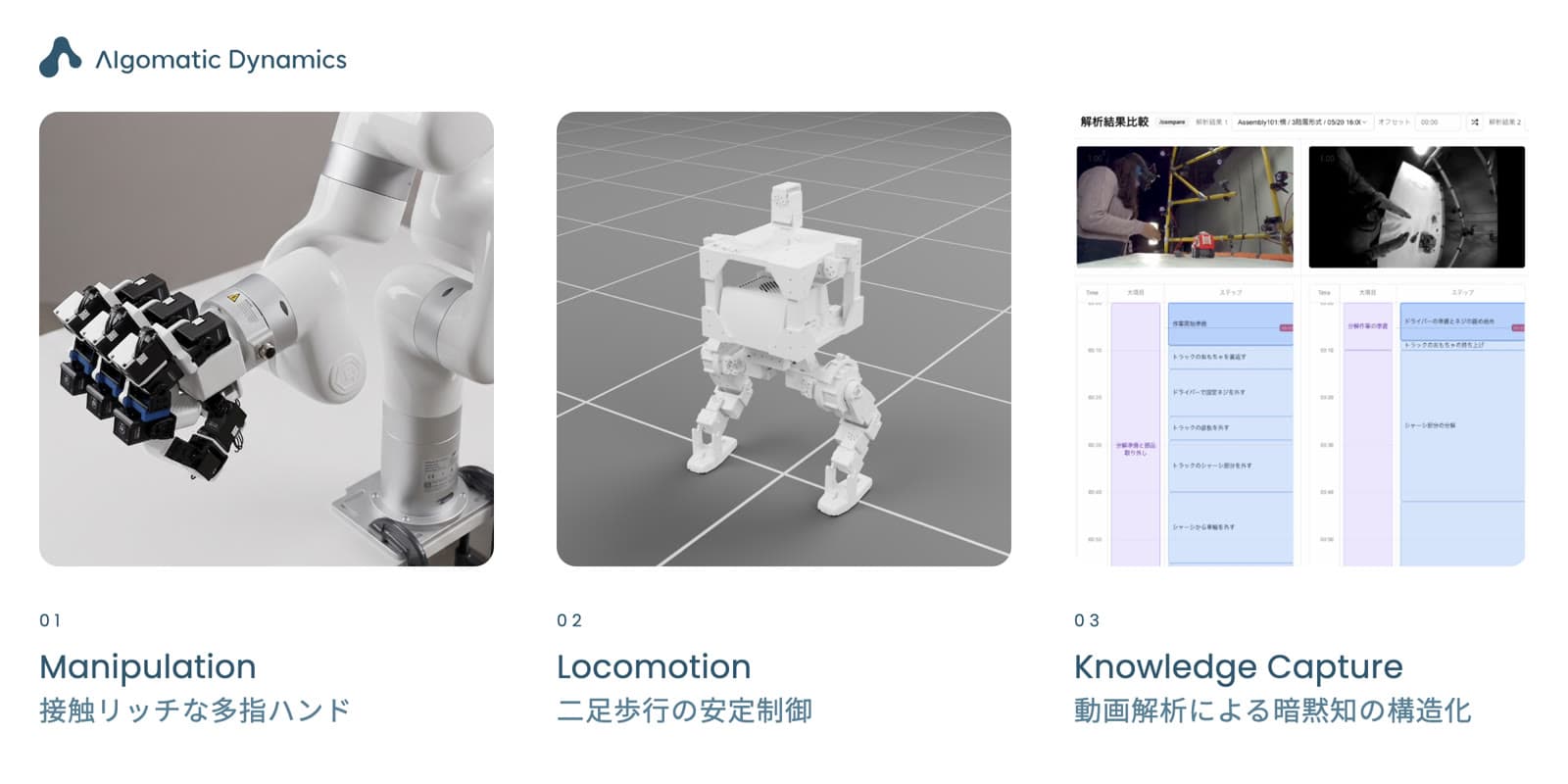
Algomatic Dynamics officially announced its launch on September 9, marking its first-ever fundraising since establishment. DMM.com backed the launch as the underwriter with ¥5 billion (about $33 million) in initial financing. Rather than building one complete robot, the Tokyo startup is dedicating its physical AI research and development to three pieces meant to work across different robot bodies: an AI multi-finger hand platform for tasks with frequent contact, targeted for release in Japan by the end of this year, stable control of bipedal walking, and a pipeline that structures tacit knowledge through video analysis to handle everything from learning-data collection to providing learning hardware for robots.
Most robotics startups race to ship a finished platform. Algomatic Dynamics is building the infrastructure layer underneath instead. This modular approach aligns with Japan’s severe labor shortages in manufacturing, logistics, healthcare, nursing care, and food services. By using video analysis to capture and structure human “tacit knowledge,” they aim to solve the hardest part of physical AI.
Whether their software and hand platform can easily plug into different external robot bodies. In practice, adapting a single control pipeline to varied third-party hardware configurations is an incredibly difficult engineering challenge. We are also watching how fast they deploy their ¥5 billion to secure computing power and launch real-world corporate demonstrations.
This is a company built almost entirely on the premise that good motion data and well-structured video are the hard part. A multi-finger hand platform that adjusts its grip during frequent physical contact will be the true test of this technology when it launches in Japan later this year.
The Data Brief
Get the Radar in your inbox, one sharp read a week on Physical AI and the data behind it.