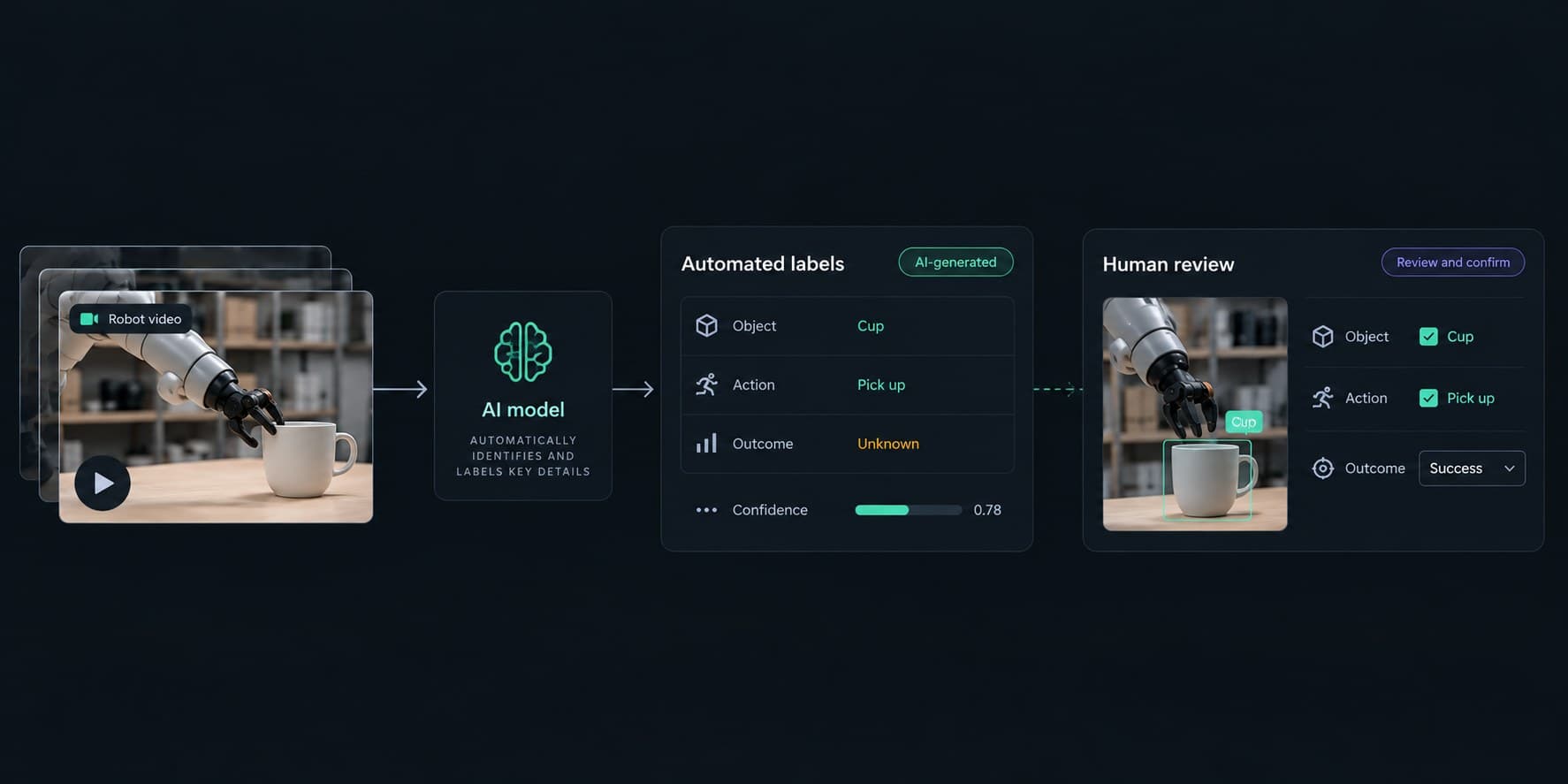
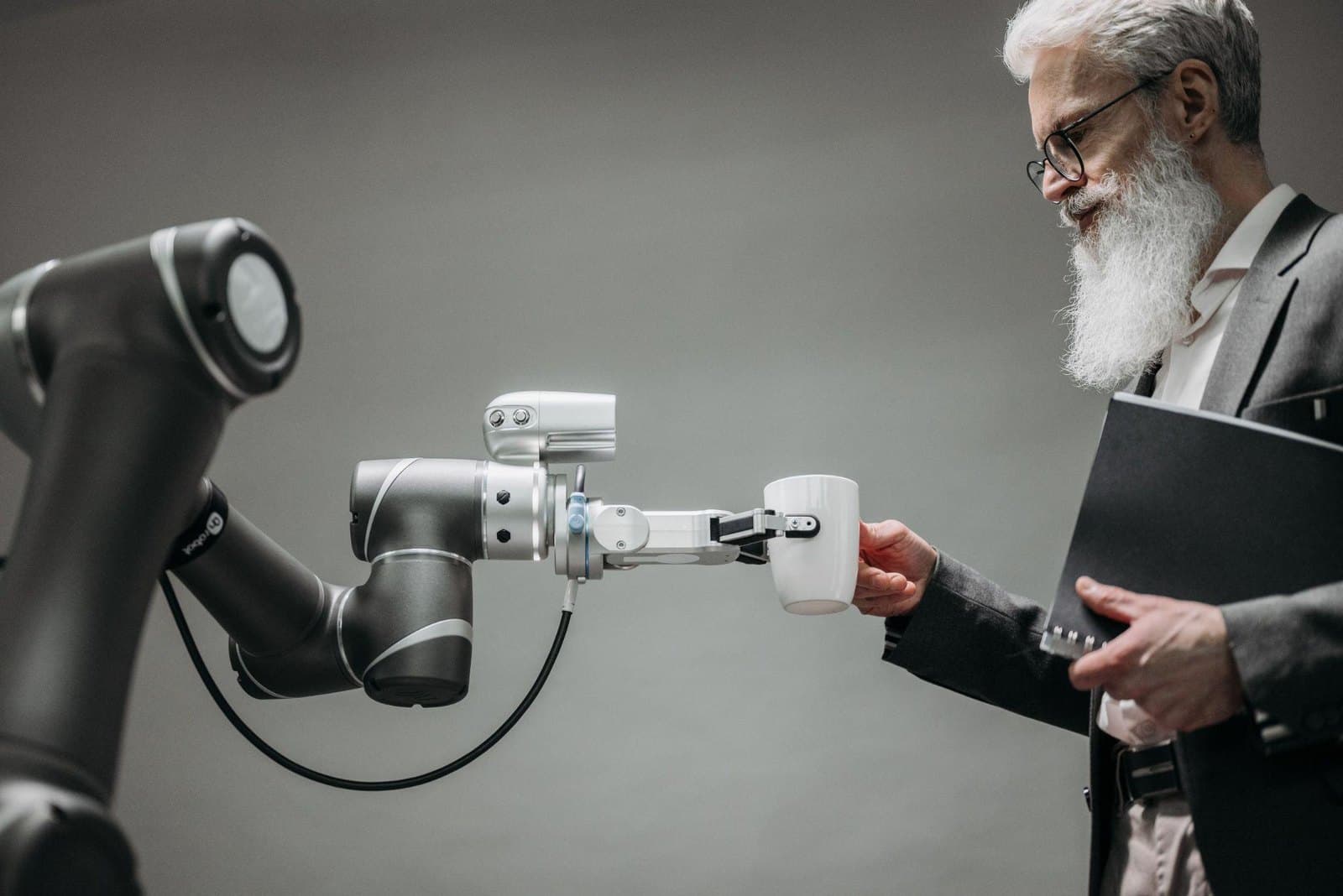
A robot misses a cup, retries, and completes the pickup. In another rollout, it lifts the cup but drops it during transport. Finding both moments across hours of video is one challenge. Understanding how they differ is another.
Video search can help locate suspected failures. Teams can then organize the results by object and observed outcome before reviewing the surrounding sequence.
This guide explores how CreativAI can help teams search robot footage and organize candidate events, and how Labelix.ai’s failure-analysis team could review and classify them. We’ll follow the cup example from video search to reviewed failure evidence.
What Counts as a Robot Failure in Video?
A robot failure depends on what the task requires. Before searching footage, define what must happen for an attempt to count as successful.
For a cup-handling task, the criteria might distinguish:
- Acquisition: The robot lifts the cup clear of the surface and holds it for the duration defined by the test.
- Transport: The robot moves the cup to the intended destination without losing it.
- Placement: The robot releases the cup at the destination, meeting the test’s requirements for position and stability.
These are illustrative criteria, not universal rules. A pickup test and a complete pick-and-place task measure different outcomes.
The unit being scored matters, too. A missed grasp followed by a successful retry includes an unsuccessful attempt. However, the overall task may still pass if retries are allowed.
Here, “robot failures” means unsuccessful task execution, rather than hardware breakdowns. These criteria establish whether an attempt failed. Determining why it failed requires further analysis, as our guide to robot failure analysis explains.
What you’ll see: A university lab runs an NVIDIA GR00T robot policy through 30 pick attempts with objects it never saw in training, a lemon and a yellow pepper. Nine attempts succeed. In the rest, the grasp slips or the object ends up misplaced near the edge of the workspace.
Video: Tamkang University Intelligent Control Lab, 2026. Plays from YouTube.
How Can CreativAI Help Find Relevant Robot Footage?
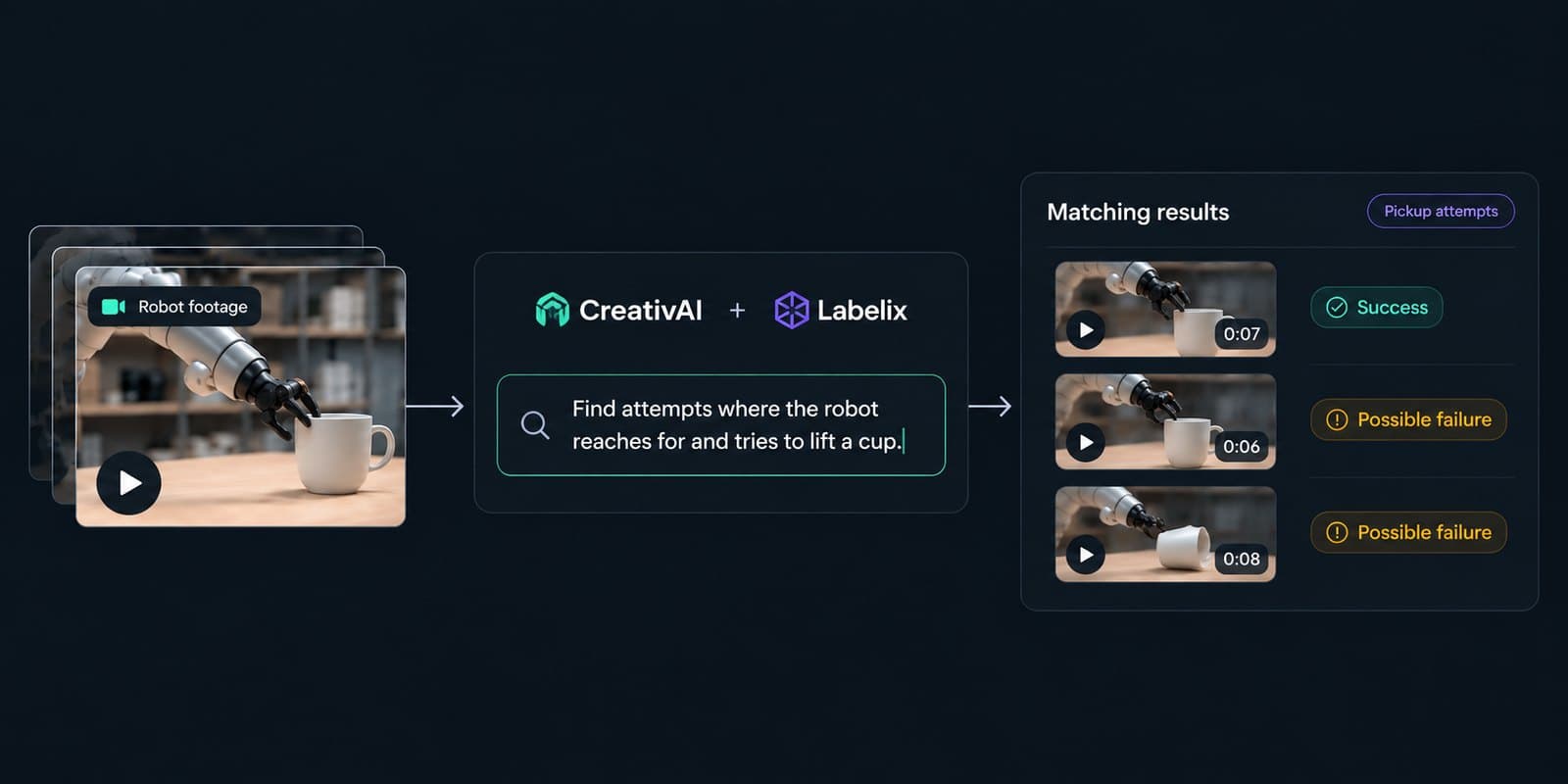
Searching for “robot failures” leaves a lot open to interpretation. A more focused approach starts with the task, object, and visible behavior. For the cup example, that means locating pickup attempts before narrowing the search to specific signs of failure.
Start with the action and object
CreativAI supports natural-language searches over video collections. For the cup investigation, start with the interaction you want to examine: a robot attempting to pick up a cup.
An illustrative query could be: “Find attempts where the robot reaches for and tries to lift a cup.”
Starting with the action provides a broader set of attempts to inspect, including successful pickups and possible failures. It also avoids assuming that every relevant event will be recognized as a failure.
Narrow the search to suspected failures
Rather than searching broadly for “robot failures,” teams can use CreativAI to identify specific behaviors, unexpected events, or unsuccessful task executions across their video datasets.
For example, engineers might ask:
- “Find every instance where a robot attempts to grasp an object but fails to pick it up.”
- “Show moments where a robot drops an object during transportation or placement.”
- “Identify instances where an autonomous robot nearly collides with a person or obstacle.”
- “Find situations where a robot repeatedly attempts a task or requires human intervention.”
These queries help teams isolate potential failures across large volumes of footage without manually reviewing every recording. From there, CreativAI’s Data Plates can organize the retrieved events into structured records, allowing engineers to compare failure types, identify recurring patterns, and prioritize which events require deeper investigation.
Importantly, identifying a potential failure is only the first step. Human reviewers and robotics engineers can then validate the events, investigate root causes, and determine the appropriate corrective actions.
Check each candidate against the original recording, including the surrounding sequence where available. A segment ending before the lift may leave the outcome unclear. A cup leaving the gripper could indicate a drop or an intended release.
Our guide to automated data labeling explains the broader process of turning extracted information into candidate labels. Here, the immediate goal is a relevant set of clips for failure review.
How Do You Organize Failure Search Results?
Once you’ve found relevant clips, organize them so you can review similar events together. Recording the object, attempted action, and observed outcome helps teams compare failures while keeping each entry connected to its source footage.
Structure candidate events with Data Plates
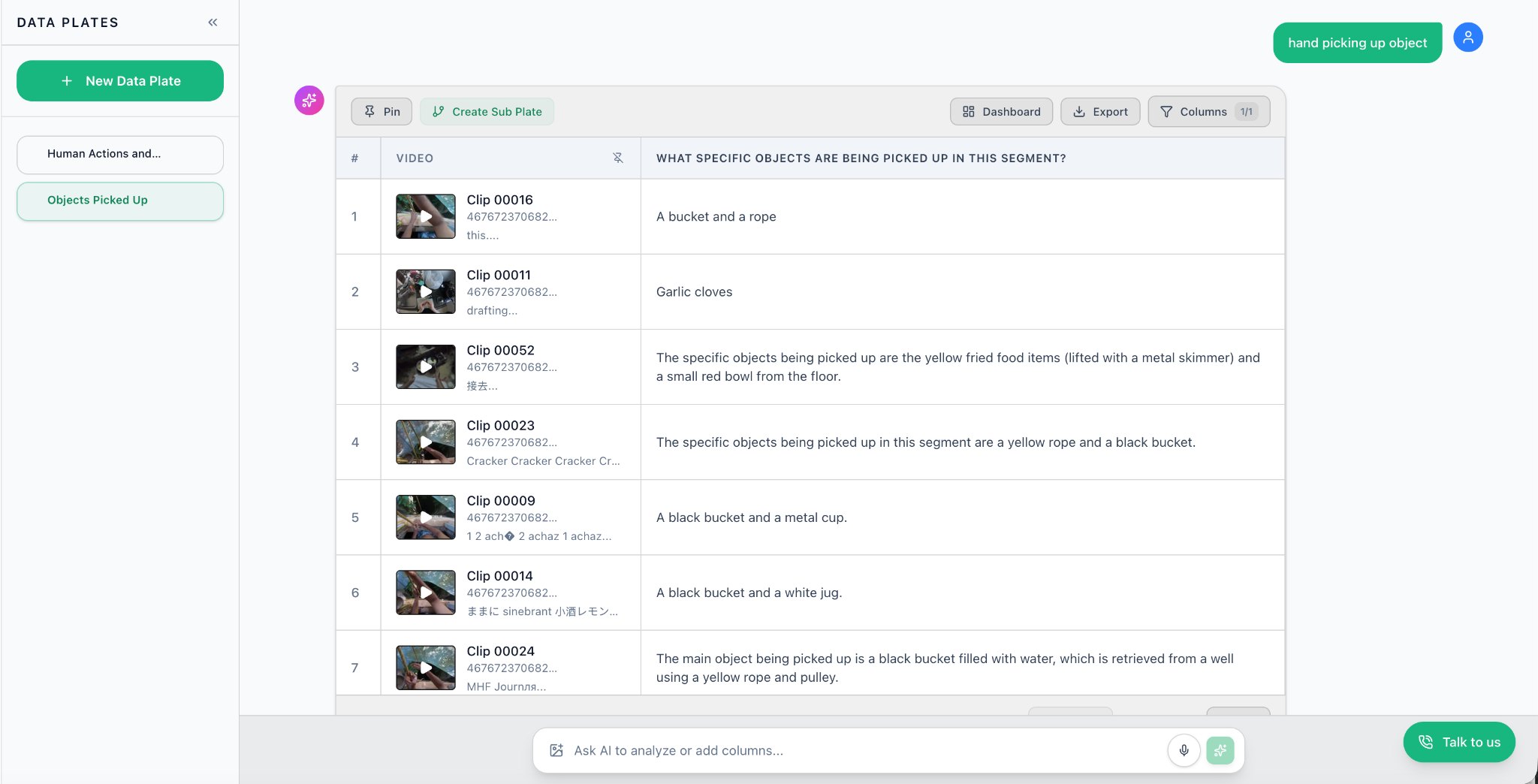
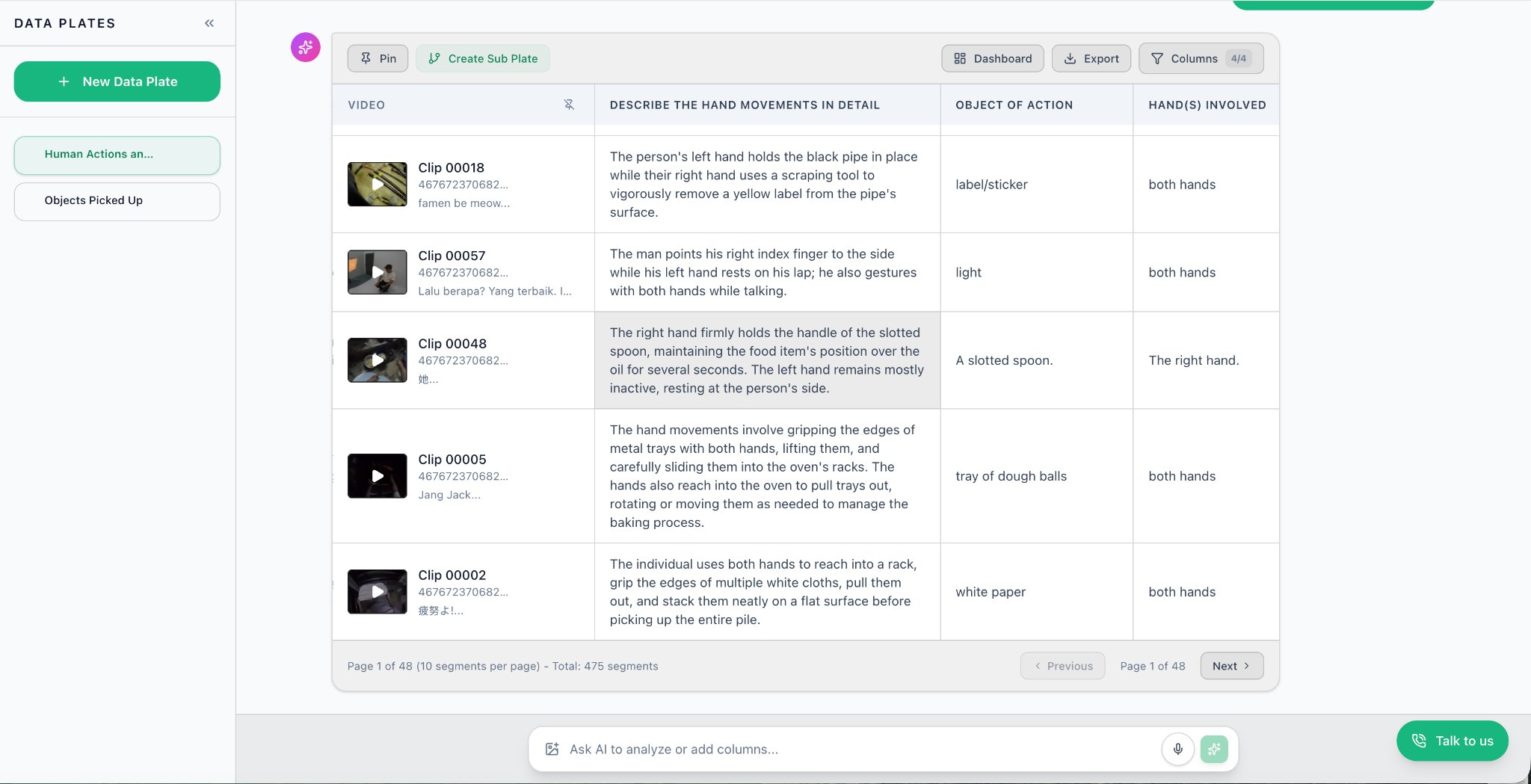
CreativAI’s Data Plates turn video query results into structured tables. Teams can run further queries, filter extracted information, collaborate on validation, and export results.
For the cup investigation, a useful record could include:
- Source and timestamp: Where to find the event.
- Object: Which cup the robot handled.
- Action: What the robot attempted.
- Observed outcome: What happened during that attempt.
- Potential failure category: A preliminary classification for review.
These suggested fields help reviewers identify which attempts deserve attention and locate the evidence behind each entry.
Break results down by object and observed failure
Start with observable differences. A missed grasp, a slip after lifting, and an unsuccessful placement describe different events. Grouping them separately helps reviewers compare similar attempts.
Where object details are available, teams could also compare events involving different cup types. Our guide to robot manipulation across different objects explains why those differences matter.
Keep the observed outcome separate from its possible cause. “Cup fell during transport” records an event. “Insufficient grip force” proposes an explanation that may require additional evidence. Keeping that distinction clear gives reviewers a stronger starting point for analysis.
How Can Labelix.ai Help Review and Classify Robot Failures?
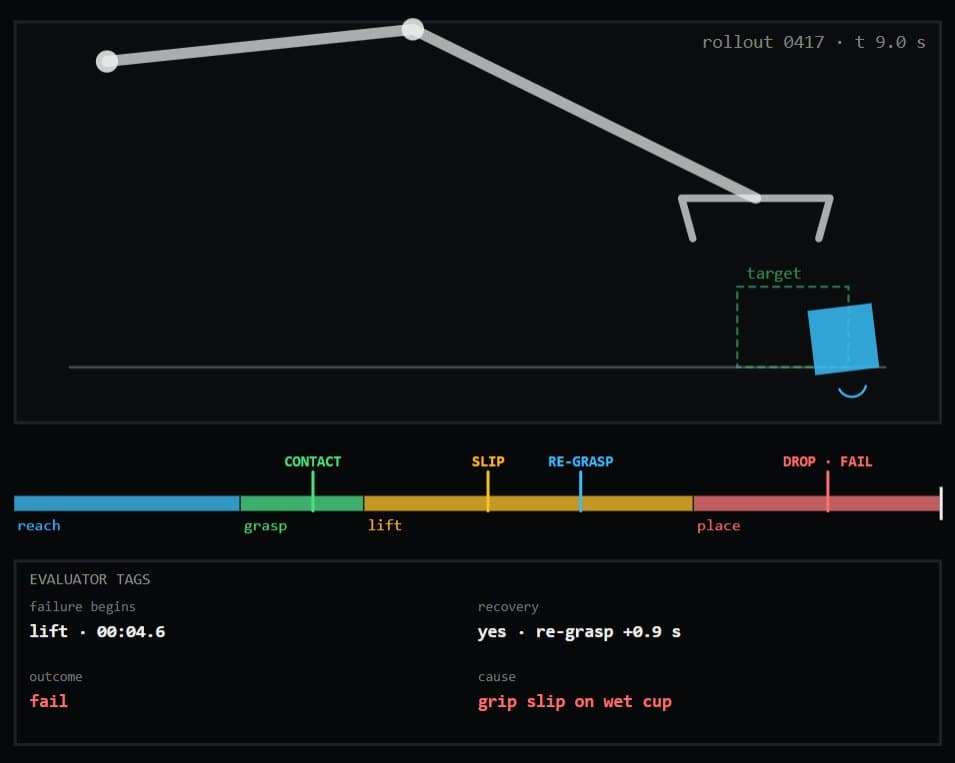
Organized search results give reviewers a focused set of events to examine. Labelix.ai’s robot failure analysis service reviews failed and borderline rollouts against a taxonomy agreed with the client’s engineers. This complements CreativAI’s discovery and structuring capabilities in the proposed workflow.
Verify outcomes against agreed project rules
Reviewers need to apply the same success criteria across the selected recordings. For the cup example, that means checking the intended destination, allowed retries, and any human assistance.
A useful review record separates the outcome from the review status. An attempt might be confirmed as unsuccessful, judged successful, or left unresolved because the relevant interaction is obscured.
The timing of contact, lifting, and release can support these decisions. Our guide to robotics data annotation explains how timestamped events represent those interactions.
Tag failure type, onset, and recovery
Labelix.ai develops failure categories from client footage, documents examples, and agrees the taxonomy with engineers before tagging begins. Reviewers then identify the failure type, where it began, and whether the robot recovered.
For example, a cup might fall after striking a shelf. Reviewing the sequence could distinguish the collision from the resulting drop, directing investigation toward the earlier event.
Unfamiliar failures are flagged for taxonomy updates. Labelix.ai also double-scores a sample of each batch to measure evaluator agreement. Where the evidence cannot establish a cause, the record should preserve that uncertainty for engineering review.
What Should Teams Check Before Drawing Conclusions?
A reviewed set of failures can reveal patterns worth investigating. Before using those patterns to guide engineering decisions, check both the evidence behind each explanation and how the clips were selected.
Review the evidence behind a suspected cause
Video may show when a cup slips without revealing why. To investigate further, engineers might need another camera angle, gripper-state data, force measurements, or action commands.
Compare the recorded commands with the robot’s observed response. This can help engineers investigate whether the intended action was executed.
When supporting data is unavailable, record what remains unknown and what evidence would help resolve it. This makes the reviewed clip useful for follow-up investigation.
Check what the search may have missed
Review a sample of recordings outside the retrieved results to look for overlooked failures. Finding additional examples can help teams refine their queries and decide whether broader review is needed.
Before counting events, check for overlapping clips or multiple camera views of the same attempt. Assigning an attempt identifier can help prevent duplicate counts.
Finally, distinguish failure counts from failure rates. Twenty verified failures do not establish a rate without knowing the total number of eligible attempts. Comparing policy versions requires a consistent scoring standard, as our guide to robot policy evaluation explains.
From Hours of Footage to Reviewed Failure Evidence
Start with one task and a clear investigation question. For the cup example, the useful output is a set of reviewed attempts that engineers can revisit, compare, and use to plan further tests.
What you’ll see: The failure moments from the second World Humanoid Robot Games in Beijing: sprinters running full speed into the barriers, robots collapsing mid-stride and carried off on stretchers, and kickboxing and soccer robots tumbling over.
Video: news.com.au, 2026. Plays from YouTube.
CreativAI’s video search and structured extraction could complement Labelix.ai’s failure-analysis services in this workflow: locating relevant events, then reviewing them against agreed criteria.
Explore CreativAI’s platform for video search and analysis. To discuss reviewing and classifying your robot’s failed and borderline attempts, contact Labelix.ai.
Have failed rollouts that need a reason?
Start with one policy. A dedicated Labelix.ai team drafts the failure taxonomy with your engineers and tags your failed and borderline attempts, in a small paid pilot.
FAQs: Finding Robot Failures in Video
How can you find robot failures in long video recordings?
Search indexed footage for relevant actions and possible failure events. Review matching clips against task criteria, then organize confirmed failures by type, timestamp, and object.
Can video search find every failed robot attempt?
Complete coverage cannot be assumed from search results alone. Reviewing a sample outside the results can help identify missed failures and guide further searches.
What information should a robot failure record include?
Include the recording source, timestamp, task, object, observed outcome, and failure category. Add failure onset, recovery, and supporting evidence where available. Flag uncertain judgments.
Can video alone reveal why a robot failed?
Sometimes. Video may show an immediate cause, such as a collision before a drop. Establishing an underlying cause may require robot logs, additional camera views, or sensor measurements.
How should you label a failed grasp followed by a successful retry?
Record the failed grasp and the recovery separately. Score the overall task against its rules: a successful retry may still count as task success if retries are allowed.

Stephanie writes about robotics, agriculture AI, and the training data behind them, for Labelix.ai, an independent data foundry for robotics and multimodal AI.
Get the next one first
One sharp read a month on Physical AI and the data behind it.