Humanoids are being asked to prove themselves. One is learning on a factory floor from a human operator, two others just logged an eight-hour run on an EV line, and Apple is testing how far simulated training can carry a robot into rooms it has never seen. In South Korea, a national lab opened a facility just to produce the data these robots learn from.
Here’s our weekly scan of what moved in Physical AI and robotics, and what it means for the data behind it.
Embodied AI unveils AIR, a humanoid built to work beside people
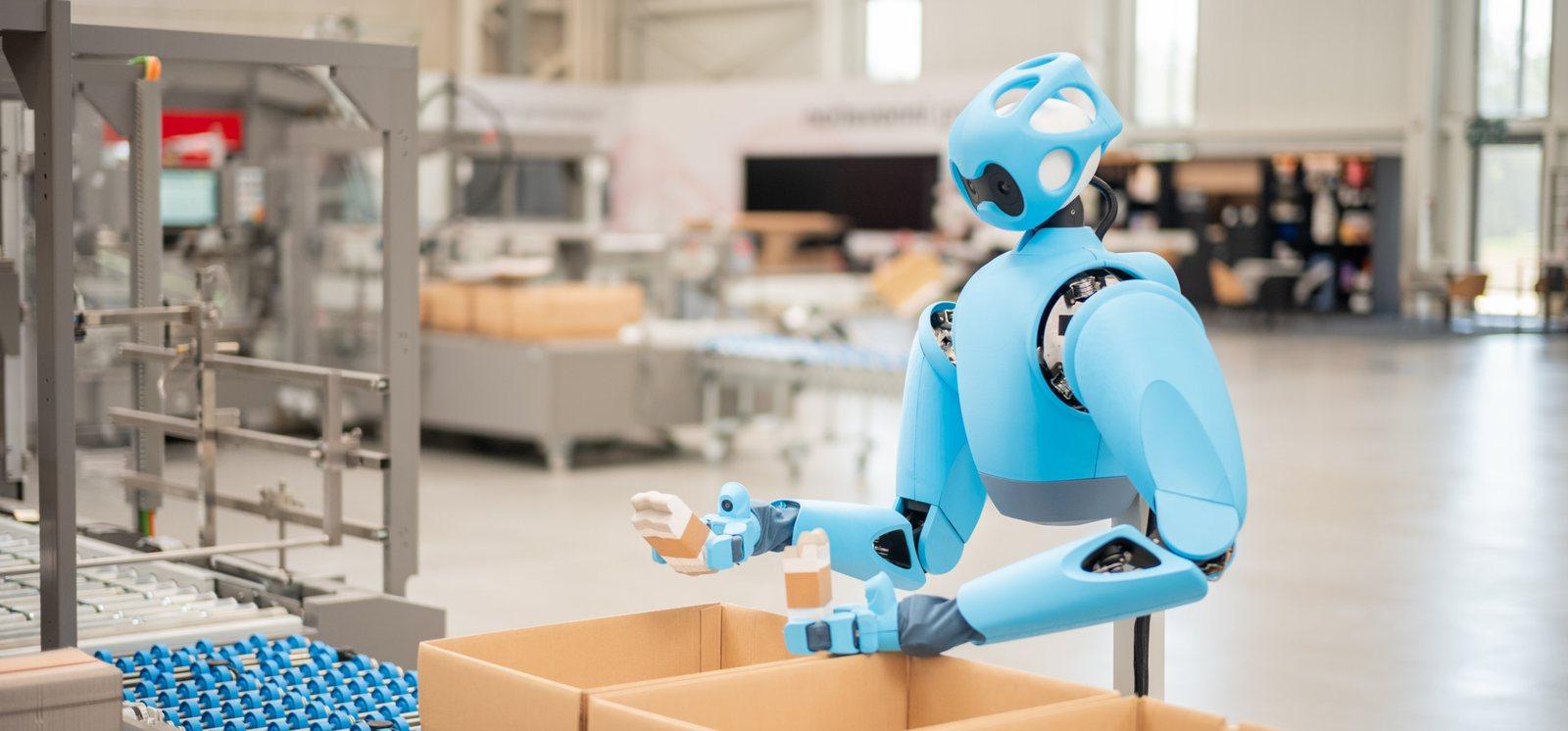
On November 6, Swiss robotics company Embodied AI unveiled AIR at Humanoid Europe 2026 in Munich. The EPFL spin-out says it went from research to an industrial humanoid in nine months. AIR is now being tested with global manufacturers, and the company is starting plans for scaled production.
AIR rides on wheels instead of legs, and its tendon-driven arms are light enough to give way on contact. Embodied AI says safety comes from the hardware rather than software limits. It is designed under ISO/TS 15066:2016, with CE marking planned for 2027.
Training happens on the job. A human operator controls AIR from its first shift and every run is recorded. Embodied AI’s AI stack learns from those demonstrations until the robot can do the task itself, which the company says typically takes about a month. The operator stays on hand for anything new.
Most humanoids are still demos, and most industrial robots work behind cages. AIR is aimed at repetitive, high-dexterity tasks next to the people already on the line. The company cites Deloitte data that more than 80% of factory task hours are expected to stay human-driven.
The proof. The key numbers are company-reported. The headline result, 98% reliability against a 90% goal, came from a cable-handling test that an unnamed consumer electronics maker ran on Embodied AI’s earlier two-arm robot cell, not on AIR. We’d like to see independent results from AIR’s own pilots.
A robot that starts under an operator’s control and records every run is building a demonstration dataset from day one. That echoes last week’s Bleu Robotics story, and the same questions apply. Do the demonstrations cover the task’s variations, and are recoveries and near-misses labeled consistently? Learning “within a month” only holds if the data behind it is clean.
We also agree with CEO Francesco Stella that physical errors can’t be reviewed and corrected like a bad chatbot answer. In robotics, as he puts it, incorrect actions “have immediate and irreversible physical consequences.” That’s why we watch robot policy evaluation and how often the operator has to step back in.
Xiaomi’s humanoids log an eight-hour run in its EV factory
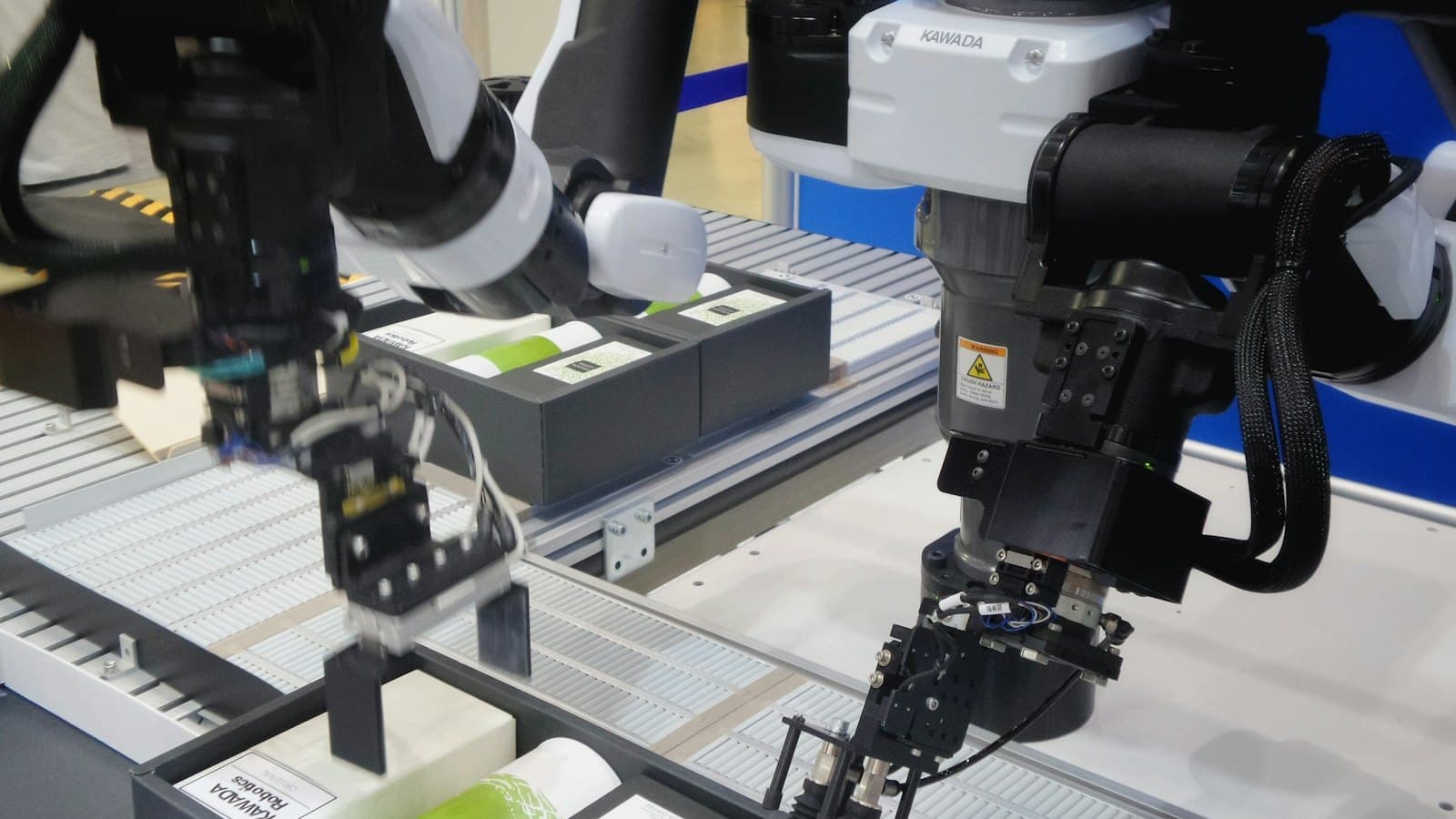
On November 3, Xiaomi posted a video of two of its humanoid robots working an eight-hour task at its electric vehicle factory. They sorted center console side covers and placed them into slots on a parts rack, logging 8 hours and 5 minutes of cumulative work. Xiaomi says the robots detected and corrected anomalies on their own and coordinated with the production line’s systems, while autonomous mobile robots (AMRs) brought in fresh parts.
The run builds on earlier tests at the plant. In March, a robot ran a self-tapping nut station with 90.2% success, and by July Xiaomi reported 98% there. The July update also added side-cover sorting and folding parts bins, each at 90% success. Separately, Xiaomi is trialing a home system built on its Xiaomi-Robotics-1 vision-language-action (VLA) model at an employee apartment, where it completed more than 50 tasks across three rooms in one run of over 30 minutes. Xiaomi says the model was pretrained on more than 100,000 hours of real manipulation data.
Eight hours is the unit factories plan around. Holding a standard shift matters more than a polished demo clip, and coordinating with AMRs shows the robots can fit into a plant’s existing flow. It’s also one narrow process, so it doesn’t mean humanoids can handle varied production work yet.
The numbers Xiaomi left out. It did not share the success rate over the eight hours, output volume or how many times humans stepped in.
This is the same gap we flagged with ROKAE last week. A pilot becomes a product when someone measures success rates, interventions and failure modes over weeks, not just one shift. That’s what failure analysis is for.
The 100,000 hours behind Xiaomi’s VLA model stood out to us. It shows how much real manipulation data a general-purpose robot model is built on. Even then, each new line and part still needs task-specific, carefully labeled data.
Apple’s HALO trains a humanoid mostly on simulated data
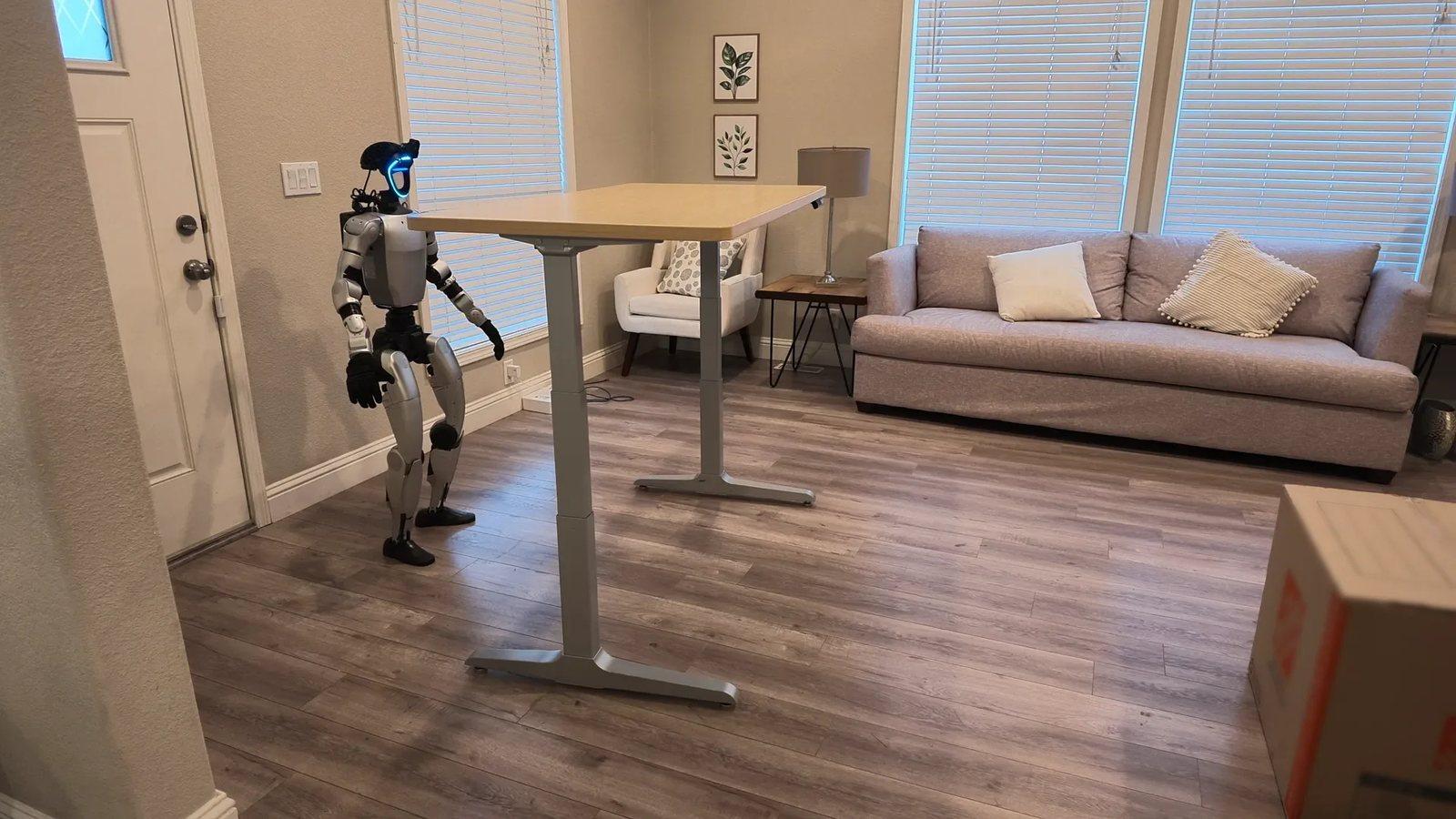
On November 4, Apple researchers posted a paper, “Perceptive Humanoid Motion from Simulation,” introducing HALO. The system runs on a Unitree G1 humanoid using camera input and natural-language requests, and its project page links to code for the data pipeline, training and deployment. Its training data comes from a pipeline that synthesizes vision-language-motion data across a thousand procedurally generated homes. The authors say the corpus scales with compute rather than human labor.
In six real environments that weren’t scanned or mapped beforehand, the robot averaged 91% success across 360 single-task trials, as Humanoids Daily and others reported. Combined tasks, tested 10 times each in one environment, averaged 70%. The hardest combination, crouching under an obstacle, walking to a box and pushing it, succeeded 50% of the time.
Collecting robot data in real homes is slow and expensive, so a pipeline that generates it in simulation is appealing. HALO is a concrete test of how far that can go. The results look promising for navigation and simple tasks, and weaker once tasks get chained.
The limits the authors acknowledge. The robot relies mainly on vision, so contact-heavy tasks degrade when an object is occluded, and touch sensing is listed as future work. Adding a new physical task still needs a person to write the prompt and hand-author keyframes. The paper also doesn’t test HALO against other published systems on the same tasks.
We see HALO as a good example of where sim-to-real stands today. Simulation scales well for motion and navigation. Contact, occlusion and long task chains are where it gets harder, and that’s where real-world data and human judgment still come in.
We also like how the team reported its results. Hundreds of trials across unseen rooms, with the weak spots listed, is the kind of structured testing we want to see more of. That’s the idea behind robot policy evaluation.
South Korea opens a “data factory” for humanoid robots
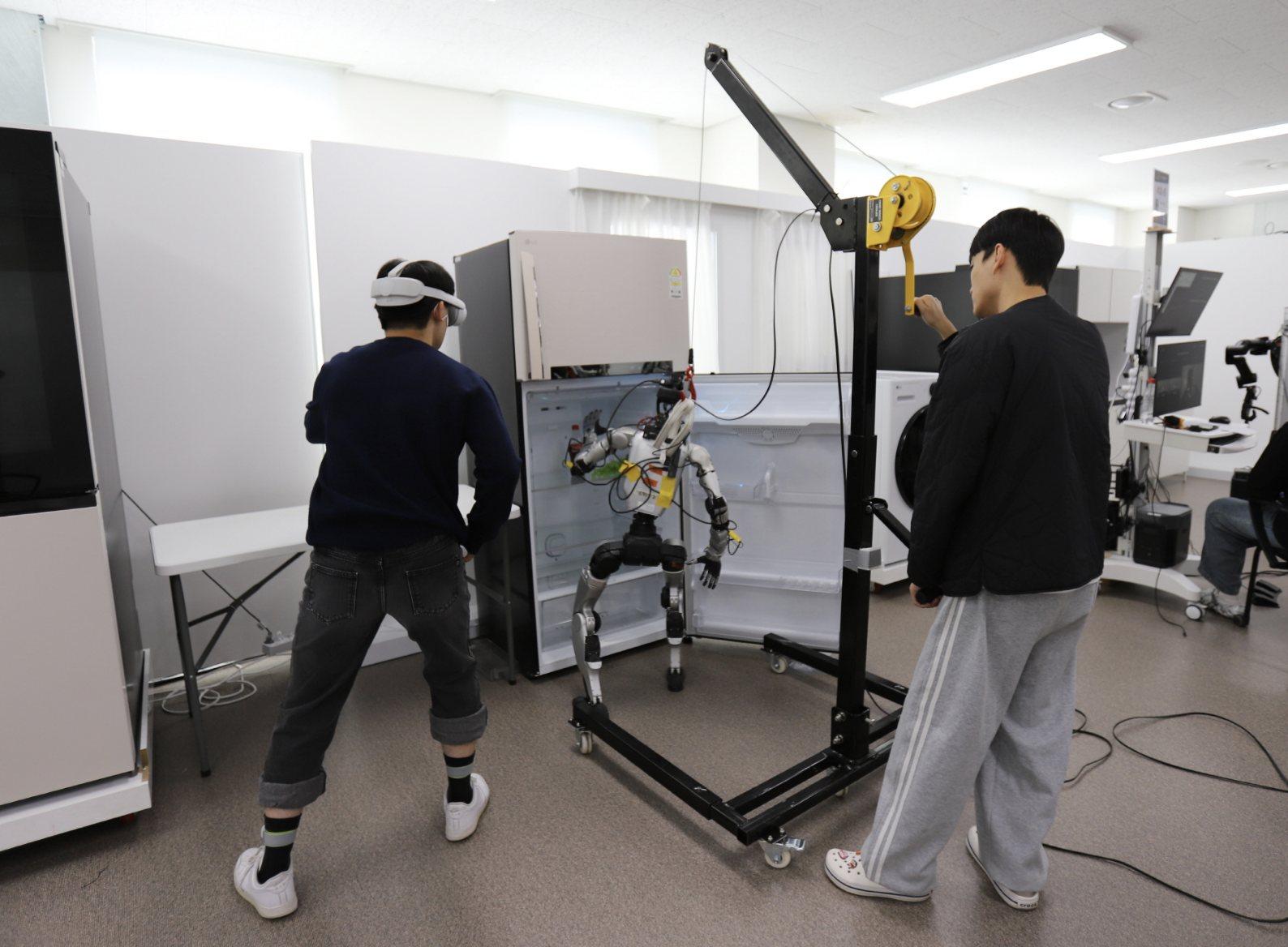
On November 3, the Korea Institute of Machinery and Materials (KIMM) and the Electronics and Telecommunications Research Institute (ETRI) held an opening ceremony for the AI Humanoid Data Factory at KIMM’s Daejeon headquarters, together with South Korea’s science ministry. It is described as South Korea’s first facility dedicated to producing training data for bipedal humanoids.
The facility currently operates 12 humanoids, with operators teleoperating them to record whole-body tasks. The data feeds a closed loop. AI is trained on it, tested on real robots, and the results go back into training. At the opening, robots demonstrated taking items from a refrigerator, handling laundry and tidying a sofa, plus industrial tasks like operating buttons and levers inside a car. The ceremony also showed data collected by imitating human motion. KIMM plans to open the facility to industry, universities and research institutes starting in late 2027.
KIMM President Seog-Hyeon Ryu said that “securing large volumes of high-quality robot task data is essential to national technological competitiveness.” KIMM expects the facility to reduce reliance on overseas data and AI models, treating data production as infrastructure.
The access timeline. Outside users have to wait until late 2027, so for now this is a national research asset rather than something the wider industry can use. The announcement also doesn’t say how much data the factory will produce or how it will be quality-checked.
It’s good to see a government treat robot data as something to build facilities for. It matches what we see across this week’s stories, from Embodied AI’s recorded operator runs to Apple’s synthetic homes. Whatever the source, the data has to be collected, labeled and verified before it’s useful.
The closed loop is the part we like most. Collecting data without checking whether it improved the robot only tells you how much you gathered. Pairing collection with evaluation is how you learn whether it helped.

Cindy writes about Physical AI, robotics, and the human data that teaches models to perceive and act, for Labelix.ai, an independent data foundry for robotics and multimodal AI.
The Data Brief
Get the Radar in your inbox, one sharp read a week on Physical AI and the data behind it.