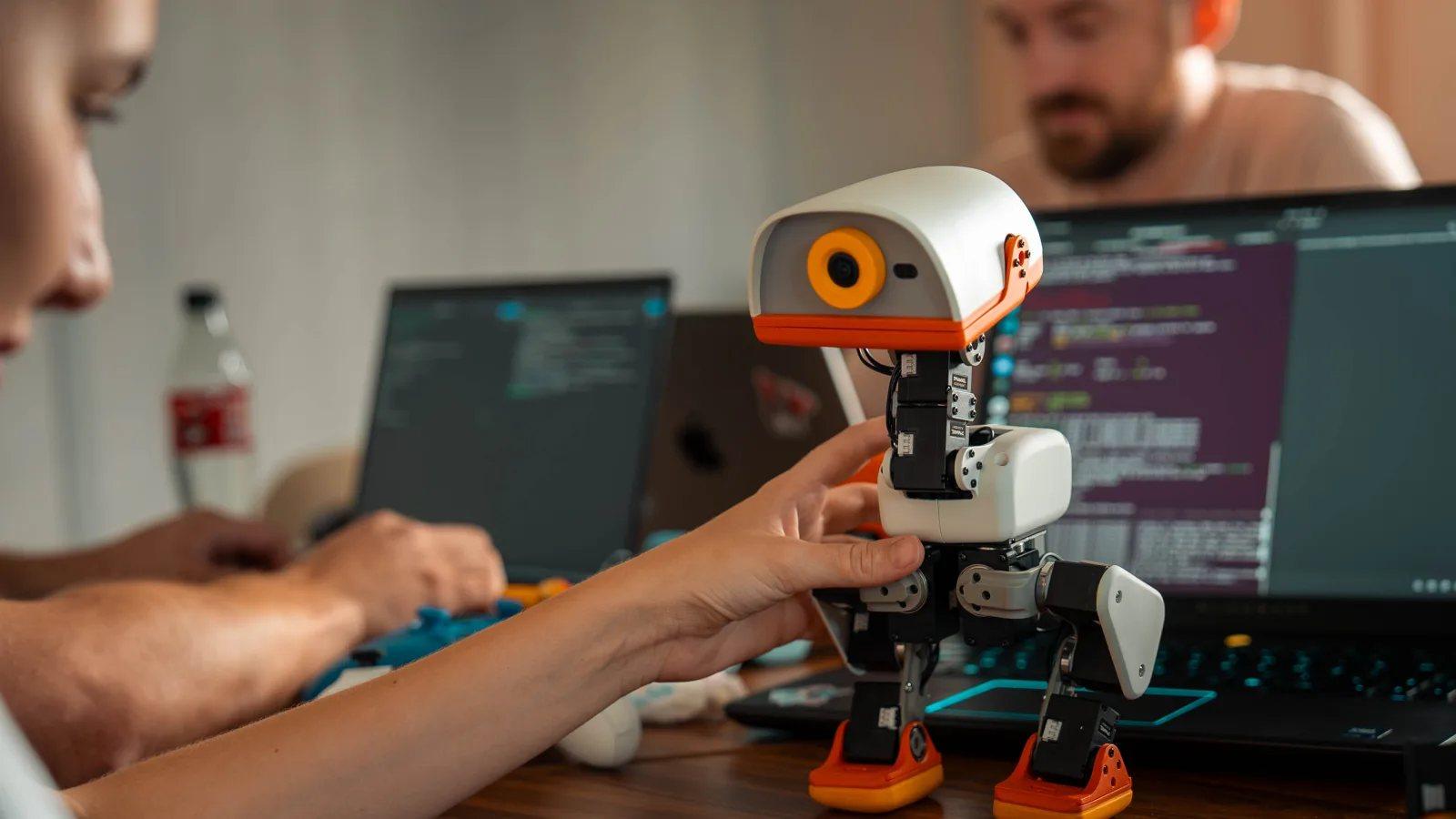
Microduck walks, picks things up with its beak, and gets back up after a fall. It is an appealing little robot. For us, though, the reason to take it seriously is that owners can train it to move differently.
Built by Pollen Robotics, part of Hugging Face, Microduck comes with built-in behaviors and open-source tools for developing new ones. Developers train movements in simulation, then test them on the physical robot.
We think that makes it a worthwhile learning platform. The question is how easily an interested owner can move from driving it with a gamepad to training a behavior of their own. That is where Microduck’s longer-term appeal will be tested.
Microduck at a Glance
| Microduck at a glance | |
|---|---|
| Company | Pollen Robotics, part of Hugging Face |
| Robot | Microduck, a small biped for reinforcement learning and movement experiments |
| Intended users | Developers, educators, and robotics enthusiasts |
| Capabilities | Walking, beak-based grasping, fall recovery, and skating with roller attachments |
| Development tools | Open-source robot software and reinforcement learning tools for simulation and deployment |
| Buying options | Preorder through Pollen’s official store |
| Official advertised price | $399 introductory preorder price, before taxes and shipping |
Company Snapshot: Pollen Robotics
What you’ll see: Pollen’s launch film: Microduck walking, sitting, roller skating, grabbing objects with its beak and getting back up after falls.
Video: Pollen Robotics, 2026. Plays from YouTube.
Pollen Robotics was founded in 2016 by Matthieu Lapeyre and Pierre Rouanet, former researchers from Inria’s Flowers team. Hugging Face acquired the company in April 2025.
Pollen’s earlier robots include Reachy Mini for desktop interaction and Reachy 2 for manipulation research. Our Hugging Face profile covers those platforms and the wider robot-learning ecosystem.
Announced in August 2026, Microduck extends Pollen’s work into small, legged robots.
The Technology: Microduck
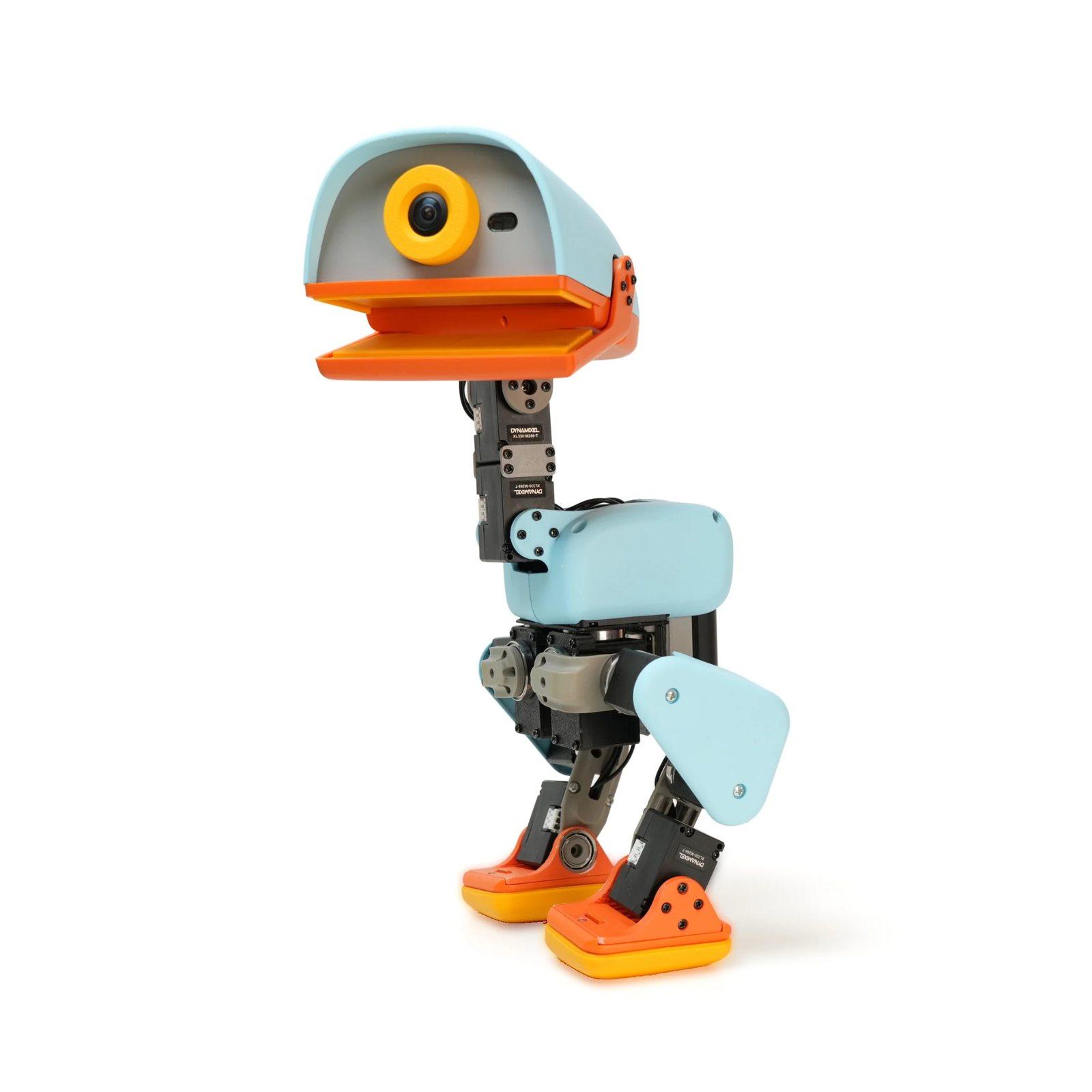
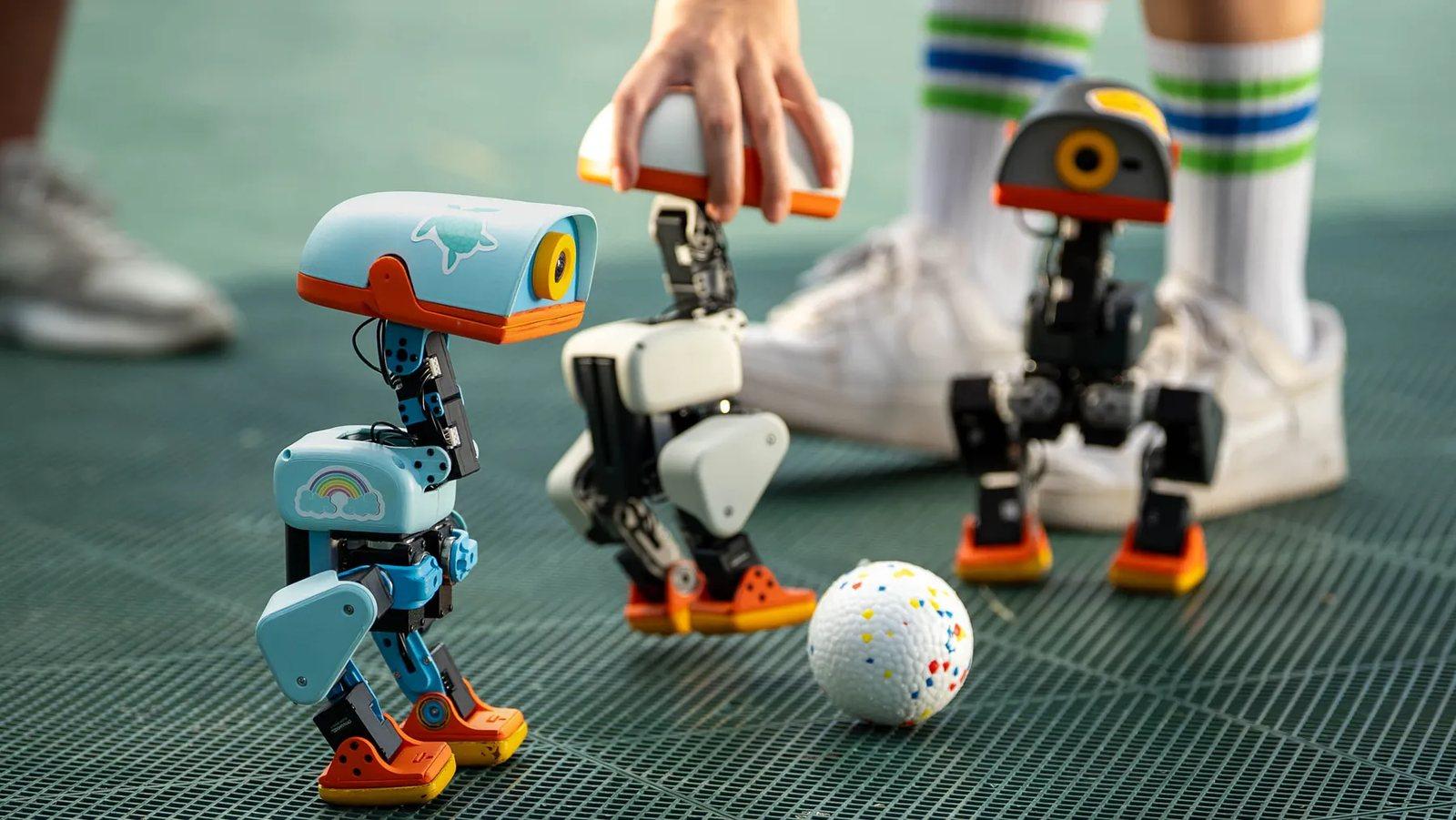
Microduck uses its legs, neck, and head to move. To pick something up, it lowers its body, closes its articulated beak around the object, and returns upright.
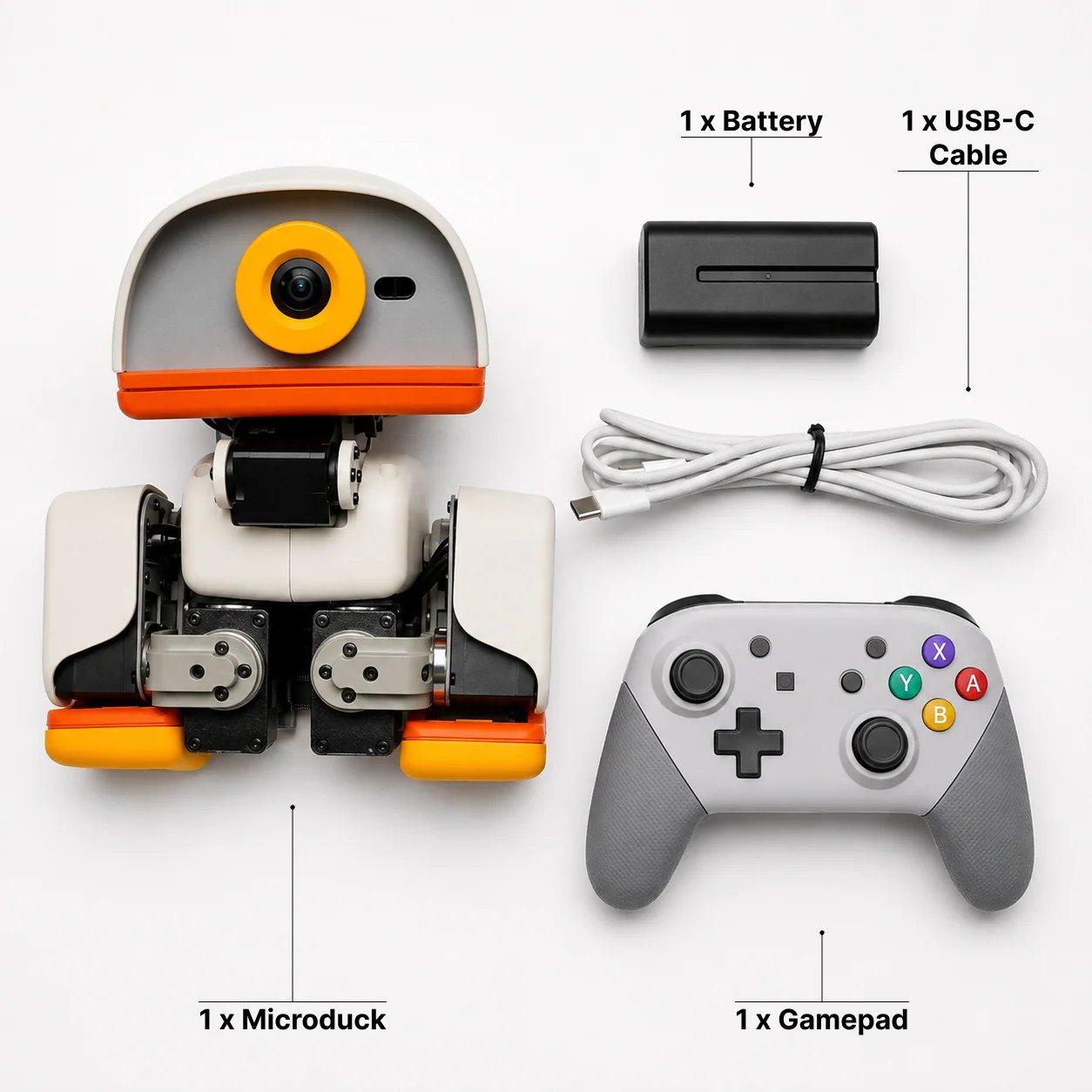
Its hardware includes:
- 15 motors for whole-body movement.
- A front camera and 8×8 ToF depth sensor for visual and distance information.
- Two IMUs for measuring motion and orientation.
- Microphones and a speaker for sound.
- NFC antennas in the head and beak for interacting with tagged objects.
- An onboard Rockchip RK3566 computer with an AI accelerator for running the robot’s software and learned movement policies.
Owners can use the included gamepad to try built-in behaviors. Developers can retrain existing movement policies or train new ones using Pollen’s open-source reinforcement learning tools.
Training happens in MuJoCo, a physics simulator. Developers train a policy, the model that determines the robot’s actions, then export it to run on Microduck. They can test the movement, adjust the simulation, and retrain.
In October 2026, Pollen opened Microduck Arena, a virtual stadium where owners train a policy in simulation, publish it to their Hugging Face account and enter it in challenges such as a two-meter sprint or a hill climb. The Arena scores every entry itself, so results are comparable across players, and no physical robot is needed.
What you’ll see: Pollen introduces Microduck Arena: train a policy, publish it, and enter it in challenges that the Arena scores the same way for every player.
Video: Pollen Robotics, 2026. Plays from YouTube.
Pollen’s actuator model documentation describes varying motor friction, battery voltage, and command delays during training. These variations help prepare policies for differences between the simulated robot and the physical machine.
Microduck Robot Facts
| Robot facts | Microduck |
|---|---|
| Height | 25 cm |
| Manufacturer-listed weight | 780 g |
| Movement | 15 motors |
| Grasping mechanism | Articulated beak; no manipulation arms or hands |
| Rated payload | Not published |
| Battery | Removable NP-F550 |
| Battery runtime | Approximately one hour |
| Connectivity | Wi-Fi and Bluetooth |
| Included controller | Gamepad |
How to buy: Preorder directly from Pollen. The introductory price is $399 before taxes and shipping. Pollen advises that current preorders should ship after April 2027, in the order received.
Business Model and Strategy
Pollen is selling Microduck to people who want different things from the same robot. Some will want to drive it around and try the tricks. Others will want to change its walking policy or build a classroom experiment. We think serving both groups makes sense. The harder job is making the development tools approachable enough for curious beginners.
There is precedent for the playful approach. In its August 2026 announcement, Pollen reported that more than 10,000 Reachy Minis had reached people worldwide. That figure concerns Reachy Mini, not Microduck. It suggests an audience for Pollen’s smaller robots, though it tells us nothing about how many owners develop their own applications.
Pollen wrote in the announcement: “We did not want Microduck to be a development kit that only becomes interesting after a weekend of setup.”
That is a sensible starting point. Buyers get something to do immediately, while the development tools give them somewhere to go next. But enjoying a gamepad-controlled robot and training a useful movement require different levels of commitment. The latter takes computing resources, time, and patience with experiments that fail.
Pollen also sells accessory, charger, and developer packs. Spare batteries let owners swap batteries between sessions. Replacement parts support maintenance and experimentation, while play accessories add activities to try.
For us, the more consequential question is what owners will be able to borrow from one another. Pollen wants developers to share behaviors alongside the simulation environments and training recipes needed to reproduce them. A working example gives beginners something concrete to adapt. It also lets more experienced developers inspect how a behavior was trained before building on it.
That is where we would judge the community strategy. A growing collection of tricks would be fun. Clear instructions and examples that other owners successfully reproduce would make Microduck more useful as a learning platform. Pollen’s challenge is to make that next step inviting enough that people actually take it.
The Data Challenge
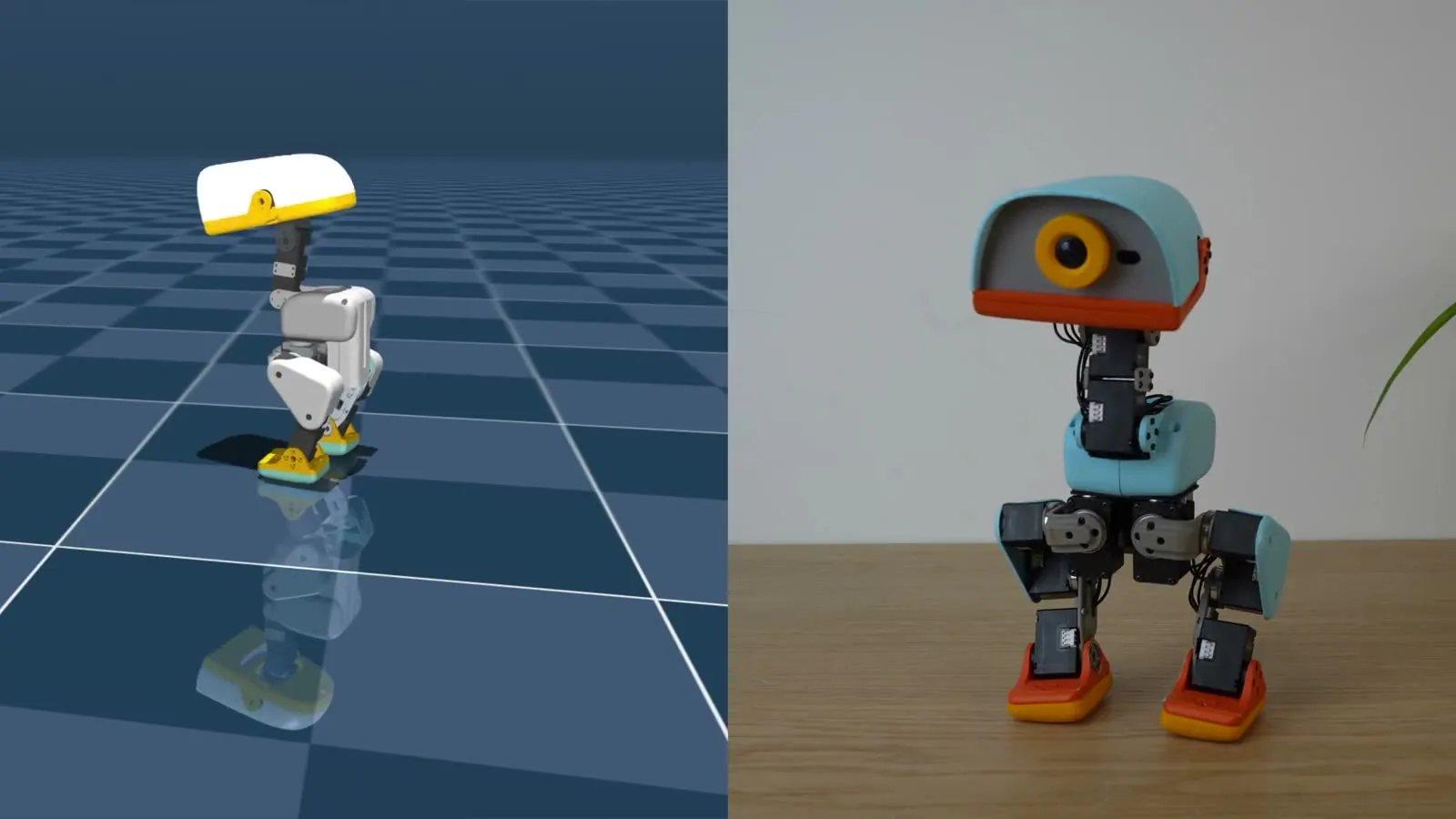
Pollen’s training documentation identifies motor-model accuracy as central to simulation-to-hardware transfer. Evaluating that transfer requires a clear record of what happened during each physical trial.
For a hypothetical walking and recovery test, useful review questions include:
- Conditions: Which surface, movement command, and policy version were used?
- Failure: When did the robot lose balance, and what happened immediately beforehand?
- Recovery: Did it stand up independently, require repeated attempts, or need human help?
- Completion: Did it resume the requested movement after standing?
A robot that falls and recovers has behaved differently from one that completes the route without falling. Recording both events preserves that distinction, even if both trials reach the destination.
These are suggested evaluation criteria, rather than Pollen’s published scoring rules. As our Atlas profile also discusses, testing on physical hardware helps establish how far simulation-trained skills carry over.
Labelix.ai’s Take
Microduck’s shared policies give developers behaviors they can test and modify. Comparing those versions becomes more useful when teams use the same conditions and scoring criteria.
Labelix.ai’s robot failure analysis services help teams review recorded trials against agreed criteria. Observable events can be tagged for engineers to investigate alongside robot logs.
Have recorded robot trials to review? Contact Labelix.ai to discuss your footage, evaluation criteria, and annotation needs.
Have robot trials that need a second look?
Send a few recorded trials: one task, your hardest failures and near misses. A dedicated Labelix.ai team tags each failure cause, the step where it began, and whether the robot recovered, against criteria agreed with your engineers.
FAQs
How much does Microduck cost?
Pollen advertises Microduck at an introductory preorder price of $399, before taxes and shipping. Accessory packs are sold separately.
When will Microduck preorders ship?
Pollen expects current preorders to ship after April 2027. Orders will ship in the order received. Check the official store for updates.
Do you need coding skills to use Microduck?
No coding is needed to try its built-in behaviors with the included gamepad. Developing or retraining movement policies requires working with Pollen's programming and reinforcement learning tools.
Can you train Microduck without owning the robot?
Yes. Pollen's training software lets developers train and test policies in simulation. Local training requires a compatible CUDA GPU, or you can use Hugging Face Jobs, a paid Hugging Face service. Physical validation requires hardware.
How is Microduck different from Reachy Mini?
Microduck focuses on movement and reinforcement learning. Reachy Mini focuses on desktop interaction, including conversational AI. Our Hugging Face profile explains Reachy Mini and Pollen's other platforms.

Stephanie writes about robotics, agriculture AI, and the training data behind them, for Labelix.ai, an independent data foundry for robotics and multimodal AI.
Get the next one first
One sharp read a month on Physical AI and the data behind it.