Boston Dynamics is the robotics company behind Spot, Stretch and Atlas, the electric humanoid now entering production. It is owned by Hyundai Motor Group, works with Google DeepMind on the AI, and has had a new CEO since October 7, 2026. What stands out is where Atlas learns: skills are trained in simulation first, then proven on real hardware, which puts a lot of weight on the data that comes back from every physical trial.
| Boston Dynamics at a glance | |
|---|---|
| Founded | 1992, as a spin-off from the MIT Leg Lab |
| Owner | Hyundai Motor Group, since 2021 |
| CEO | Rohit Prasad, since October 7, 2026 |
| Robots | Spot (industrial inspection), Stretch (truck unloading), Atlas (humanoid) |
| Atlas | 56 degrees of freedom, 2.3-meter reach, lifts up to 50 kg, about four hours per battery, which it swaps itself |
| New hand | GR3: four fingers, 13 degrees of freedom, unveiled October 1, 2026 |
| AI partner | Google DeepMind, on Gemini Robotics |
| First deployments | Hyundai’s RMAC and Google DeepMind in 2026; more customers from early 2027 |
| Price | Not announced |
Company Snapshot
Founded in 1992 out of MIT’s Leg Lab, Boston Dynamics spent decades building its reputation through robots that could run, jump, and recover from falls. Commercialization came later. Google acquired the company in 2013, SoftBank in 2017, and Hyundai Motor Group took control in 2021.
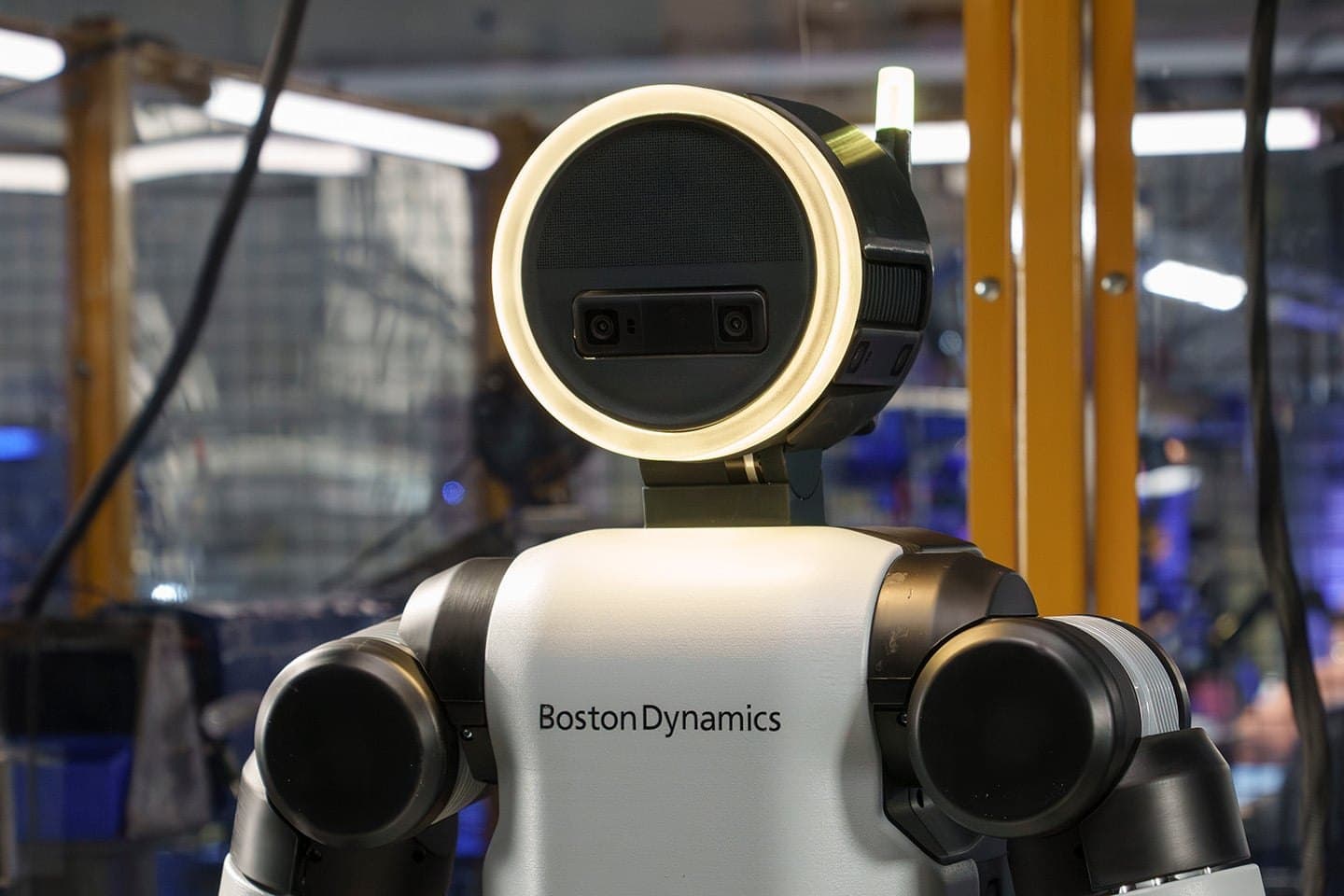
Today, Spot handles industrial inspection, Stretch automates truck unloading, and Atlas represents the company’s push into humanoid robotics (more on Atlas below).
Leadership is entering a new chapter. Robert Playter, a 30-year company veteran, stepped down as CEO in February. On October 7, 2026, Rohit Prasad took over, bringing an AI-first background from Amazon, where he led work on Alexa, artificial general intelligence, and the Nova models.
The Technology: Atlas
The hydraulic Atlas, famous for its parkour demonstrations, retired in 2024. Its electric successor is designed for industrial work. The product version, unveiled in January 2026, has 56 degrees of freedom, a 2.3-meter reach, and a stated lifting capacity of 50 kg. It can operate autonomously, through teleoperation, or via a tablet. When its battery runs low, it can walk to a charging station and replace its own battery pack. Skills learned by one robot can also be transferred across the fleet.
The hardware reflects a deliberate focus on simplicity. Atlas uses two actuator types, its two arms are identical, as are its two legs, and no cables cross its joints. Limbs and hands can be replaced in minutes. Standardizing components also makes the robot easier to model and train in simulation.
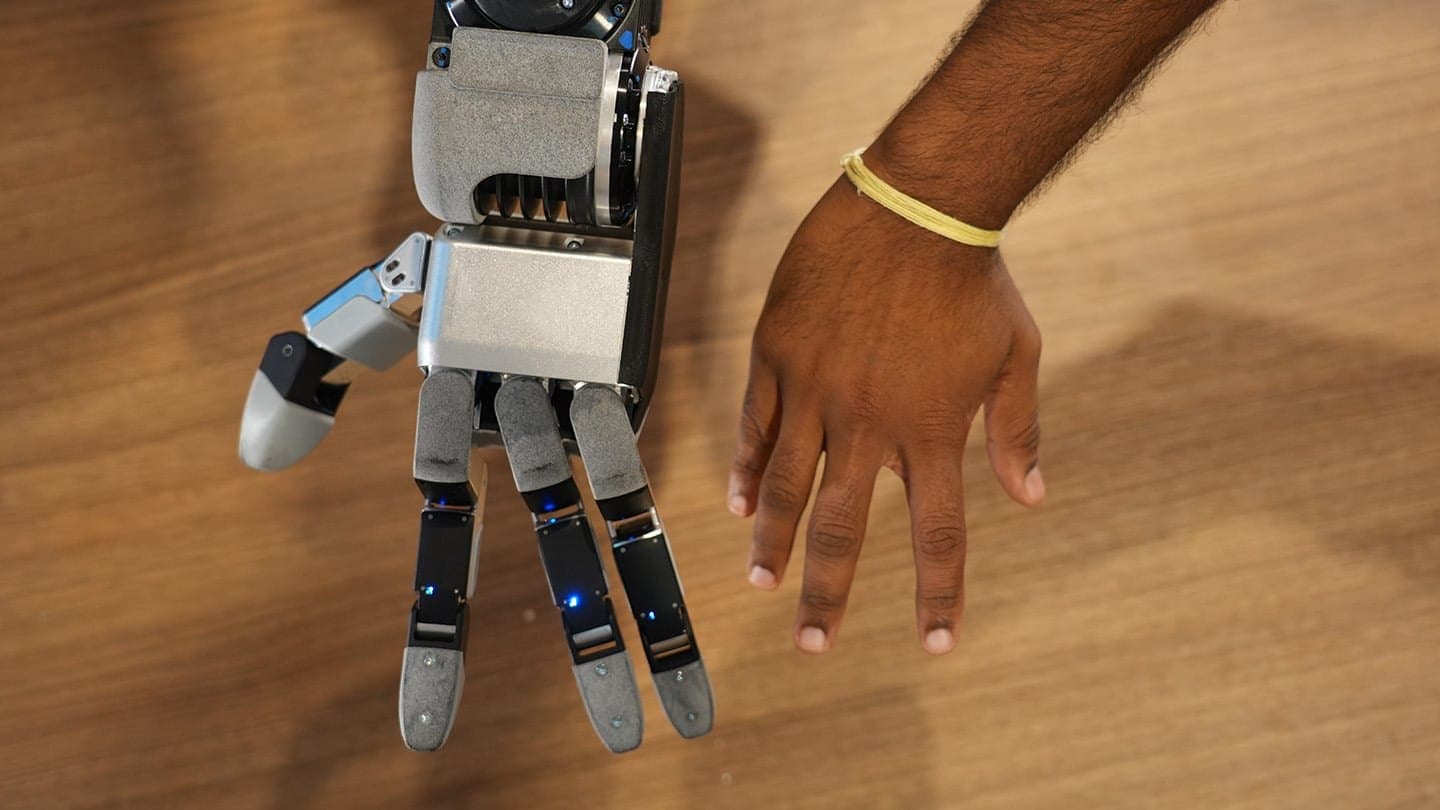
Dexterous manipulation is the next frontier. Unveiled on October 1, 2026, the GR3 hand has four fingers, 13 degrees of freedom, and pressure sensors across its fingertips and palm. The design omits a pinky, prioritizing useful capabilities over mechanical complexity. Its human-scale dimensions help bridge the gap between human demonstrations and robotic execution, while its target tasks include operating drills, grinders, and torque drivers.
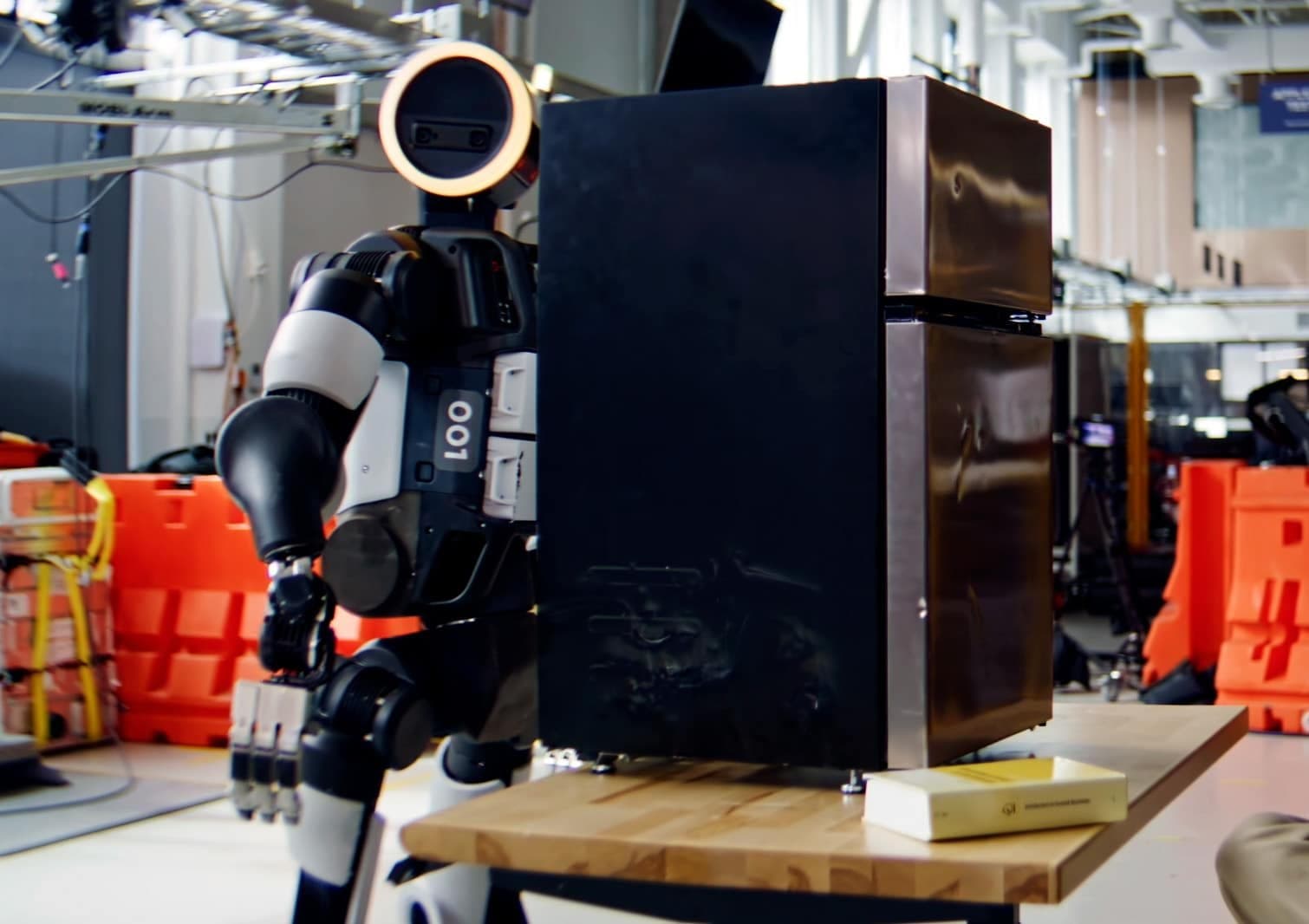
Atlas develops many of its movements through reinforcement learning in simulation. For a mini-fridge lift, for example, the robot practiced across millions of simulated hours while variables such as object weight, floor friction, and motor strength were randomized. Trained on loads of 50 to 70 pounds, it subsequently lifted a fridge weighing more than 100 pounds on real hardware.
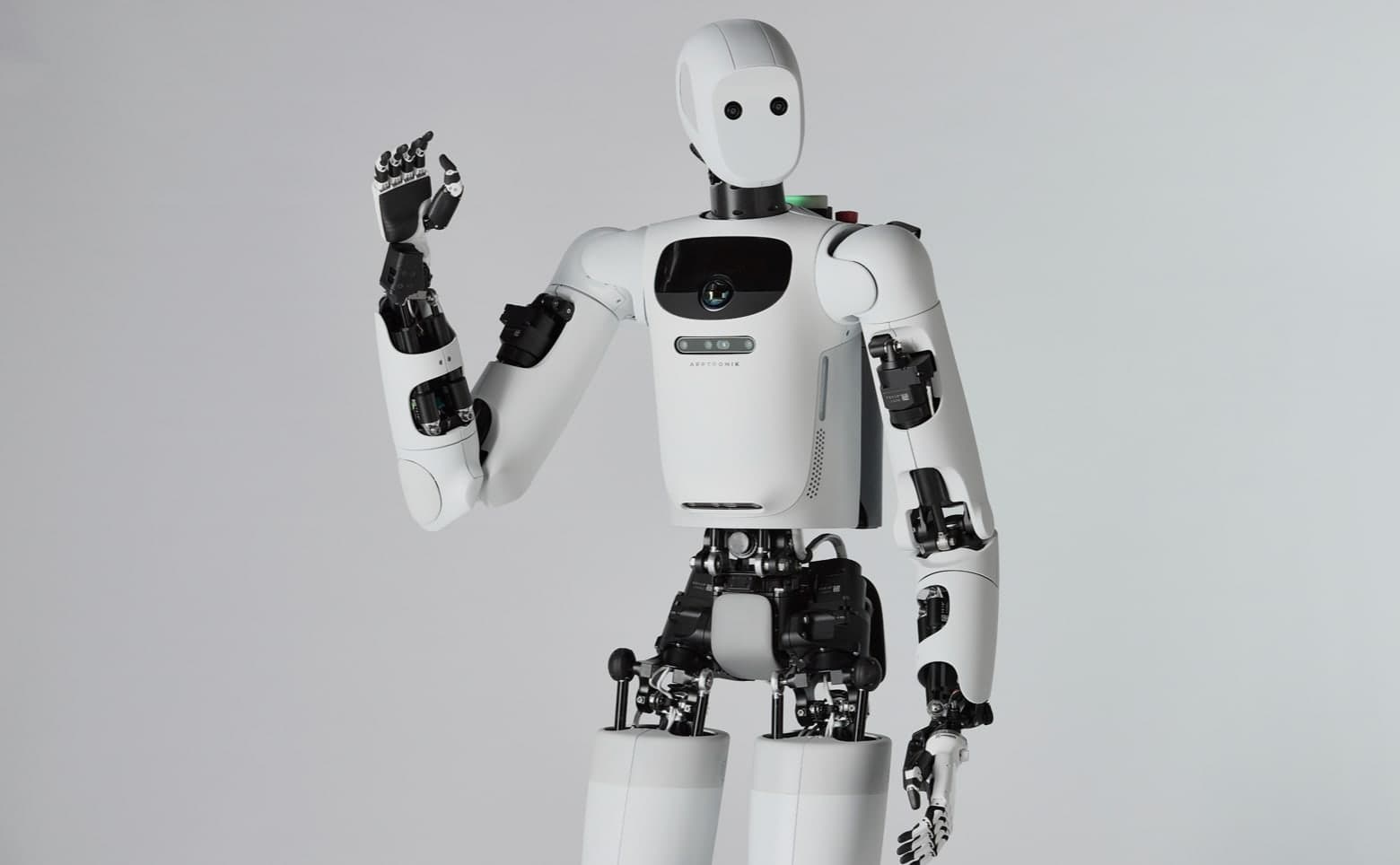
Simulation reduces the cost and risk of training, but it doesn’t eliminate the need for physical testing. Boston Dynamics’ partnership with Google DeepMind, announced in January 2026, aims to bring Gemini Robotics models to Atlas, extending its ability to interpret tasks beyond individual pre-trained movements. (Apptronik works with the same lab on its Apollo humanoid; see our Apptronik profile.)
Business Model and Strategy
Atlas is not yet commercially available to general customers. All units produced in 2026 are earmarked for Hyundai’s Robotics Metaplant Application Center (RMAC) or Google DeepMind, with additional customers expected from early 2027. Boston Dynamics has not announced an official price.
Hyundai gives the company something valuable: a deployment environment at industrial scale. Hyundai Mobis will supply Atlas’s actuators, while Hyundai’s broader $26 billion US investment includes plans for a robot factory with an annual capacity of 30,000 units.
The automaker plans to begin deploying Atlas at its Georgia facility in 2028, starting with parts sequencing. At an investor session in May 2026, the group also said it plans to put more than 25,000 Atlas robots into Hyundai and Kia plants, The Korea Herald reported. No detailed timeline came with that figure, so it should be treated as a stated ambition rather than a confirmed deployment schedule.
Automotive manufacturing is the initial proving ground, where repetitive material handling and parts movement offer practical entry points. Success will depend on whether Atlas can perform these tasks reliably across shifts, workstations, and changing production conditions.
Hyundai’s ownership provides access to real factories, operational feedback, and a path to production. It also concentrates early demand within one corporate group, leaving Boston Dynamics to prove that Atlas can deliver repeatable results before expanding into a broader market.
The Data Challenge
Boston Dynamics’ approach puts simulation at the center of robot training, particularly for whole-body coordination and force-sensitive manipulation. Human demonstrations can show a robot what a task should look like, but they don’t automatically capture the balance corrections, contact forces, and rapid adjustments needed to execute it reliably.
Three data challenges remain central to bridging simulation and real-world performance.
1. Demonstrations that translate into useful training data
Demonstrations can provide reference behaviors for new skills, whether captured through teleoperation or other human-guided methods. But raw footage alone rarely tells the full story. An effective dataset needs consistent task boundaries, action labels, and outcome definitions so that models can learn what the robot did, what it was trying to achieve, and whether the attempt worked.
This is where teleoperation and imitation learning intersect with data quality: the value of a demonstration depends on how accurately the behavior is captured and represented.
2. Evaluation on real hardware
A behavior that works in simulation may fail when friction, object placement, sensor noise, or physical contact differs from the model. Real-world trials must therefore be evaluated against consistent criteria, distinguishing successful execution from partial completion, unsafe behavior, or recovery after an error.
Without structured evaluation, teams risk measuring progress by how convincing a demonstration looks rather than how reliably a robot completes the task. (We cover what that takes in robot evaluation and benchmarking.)
3. Failure analysis that improves the next training cycle
A slipping grasp or shifting load can expose a weakness that simulation failed to reproduce. Identifying the failure is only the first step; teams need to establish what happened, where the behavior diverged from expectations, and whether the cause was perception, planning, control, or the physical environment.
That requires traceable annotations and consistent failure categories. As explored in Labelix.ai’s work on robot failure analysis, understanding why a run failed is essential to turning operational experience into actionable training and evaluation data.
Labelix.ai’s Take
Boston Dynamics is a useful case study in how simulation and real-world data complement each other. Its strategy is to develop skills in a controlled virtual environment, then validate them on physical hardware. Hyundai’s factories provide a potential route to scale, but they also raise the bar for reliability: performance must hold across different tasks, workstations, and operating conditions.
The important distinction is that simulation can generate enormous volumes of experience, but volume alone doesn’t establish whether a model is learning the right behavior. Real-world trials provide the evidence needed to test those assumptions. Their value depends on consistent annotation, clear success criteria, and reliable failure attribution.
This is where Labelix.ai’s expertise in robotics data annotation and robot evaluation becomes relevant. Structured task labels, outcome verification, and failure analysis help robotics teams turn raw demonstrations and deployment footage into data they can use to assess performance and improve training.
For Atlas, the question isn’t simply how many simulated hours it can accumulate. It’s whether the lessons learned in simulation translate into dependable work on the factory floor. The stronger that feedback loop becomes, the more effectively each real-world trial can inform the next iteration of the robot.
Have real-world robot trials that need labeling?
Send a representative sample: one task, a few episodes, your hardest cases. A dedicated Labelix.ai team labels steps, outcomes and failures against your guideline and shows you how the close calls were decided.
FAQs
What is Boston Dynamics?
Boston Dynamics is a robotics company founded in 1992 as a spin-off from the MIT Leg Lab. It is owned by Hyundai Motor Group and makes three robots: Spot for industrial inspection, Stretch for unloading trucks, and Atlas, an electric humanoid built for industrial work.
Who owns Boston Dynamics?
Hyundai Motor Group has been the majority shareholder since 2021. Before that, Google acquired the company in 2013 and SoftBank in 2017.
Who is the CEO of Boston Dynamics?
Rohit Prasad became CEO on October 7, 2026. He was previously senior vice president and head scientist for Alexa and artificial general intelligence at Amazon. He succeeded Robert Playter, who stepped down in February 2026.
Can you buy an Atlas robot?
Not yet. Boston Dynamics says all Atlas deployments for 2026 are committed to Hyundai's Robotics Metaplant Application Center and Google DeepMind, with more customers planned from early 2027. It has not announced a price.
How does Atlas learn new tasks?
Many of Atlas's movements are trained with reinforcement learning in simulation, starting from a reference such as a teleoperated demonstration or an animation, and are then tested on real hardware. Boston Dynamics is also working with Google DeepMind to bring Gemini Robotics foundation models to Atlas.

Cindy writes about Physical AI, robotics, and the human data that teaches models to perceive and act, for Labelix.ai, an independent data foundry for robotics and multimodal AI.
Get the next one first
One sharp read a month on Physical AI and the data behind it.