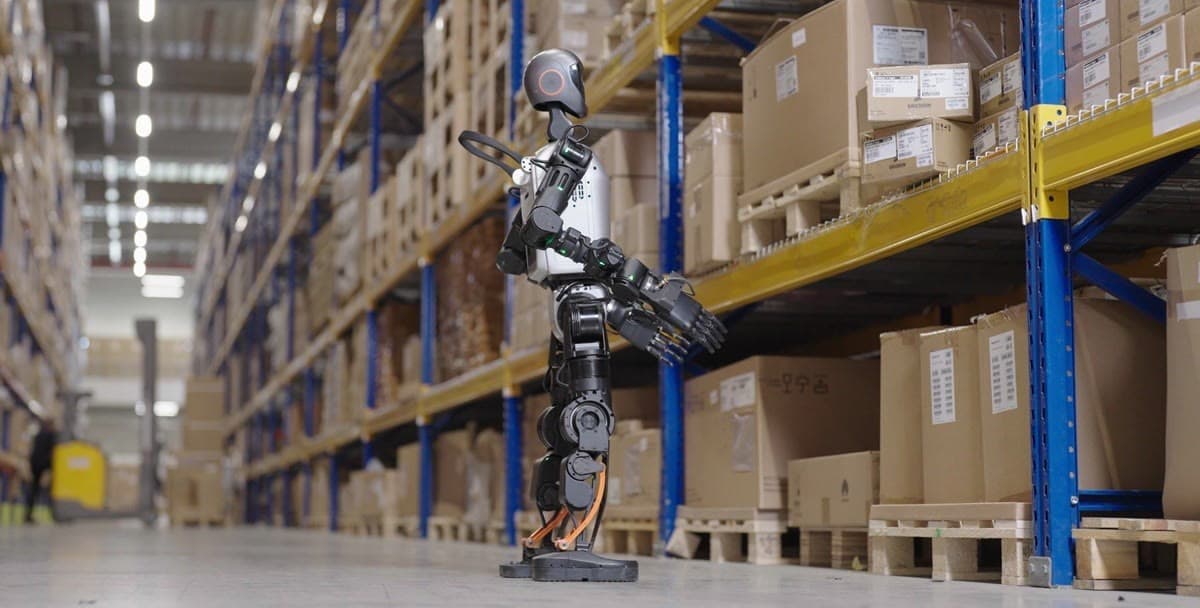
Apptronik is the Austin company behind Apollo, a human-sized humanoid robot built for logistics and manufacturing work. It has raised nearly $1 billion, works with Google DeepMind on the AI, and tests its robots with Mercedes-Benz, GXO Logistics and Jabil. Its latest move is a nearly 90,000-square-foot building where robots work all day to produce training data, which says a lot about where the company thinks the hard part is.
| Apptronik at a glance | |
|---|---|
| Founded | 2016 in Austin, Texas, out of the University of Texas Human Centered Robotics Lab |
| CEO | Jeff Cardenas, co-founder |
| Robot | Apollo, a humanoid for logistics and manufacturing. Original model: 5'8", 160 lbs, 55 lb payload, about four hours per swappable battery |
| Current version | Apollo 2, in bipedal and wheeled configurations |
| AI partner | Google DeepMind, on Gemini Robotics |
| Pilot partners | Mercedes-Benz, GXO Logistics, Jabil |
| Funding | Nearly $1 billion raised, including $520 million in February 2026 |
| Data facility | Robot Park, Austin, nearly 90,000 square feet |
| Price | Not published |
Company Snapshot
Apptronik was founded in Austin in 2016 by a team that included Jeff Cardenas, Nick Paine and Luis Sentis, growing out of the University of Texas’ Human Centered Robotics Lab. The company’s roots go back even further: Paine and Sentis worked on NASA’s Valkyrie robot for the DARPA Robotics Challenge, and that early space-robotics work still shapes the company’s pitch today.
Apptronik has raised nearly $1 billion. That includes a $520 million Series A extension in February 2026 that valued the company at about $5.3 billion, with backing from Google, Mercedes-Benz, B Capital and the Qatar Investment Authority, among others. Through all of it, the company has stayed focused on a single humanoid.
The Technology: Apollo
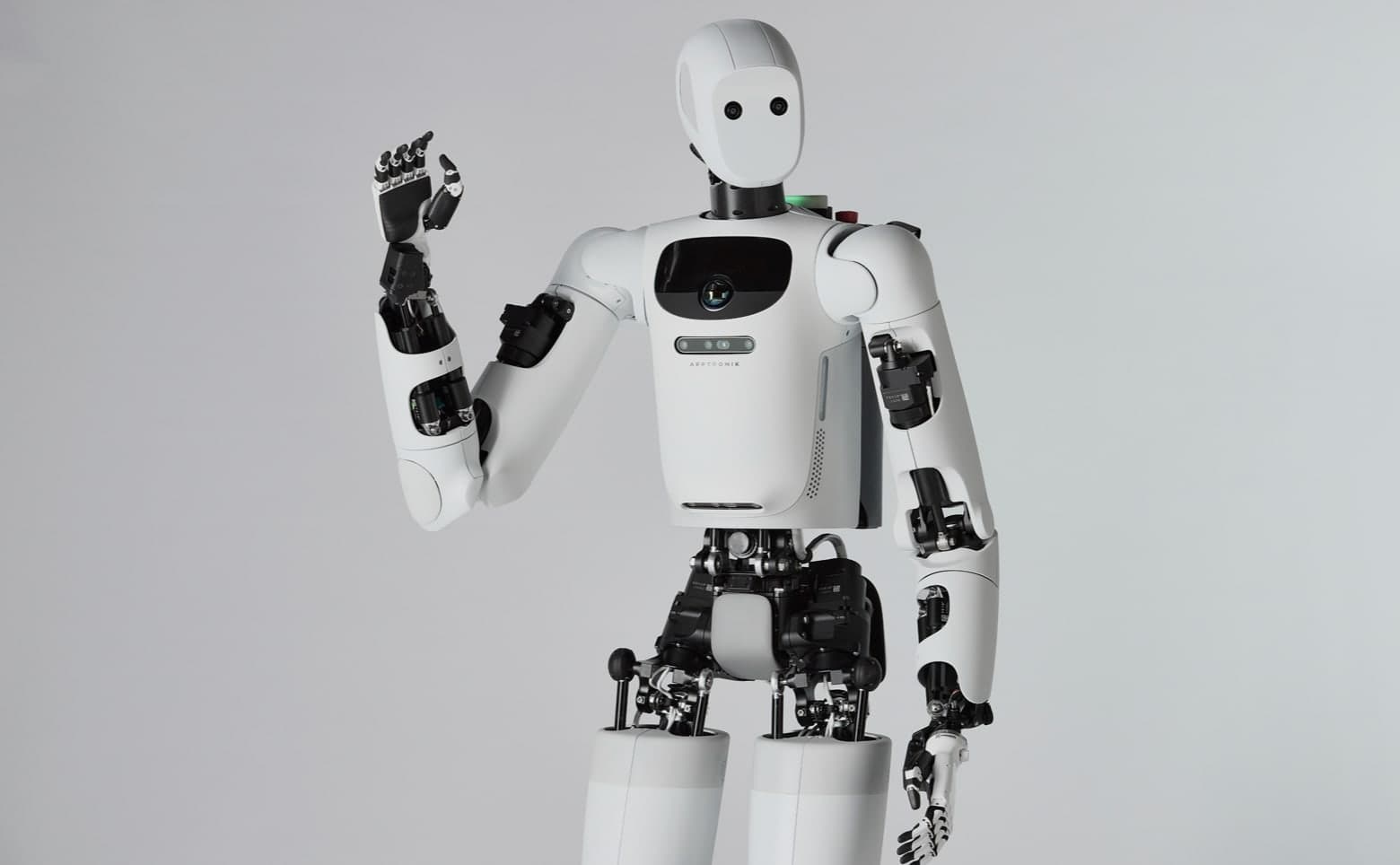
Apollo is a human-sized bipedal robot. The original model, unveiled in August 2023, stands 5'8", weighs 160 lbs, is designed to lift 55 lbs and runs about four hours on a swappable battery. It is aimed squarely at logistics and manufacturing tasks like moving totes and cases, kitting parts and delivering them to the line.
What sets Apollo apart isn’t flash. It’s how the hardware is put together. The design is modular: the same upper body can walk on two legs, ride on a wheeled base or be mounted in a fixed spot, so one robot can suit a warehouse today and a different setup tomorrow.
Apptronik has also leaned on outside hardware where it makes sense. Apollo’s end effectors are modular, and the robot has been shown working with the Ability Hand, a five-finger hand from prosthetics company PSYONIC, including at Mercedes-Benz.
The bigger story is the AI running underneath. Apptronik announced a strategic partnership with Google DeepMind’s robotics team in December 2024, and the two now work together on Gemini Robotics, DeepMind’s foundation models for robots.
Apptronik supplies the hardware and the real-world data. DeepMind supplies the models that run on top. It’s a split that mirrors how much of the industry is organizing itself: hardware companies pairing with foundation-model labs rather than trying to build both in-house.
Apptronik has also been candid about pacing. In February 2026, Cardenas told A3 that one of his bars is, “if I can show you something in a video, I should be able to show you the same thing in person live.” That is part of why Apollo 2 worked for more than a year, in pilots and with DeepMind, before its public unveiling on June 30, 2026.
The next iteration, Apollo 3, is positioned as the company’s commercial product. Cardenas told Reuters that pilots continue through 2026, with production versions arriving “in 2027 and beyond.” Apollo 2 is the platform the company is learning on, and he says it has built hundreds of them.
Business Model and Strategy
Apptronik’s commercial strategy centers on partnerships rather than direct sales. It doesn’t publish a price for Apollo, and there’s no way to simply order one. Instead, the robot moves into the world through pilot agreements with companies like Mercedes-Benz, GXO Logistics and Jabil. Jabil is also Apollo’s worldwide manufacturing partner, and the plan is for Apollo robots to work on the same lines that build Apollo.
The data side took a concrete step forward on June 30, 2026, when Apptronik opened its newly expanded Robot Park in Austin, a nearly 90,000-square-foot site it calls its flagship data collection and training facility. Fleets of Apollo 2 robots repeat real logistics, manufacturing and retail tasks there every day, through a mix of teleoperation and autonomous work, and the recordings train Gemini Robotics models. As Cardenas put it to Reuters, “we also have a factory that produces data.”
It’s a telling choice. Apptronik is treating the data its robots generate as something to be produced deliberately and at scale, the same way it treats the robots themselves.
The company is also playing a longer game than some of the price points floating around suggest. A widely repeated $50,000 figure traces back to an August 2023 interview with IEEE Spectrum, where Cardenas said that, long term, a humanoid needs to cost less than $50,000. That was a long-term cost target, not a current price. Apptronik has not published a price or said how it will charge for Apollo once volume production begins.
The Data Challenge
Apollo’s design philosophy, fitting into spaces built for people, creates an unusually demanding data problem. A robot meant to work in a Mercedes-Benz plant one month and a GXO warehouse the next needs training data that generalizes across very different environments, lighting conditions and task variations, not data tuned to a single fixed setup. (We compared what home, warehouse and factory robots each need in robot training data by environment.)
The DeepMind partnership is partly an answer to that. Gemini Robotics is meant to bring general-purpose reasoning to Apollo so it doesn’t need to be retrained from scratch for every new site. But general-purpose reasoning still has to be grounded in real, well-structured examples of what a successful grasp, a blocked path or a misjudged handoff actually looks like.
Robot Park exists because Apptronik sees that scaling deployments means scaling data collection just as deliberately as it scales manufacturing.
That’s a harder problem than it sounds. A humanoid’s sensors generate several streams at once, and they all need to be time-aligned, labeled consistently and checked for quality before a model can learn anything useful from them.
A near-successful pick and an actual failure can look nearly identical in raw footage. Without careful annotation distinguishing the two, a model trained on that data won’t know the difference either, and neither will the robot repeating the task on a factory floor six months later. Telling them apart, and recording why an attempt went wrong, is the work of robot failure analysis.
Labelix.ai’s Take
Apptronik’s story shows what a focused bet looks like. It has picked one robot, one form factor and a small number of deep enterprise relationships, betting on depth. That approach only works if the data behind each deployment is treated with the same discipline as the hardware. (For a very different bet, see our profile of 1X Technologies, which went to the home first.)
A facility like Robot Park signals that Apptronik already sees this. Owning the pipeline from real-world operation to training-ready dataset isn’t a side project. It’s core infrastructure. But infrastructure alone doesn’t guarantee quality. Multimodal sensor streams, ambiguous task outcomes and variation from one environment to the next are exactly the kind of problems that need careful, consistent annotation rather than volume for its own sake.
As more humanoid companies move from pilots to real commercial scale, the ones that win won’t just be the ones with the most partnerships or the biggest funding rounds. They’ll be the ones whose data can actually be trusted to teach a robot the difference between doing a task right and almost doing it right.
Have robot recordings that need labeling?
Send a representative sample: one task, a few episodes, your hardest cases. A dedicated Labelix.ai team labels steps, outcomes and failures against your guideline and shows you how the close calls were decided.
FAQs
What is Apptronik?
Apptronik is a robotics company founded in Austin, Texas in 2016 out of the University of Texas Human Centered Robotics Lab. It builds Apollo, a human-sized humanoid robot for logistics and manufacturing work.
How much does the Apollo robot cost?
Apptronik has not published a price for Apollo. The often-quoted $50,000 comes from a 2023 interview in which CEO Jeff Cardenas described a long-term cost target, not a current price.
Who are Apptronik's partners?
Apptronik works with Google DeepMind on Gemini Robotics models, runs pilots with Mercedes-Benz and GXO Logistics, and has a pilot and manufacturing agreement with Jabil.
What is Robot Park?
Robot Park is Apptronik's data collection and training facility in Austin, Texas, expanded to nearly 90,000 square feet in June 2026. Fleets of Apollo 2 robots perform real tasks there to produce training data for Gemini Robotics models.
When will Apollo be commercially available?
Apptronik says Apollo 3 will be its commercial product. CEO Jeff Cardenas has said pilots continue through 2026, with production versions expected in 2027 and beyond.

Cindy writes about Physical AI, robotics, and the human data that teaches models to perceive and act, for Labelix.ai, an independent data foundry for robotics and multimodal AI.
Get the next one first
One sharp read a month on Physical AI and the data behind it.