Four robots showed up this week in places that don’t forgive mistakes: an automotive supplier’s production floor, a carmaker’s plants, a Formula 1 weekend and a convenience store cooler. Each raises the same practical question. Not “Can a robot do this?” but “How do you teach it, evaluate it and trust it in an environment that wasn’t built for it?”
Here’s our weekly scan of what moved in Physical AI and robotics, and what it means for the data behind it.
A humanoid learns an automotive task from 12 demonstrations
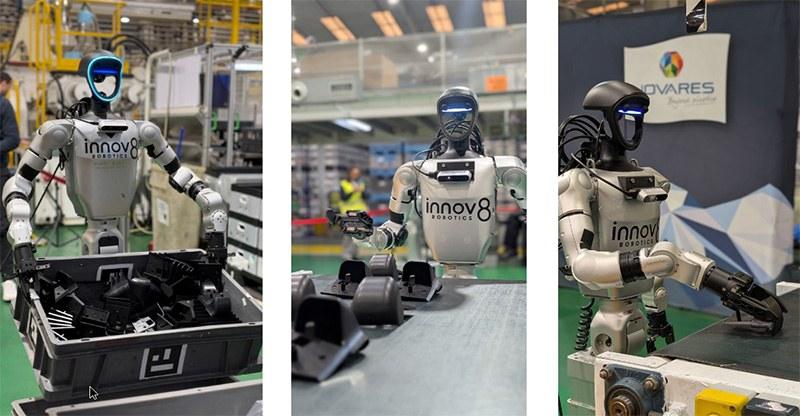
On November 17, Novares and Innov8 shared the first results of a proof of concept at Novares’ plant in Seseña, Spain, which the companies call one of the first humanoid deployments at an automotive production site in Europe.
The robot is a Unitree humanoid integrated by Innov8 and running learning software from French startup Bleu Robotics. Its tasks include part detection, pick-and-place and box handling alongside production teams. The reported results: 100% accuracy in part detection, 99.5% in part pick-and-place and 95% in box handling, with 60 minutes of autonomous operation across 200 cycles.
Bleu Robotics says its model learns from a few operator demonstrations at the workstation, without a large dataset. The first task took 11 minutes of demonstration across 12 demos, within the company’s 10-to-15-minute target for a simple job.
What you’ll see: Innov8’s November 2026 film from the Seseña line, with the humanoid handling parts and boxes next to production staff.
Video: Innov8 Robotics, 2026. Plays from YouTube.
This is the opposite of the foundation-model approach we covered last week, where GR00T 2 leaned on hundreds of thousands of hours of video. Here, a small amount of data collected on site gets the job done, and Bleu Robotics says its software works with any humanoid platform. If this approach holds up, teaching a robot a new task could start to look more like onboarding a new hire than launching a research project.
The scale of the test. One hour and 200 cycles are a promising start, but they’re not a full shift, and the results come from the partners’ own announcement. We’d like to see longer runs, more tasks and a clearer picture of how often a person had to step in.
Twelve demonstrations sound like very little data, which is exactly why each one has to count. With so few examples, a hesitation, a re-grasp or an unclear starting position can teach the wrong behavior. Small datasets raise the bar for data quality rather than lowering it.
They also make robot policy evaluation especially important. The gap between 95% in box handling and 99.5% in part handling shows where the next round of demonstrations should focus.
GM plans 20% more factory automation by 2028
On November 17, Reuters reported, citing people familiar with the matter, that General Motors aims to increase its use of robots and other automation at its North American plants by 20% by 2028.
The focus is on autonomous mobile robots (AMRs), which move parts around the plants. GM is assembling some of its own robots at its Kokomo, Indiana, plant while still buying equipment from outside vendors, and the company has said that about 100 roboticists, AI engineers and hardware specialists work on its robotics programs.
The push extends to suppliers. Companies bidding for new contracts are reportedly being asked to present automation plans, with a scorecard that could influence contract decisions. GM has said automation improves safety, quality and efficiency. The United Auto Workers has criticized the effort as a way to cut jobs, ahead of contract talks in 2028.
The headline robot here isn’t a humanoid. It’s a mobile robot hauling parts, which is probably how much of physical AI will reach factory floors first: quietly, through unglamorous but essential jobs. Building some robots in-house also suggests GM sees robotics as a core capability rather than something it simply buys.
The sourcing. GM hasn’t confirmed the 20% target or the Kokomo detail, both of which rely on Reuters’ sources. We’re also curious what counts as “automation” in that 20%. AMRs, robot arms and inspection systems do very different jobs, so the metric is worth a closer look.
A scorecard for supplier automation only works if someone defines what good performance looks like: measurable tasks, consistently evaluated runs and honest records of failures. That’s the logic behind robot failure analysis. The point isn’t just how often a robot fails, but why, and what needs to change. An in-house robotics team will also need training data from every plant it works in. No two factory layouts are identical, and a system that performs well in one can struggle in another.
Figure’s F.03 heads to the Las Vegas Grand Prix
On November 20, Figure AI said it was partnering with T-Mobile to bring its F.03 humanoids to the Formula 1 Las Vegas Grand Prix, which ran November 19 to 21. The more interesting story is the technology behind the partnership.
F.03 is designed to connect to T-Mobile’s network. In October, T-Mobile CTO John Saw wrote that the companies are evaluating whether parts of Figure’s Helix S1 and S2 models can run at the network edge rather than entirely inside the robot. The idea is to ease the onboard computing, power and thermal limits of a humanoid body.
F.03 itself, launched in October 2025, is designed for both commercial and home use, with wireless charging, soft exterior materials and a bigger speaker. It has already worked in industrial settings, including BMW’s plant in Spartanburg.
What you’ll see: Figure’s June 2026 film of F.03 working at BMW’s Spartanburg plant. Figure’s 18-second Las Vegas clip shows an F.03 in T-Mobile colors on the floodlit Strip circuit.
Video: Figure, 2026. Plays from YouTube.
If part of a robot’s intelligence can live on the network, humanoids could take on more complex tasks without carrying all their computing power onboard. That matters as robots move beyond controlled factory floors and into homes, offices and crowded public spaces.
Latency and failure modes. Neither company has said that edge AI is being tested in Las Vegas. And a robot that depends on a network connection needs a clear answer to one important question: what happens when the connection drops?
Splitting a model between the robot and the network adds another layer of evaluation. Teams will need to test performance on degraded connections, from slow links to complete outages, and record how the robot behaves when connectivity is interrupted. A crowd is also the ultimate long tail: unpredictable people, noise, lighting and movement that a controlled factory pilot rarely captures.
FamilyMart rolls out a drink-stocking robot nationwide
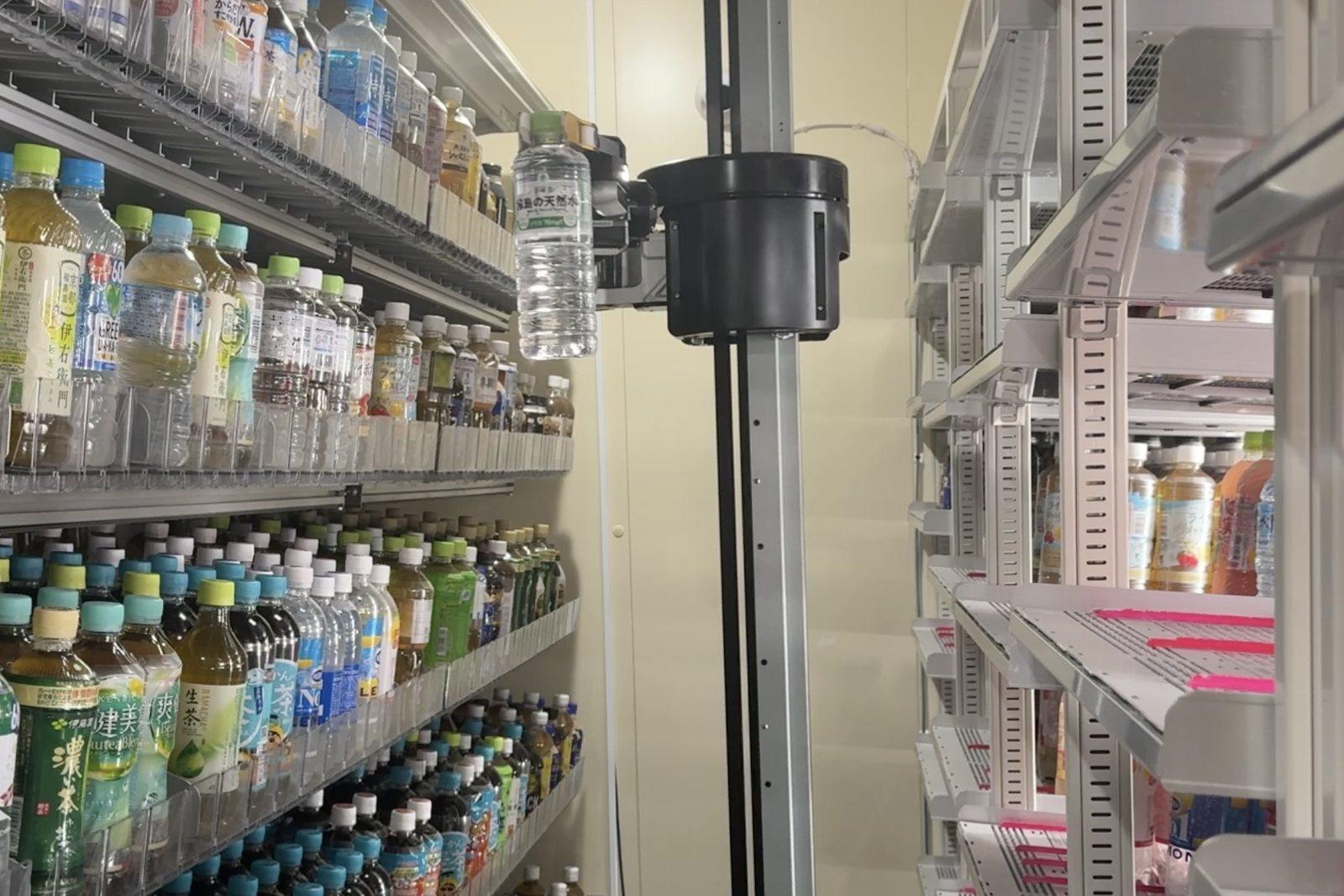
On November 19, FamilyMart and Telexistence announced that physical AI drink-restocking robots will roll out to FamilyMart stores in Japan from January 2027, starting with stores in the Tokyo area, Kansai and Tokai and then expanding nationwide.
The system pairs Telexistence’s TX GHOST robot with a digital smart shelf. The robot arm takes bottles from a stock shelf in the refrigerated backroom and places them in the display cooler. Sensors track inventory, and AI decides how many bottles to restock based on sales.
The robot can restock about 1,800 bottles a day. If a bottle tips over, it can be set upright, with Telexistence’s remote operators stepping in when needed. FamilyMart says stores that adopted the system early cut their daily drink-stocking work by about 70%.
This is physical AI taking on a simple, repetitive task at national scale. But getting here took time. Telexistence started with VR-piloted robots in FamilyMart stores in 2020, then brought its TX SCARA robot to 300 stores in 2022. A human-piloted system grew into a largely autonomous one over several years, a useful reminder that real-world deployment is usually an iterative process, not a single breakthrough.
Real-world speed and maintenance. SoraNews24 noted that the robot is fairly slow but can run around the clock, and staff still have to load the backroom shelf. Readers were skeptical, and the writer asked what the 70% figure means in practice. Those are fair questions, and store-level results will answer them.
The fallen bottle is the detail we like best. The robot handles it, and a remote operator steps in when it can’t. Every one of those handoffs is a mistake caught in the act, and a robot learns to fix its own mistakes only from examples like these, labeled as such. The same goes for cooler glare, crowded shelves and bottles that look almost identical.
A nationwide rollout adds one more challenge: evaluating every store against the same standard. That’s what turns a successful pilot into a reliable fleet.

Cindy writes about Physical AI, robotics, and the human data that teaches models to perceive and act, for Labelix.ai, an independent data foundry for robotics and multimodal AI.
The Data Brief
Get the Radar in your inbox, one sharp read a week on Physical AI and the data behind it.