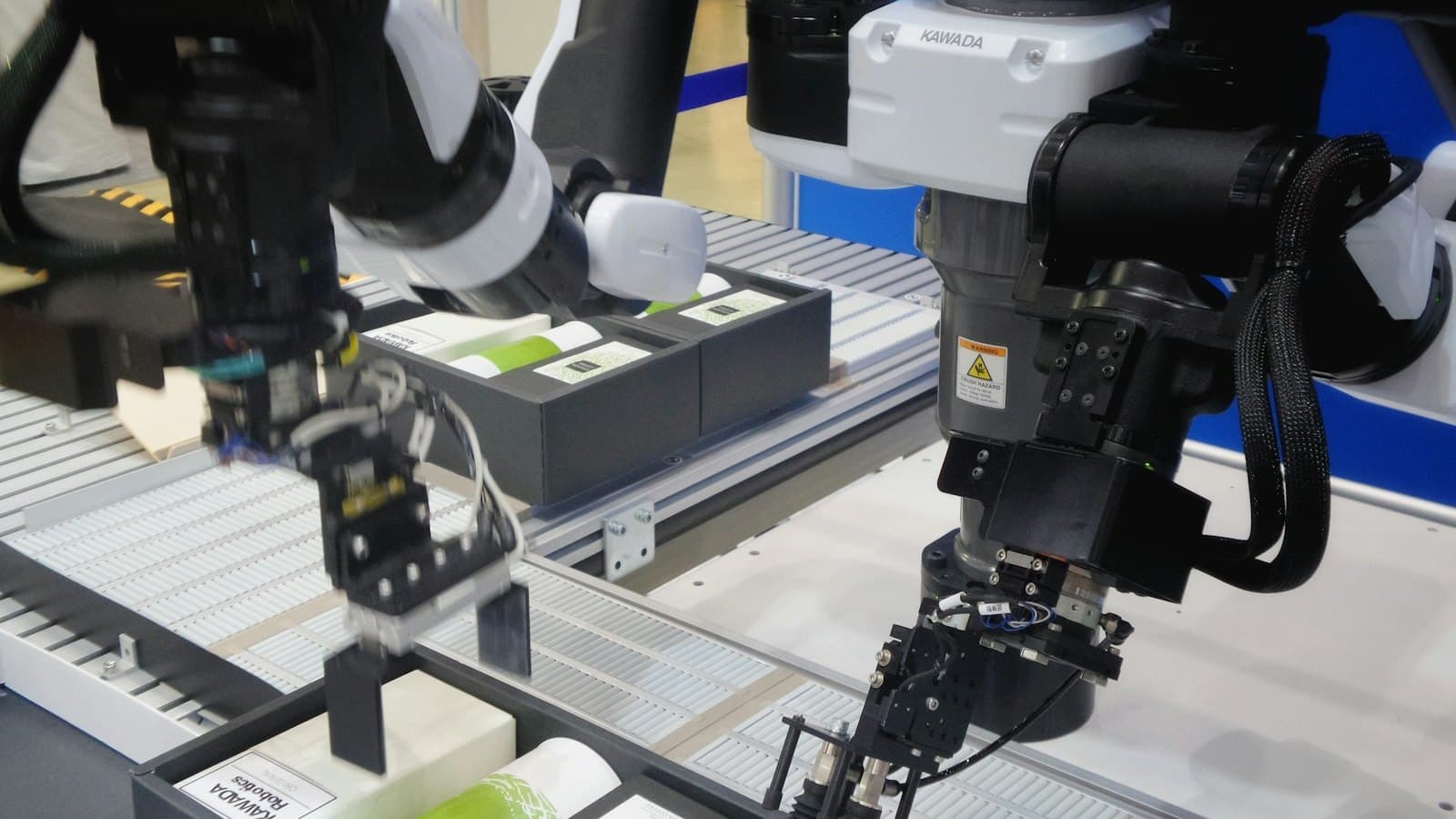
Robots are getting better at learning from us. NVIDIA showed a model that picks up new tasks from a handful of demonstrations and can learn some skills just by watching people, DeepMind put a humanoid to work on live Mercedes-Benz lines, J.P. Morgan sized up how many humanoids the US could build by 2030, and ASUS revealed a robot that learns its job by watching factory workers. Under all four sits the same ingredient: data that somebody has to collect, label and check.
Here’s our weekly scan of what moved in Physical AI and robotics, and what it means for the data behind it.
NVIDIA’s GR00T 2 teaches robots from human demonstrations

On November 9, NVIDIA introduced GR00T 2 at the Conference on Robot Learning in Austin. It is a world-action model, meaning it predicts future video and robot movements together, and NVIDIA says it runs on gripper arms, five-fingered hands and humanoids.
After five demonstrations per task and a 30-minute fine-tune on a single RTX 5090, it averaged 95% success across 50 new tasks. Without any demonstrations for those tasks, it succeeded in 40% of trials. The training mix includes 402,730 hours of first-person human video, 10,184 hours of handheld-gripper demonstrations and 23,500 hours of robot teleoperation.
NVIDIA’s X-Adapt method moves skills between bodies. A robot with two five-fingered hands lined a lab funnel with filter paper after only watching a human, succeeding 65% of the time, and a robot arm assembled a toy dump truck in 60% of trials after learning from handheld-gripper demonstrations, with no robot demos of that job.
Demonstration data is the slowest and priciest part of teaching a robot. If human hands, wearable cameras and cheap grippers can all feed the same model, the pool of usable data gets far bigger, and five demos per task changes what onboarding a new job costs.
The gap between the headline and the transfer tests. The 95% came with robot demonstrations for each task, while skills learned from a human or a handheld gripper landed at 60 to 65%. These are also NVIDIA’s own results, and the code is listed for December, so we’re waiting for independent replication.
More than 400,000 hours of human video shows how much weight footage now carries, and footage only helps when it’s labeled well: where a task starts and ends, which steps happened, whether a grasp held. The 60% and 65% results are an evaluation story too, since robot policy evaluation is how you learn which tasks transfer and which don’t.
Apollo 2 sorts parts on live Mercedes-Benz lines
On November 10, Google DeepMind introduced Gemini Robotics 2.5, a vision-language-action (VLA) model, and reported a 96% success rate in a proof of concept with Apptronik’s Apollo 2 humanoids, which sorted automotive parts on active Mercedes-Benz production lines in Kecskemét, Hungary, and Sindelfingen, Germany. The robot picked metal brackets from bulk bins and placed them into sequencing containers in the exact order each vehicle needs, fixing gaps as it went.
Apptronik CEO Jeff Cardenas said the models improved dramatically in a few weeks of post-training and carried over to Mercedes-Benz production with “very little drop-off.” Separately, DeepMind reports that in its own tests the new model improved safe task completion by 33% around obstacles and 43% around nearby people.
What you’ll see: Apptronik’s June 2026 film for Robot Park, its nearly 90,000-square-foot facility where Apollo 2 collects real-world training data, with shots of Apollo 2 at a Mercedes-Benz workstation and in a warehouse.
Video: Apptronik, 2026. Plays from YouTube.
Even as a proof of concept, this ran on active production lines, not in a lab cell. Kitting is repetitive prep work, and handing it off keeps technicians on complex builds.
The detail behind the 96%. It covers one kitting task, and DeepMind did not share the number of runs, hours of operation or human interventions.
The key word is post-training. The model didn’t arrive factory-ready. It was adapted with task data and checked on the floor, and every new part or tray layout restarts that loop. That echoes Xiaomi’s eight-hour run in last week’s Radar. Safety tests like DeepMind’s pair well with failure analysis, which shows why a robot slipped, not only how often. We looked at Apptronik’s approach in our Apollo profile.
J.P. Morgan sees up to 400,000 US humanoids a year by 2030
On November 12, J.P. Morgan said US humanoid production could reach 300,000 to 400,000 units by 2030 and about 1.5 million by 2035, according to reports. The report ties the growth to labor shortages, improving economics and rising production capacity, and the bank estimates humanoid costs are nearing parity with labor costs. Multi-shift deployment could save a customer about $100,000 a year.
Most US makers outside Tesla target 10,000 to 30,000 units annually, and the bank sees the biggest near-term opportunity in components, with actuators, motors and vision systems approaching a $30 billion market by 2035.
The question is shifting from “can a humanoid do the job?” to “can anyone build enough of them?” The bank lists the bottlenecks as hands, actuators, the brain and production capacity.
The range. A forecast isn’t a shipment count. J.P. Morgan also notes that the US government’s finding on imported robots could lead to tariffs or other measures to boost domestic production. For now, that October determination calls for negotiations with trading partners, not new tariffs.
Of those bottlenecks, “the brain” is the one we sit closest to, because a robot is only as good as the data it learned from. Hundreds of thousands of humanoids a year means hundreds of thousands of new workplaces, each with its own objects and edge cases. Hardware volume tells you how many robots exist, not how well each one does its job.
ASUS shows Gallop, a humanoid that learns from its own workers
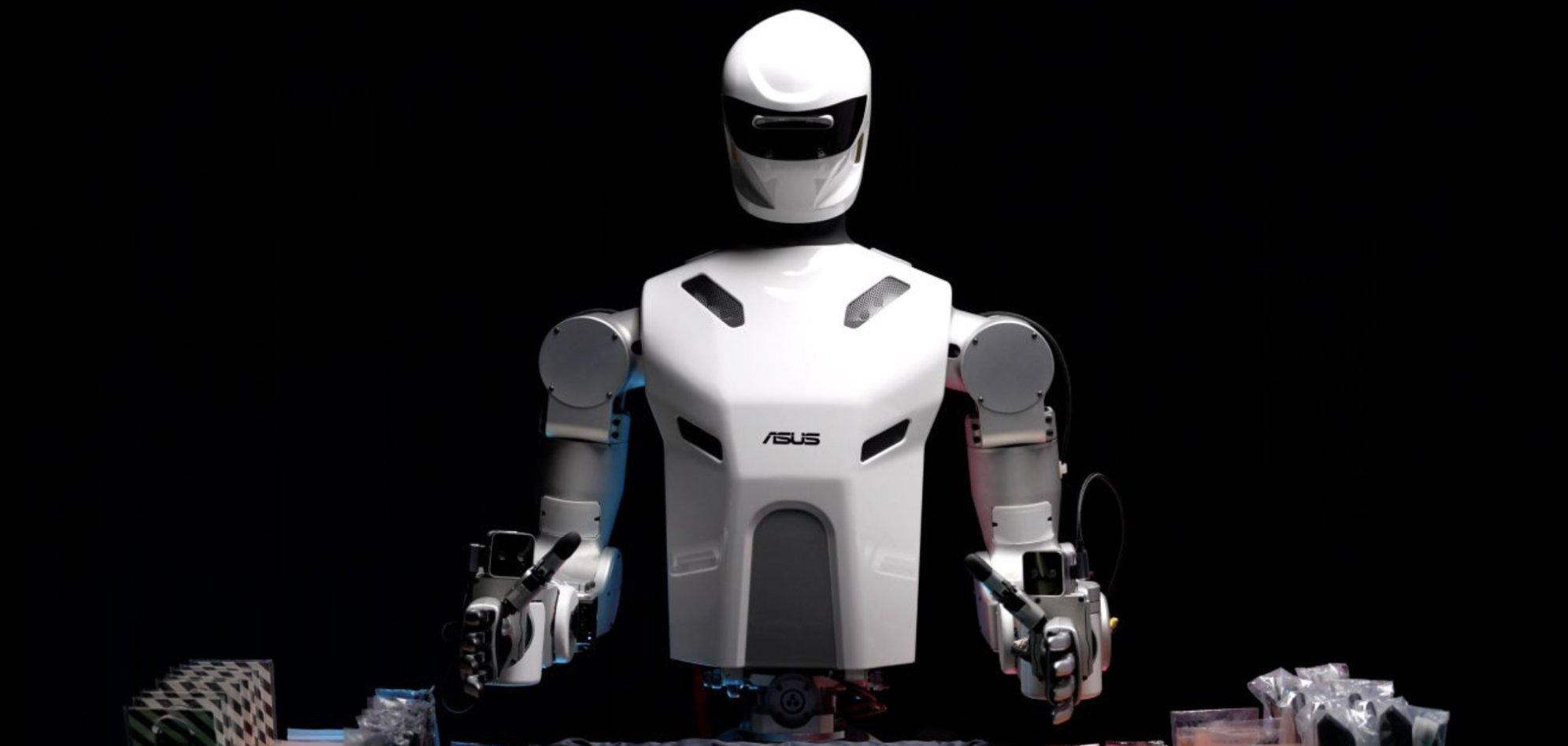
On November 13, ASUS unveiled Gallop, its first humanoid robot. Gallop is an upper body with a head and two arms on a fixed base, and it is being tested at an ASUS group electronics manufacturing plant, where its first job is packing motherboard accessories. The task covers 15 small parts, many of them in thin, clear plastic bags, and takes about 20 seconds per board. ASUS is aiming for 99.5% success within that time, Interesting Engineering reports.
Training blends three sources. Experienced workers, with their consent, wear small head cameras to record the job. Simulation then generates variations of those recordings, and an operator in a VR headset and gloves guides the robot through the task. Everything runs on a single onboard NVIDIA Jetson AGX Thor. Customer pilots are planned for 2027 and a market launch for the second half of 2028.
Packing thin bags of tiny parts is a tougher test than moving rigid items between bins. A company that builds its own robot and owns the factory floor can also collect training data right where the work happens.
The 99.5% target is a goal, not a result. ASUS hasn’t shared a current success rate, and today’s version sits on a fixed base, with a wheeled platform planned for later.
Recording skilled workers on the job and multiplying that footage in simulation is the kind of pipeline our work supports. A 99.5% bar makes the labels the hard part, because every one of those 15 parts has to be marked placed, missing or wrong in the same way every time. It also shows why sim-to-real work still leans on real recordings as its anchor.

Cindy writes about Physical AI, robotics, and the human data that teaches models to perceive and act, for Labelix.ai, an independent data foundry for robotics and multimodal AI.
The Data Brief
Get the Radar in your inbox, one sharp read a week on Physical AI and the data behind it.