CoRL 2026, the year’s main robot learning conference, wrapped up in Austin on November 12. Three developments stood out to us: RLWRLD’s pipeline for turning human video into robot training data, Fei-Fei Li’s Atlas world model, and Russ Tedrake’s case for learning on the factory floor. Each one gives a different answer to the same question: what does a robot learn from, and how do we know it works?
It was a big year for the Conference on Robot Learning. Program chair Georgia Chalvatzaki reported 2,094 submissions and 687 accepted papers, nearly three times last year’s submission count. Google DeepMind, NVIDIA, Meta, Tesla and Boston Dynamics were among its top-tier sponsors.
We followed the conference from afar. With so many announcements, papers, and demonstrations competing for attention, we wanted to look beyond the headlines.
RLWRLD turns human video into robot training data
One of the most relevant developments for us came from RLWRLD, which presented seven papers at CoRL 2026: five in the main conference and two as workshop talks. One of them, HuRo, built with Yonsei University, converts human videos into robot-aligned training data and scales the process to about 630,000 episodes.
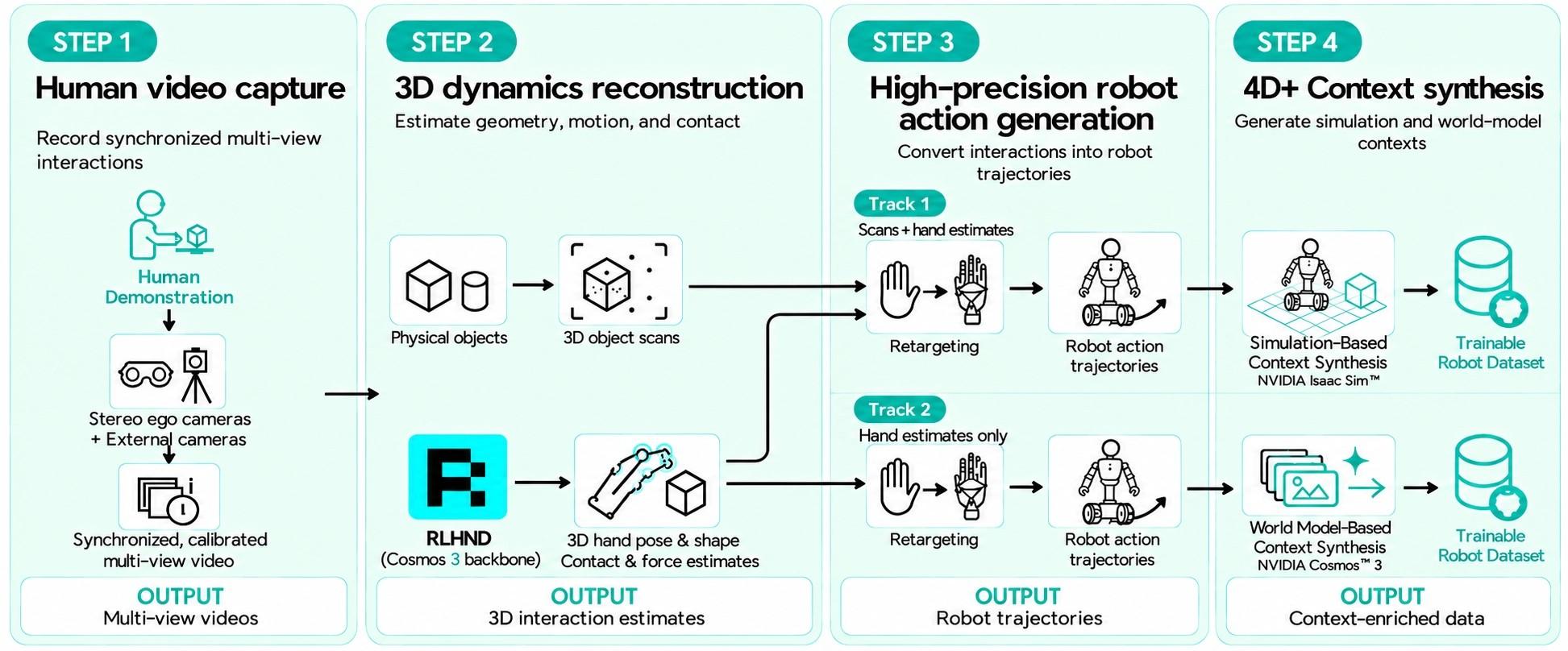
The idea is compelling. Human video offers a potentially enormous source of demonstrations, but people and robots move differently, have different physical capabilities, and interact with the world through different bodies. Turning footage into useful robot training data means bridging those differences rather than simply collecting more video.
For Labelix.ai, that distinction matters. Human footage is valuable, but the annotations behind it can be just as important: which action is happening, which object is involved, and what counts as a successful interaction? The more effectively researchers can translate human demonstrations into structured robot-learning data, the more useful those datasets become.
The scale is promising, and the paper and code are public. The real-robot evidence is still narrow: the authors report overall task completion rising from 51.5% to 80.3% as HuRo pretraining data grows, measured on four tasks with one humanoid, ALLEX. The important question isn’t only how much data a pipeline can produce, but how well that data transfers to real robot behavior.
Fei-Fei Li puts a world model on stage, next to her future boss
Fei-Fei Li’s CoRL keynote centered on Atlas, the world model from her company World Labs, followed by a fireside chat with AMD CEO Lisa Su. The pairing was notable: in late September, AMD agreed to acquire World Labs in an all-stock deal valued at about $8.2 billion. The deal is expected to close by the end of 2026, pending regulatory approval, with Li set to become AMD’s executive vice president and chief scientist, reporting to Su.
The technical story is Atlas. As World Labs describes it, the system combines text, images and video, camera poses, and depth into a spatial model, and can reconstruct a scene from just two or three images.
What you’ll see: World Labs’ release film for Atlas: a pencil sketch becomes a wireframe, a typed prompt adds wooden balconies, and the finished courtyard turns into a 3D world a character can walk through, with camera paths and a generated 3D mesh.
Video: World Labs, 2026. Plays from YouTube.
The robotics implications are straightforward. If researchers can generate realistic 3D environments more cheaply, they can expose robots to a much wider range of situations during training. A model that predicts how a scene looks and changes could also help generate the visual observations a robot would encounter.
There is still a considerable gap between that promise and deployment. World Labs has not published a technical paper or code for Atlas, and its performance figures are its own. It opened Atlas to everyone on November 12, and its real-time research preview streams from cloud GPUs at up to 15 frames per second. That makes Atlas an intriguing research direction, not yet a demonstrated solution for autonomous robots operating in the field.
Russ Tedrake takes the other side: learning in the factories
MIT professor Russ Tedrake, co-founder and CEO of Walden Robotics, took a more grounded approach in his keynote, titled “Learning in the factories.”
Walden launched in July with $300 million at a $1.1 billion valuation, and according to Walden, its robots have been doing production work at a Toyota plant in North America since February.
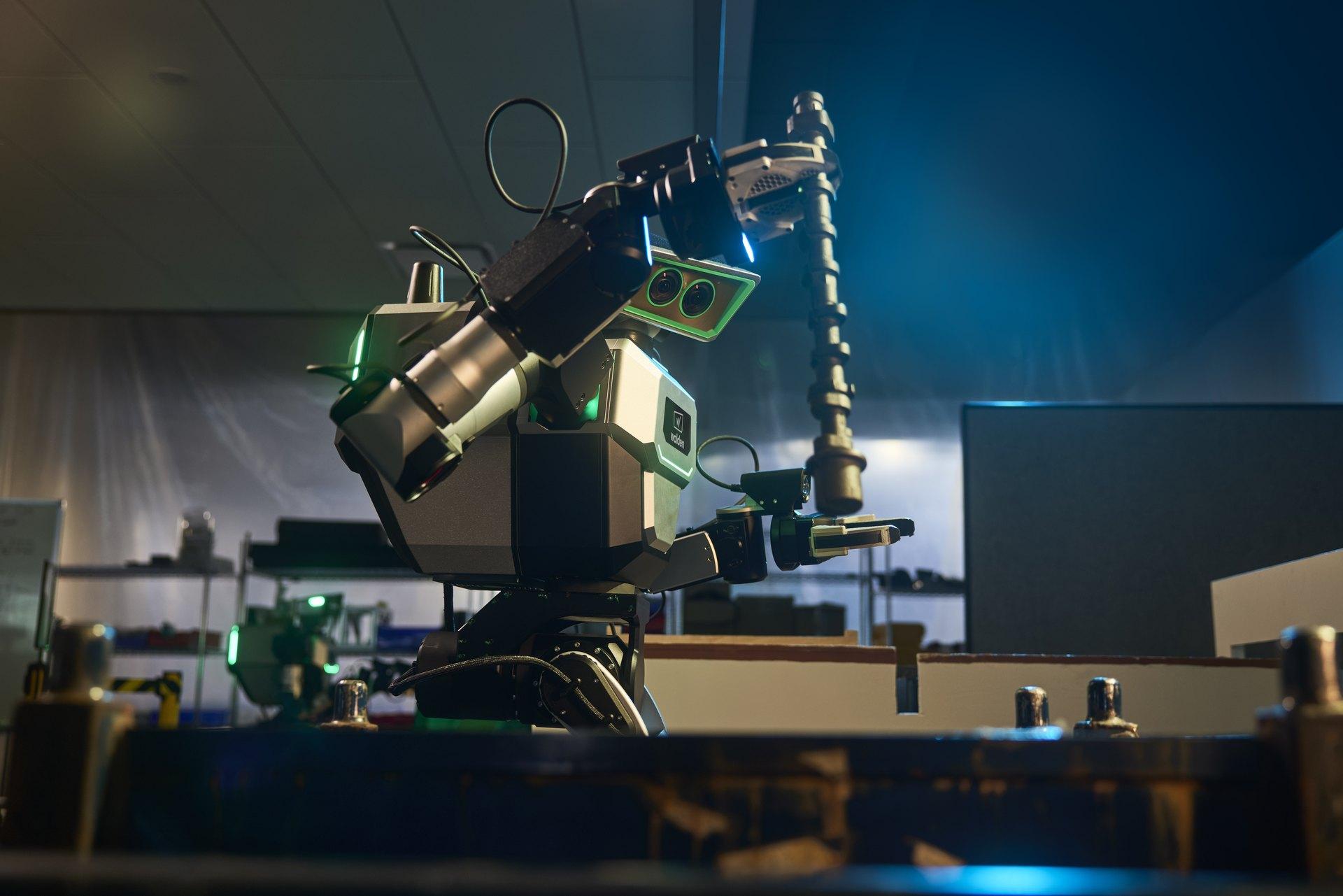
Before Walden, Tedrake led Toyota Research Institute’s work on Large Behavior Models. That team’s 2025 paper evaluated multitask policies across roughly 1,800 real-world rollouts and more than 47,000 in simulation. The results offer a useful distinction: fine-tuned models matched from-scratch performance using three to five times less task data, while pretrained models without fine-tuning did not consistently outperform single-task policies.
What you’ll see: Walden’s launch film from July 2026: its robots picking parts from bins in the company’s lab, engineers at work, and the team explaining why it builds around learning fast in deployment.
Video: Walden Robotics, 2026. Plays from YouTube.
That is a more nuanced picture of robot learning than the idea that pretraining alone will solve everything. Large models can help, but their value still depends on the tasks, the data, and how they are adapted to the environment where they must work.
The argument also connects to a workshop held on November 12, “Do Robots Need World Models?” Reporting ahead of the event framed Li’s world models and Tedrake’s factory-trained behavior models as competing bets. That framing came from TechTimes, not the conference itself, but it captures an interesting tension in the field: should robots learn by predicting the world, by learning behaviors from demonstrations, or by combining both?
Labelix.ai’s notes
We’re excited about this direction. Across the conference, one theme kept coming up: robot learning depends not just on models, but on the quality of the data and the rigor of the tests used to evaluate them.
Here are three takeaways:
Human video is becoming a serious training resource. NVIDIA’s open release of 100,000 hours of first-person human video, used to train its GR00T 2 model, and RLWRLD’s work on converting human demonstrations into robot training data point in the same direction. This is the kind of data Labelix.ai records and annotates. But footage is only the starting point. Someone still has to identify the action, the relevant object, and the difference between success and a near miss. As datasets grow, we expect annotation quality and structure to matter as much as volume.
Benchmarks are useful only when they explain failure. New open benchmarks announced alongside CoRL, including DexBench (RLWRLD with NVIDIA) and VABAR (UC Berkeley with NVIDIA), are encouraging because they give researchers a common way to test policies across different scenarios. But a benchmark score alone cannot tell us why a robot failed. Scenario design, success criteria, and failure analysis deserve just as much attention as the headline result.
What you’ll see: RLWRLD’s team on why it built DexBench from real industrial work: breaking factory jobs into more than 5,000 pieces, finding 18 core tasks that keep repeating, building the benchmark with NVIDIA, and why a benchmark and a demo are not the same as deployment.
Video: RLWRLD, 2026. Plays from YouTube.
World models and factory-trained policies don’t have to compete. Generated environments offer scale and flexibility. Real-world demonstrations and task-specific data provide grounding. We think the most useful systems will combine both: learn in simulation, refine with real demonstrations, and validate against real robots. The challenge is making sure the simulated experience actually transfers.
We’ll be watching three things:
- How human-video pipelines develop beyond their headline dataset sizes
- Whether World Labs publishes technical details on Atlas
- Whether new benchmarks such as DexBench and VABAR gain traction beyond their initial collaborators
Turning human video into robot training data?
Tell us the tasks your robot needs to learn. A dedicated Labelix.ai team records trained people doing the work and labels every step, object and outcome the same way, starting with a small paid pilot.
FAQs
What is CoRL?
The Conference on Robot Learning is an annual international conference focused on the intersection of robotics and machine learning. The 2026 edition ran November 9 to 12 in Austin, Texas, with the main conference on November 9 to 11 and workshops on November 12.
What is HuRo?
HuRo is a pipeline from RLWRLD and Yonsei University that converts human video into robot-aligned training data. It has produced about 630,000 episodes and 142 million frames from five human-video sources, and the paper was accepted at CoRL 2026.
Why does AMD's World Labs deal matter for robotics?
AMD has agreed to acquire World Labs, the company developing the Atlas world model, in an all-stock deal valued at about $8.2 billion. If the deal closes, it will bring a major chipmaker closer to spatial intelligence and physical AI research.

Cindy writes about Physical AI, robotics, and the human data that teaches models to perceive and act, for Labelix.ai, an independent data foundry for robotics and multimodal AI.
Get the next one first
One sharp read a month on Physical AI and the data behind it.