Vibe Robotics is building a two-armed robot for hotels, and it is proving the idea with a towel. Vibe 01 is designed to carry linens, deliver guest requests and fold laundry overnight. A prototype already folds a towel on its own, according to the company.
Here is how Vibe 01 works, where the open-source Vibe A1 fits in, and why a folded towel is a harder test than it looks.
| Vibe Robotics at a glance | |
|---|---|
| Company | Vibe Robotics Technologies Inc., founded by four Purdue students |
| CEO | Archer Lin |
| Accelerator | Purdue Innovates Accelerator, second cohort, 2026 |
| Vibe 01 | Wheeled, two-armed robot for hotel service work; pilots by request |
| Vibe A1 | Open-source humanoid for research and education |
| Vibe 01 price | Not public |
| Vibe A1 price | $799 to $1,999 at launch pricing |
Company Snapshot
Vibe Robotics says it builds versatile humanoid robots that free people from repetitive physical work. Founded by four Purdue students, it joined the second cohort of the Purdue Innovates Accelerator in 2026, and its story there is a useful clue to its thinking.
What you’ll see: CEO Archer Lin explains how he started Vibe Robotics at Purdue to build an affordable humanoid, with a first prototype that cost under $700 to develop, before selling robots to classrooms and labs. He describes the team’s work on Vibe 01, taking on chores one at a time.
Video: Purdue University Autonomy, IoT, and Robotics, 2026. Plays from YouTube.
In Purdue’s write-up, CEO Archer Lin said the team first approached humanoids broadly, then narrowed to one high-frequency task and a deployment-first plan. Restaurants were once the expected market. Customer discovery and mentor feedback pushed the team toward one narrow but painful chore, done extremely well. At the time, Purdue described that chore as a household one.
On its website today, hotels are where that plan starts. Vibe cites hotel labor shortages, and the company lays out a path from hotels to senior living, hospitals, apartments and offices, and eventually homes. Each deployment is meant to make the platform more capable for the next one.
The Technology: Vibe 01, the Towel Test, and Vibe A1
Vibe 01: A Wheeled Robot Built for Hotel Service Work
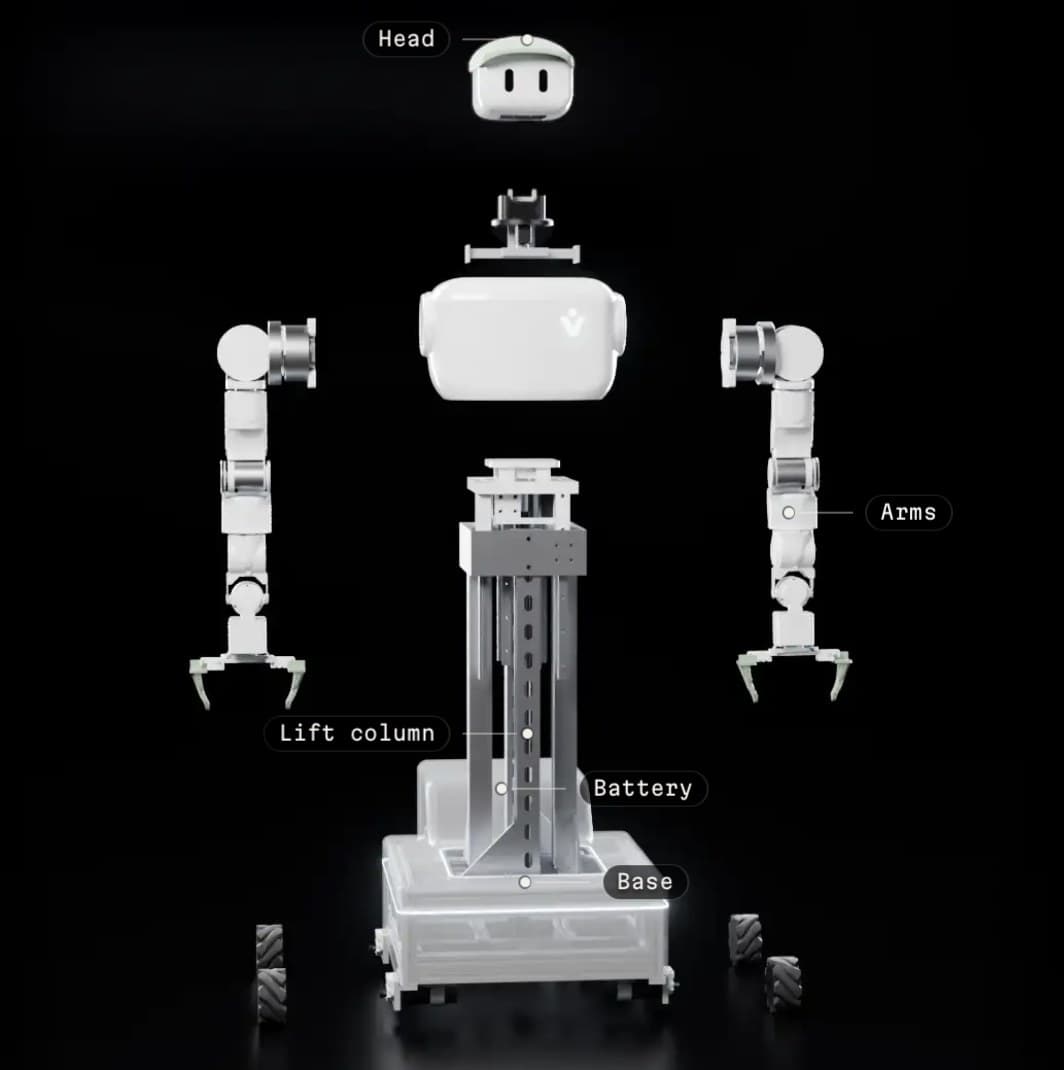
Vibe 01 is not a walking humanoid. It rolls. That choice fits a hotel, where floors are flat, corridors are predictable and elevators do the climbing. Below are Vibe 01’s five parts:
| Part | What it does |
|---|---|
| Head | Stereo camera on a neck that turns and tilts |
| Arms | Two arms, seven joints each, each ending in a gripper |
| Lift column | Linear actuator that raises and lowers the arms and head |
| Battery | Sits low in the base |
| Base | Drive motors and wheels under a cover with light strips and an emergency stop |
In our view, the lift column matters more than it sounds. It lets one pair of arms work at a laundry table, a linen shelf and a guest door without a taller, heavier body. The low battery keeps the center of gravity down while the robot carries a load.
Vibe has not published payload, battery life, speed or pricing for Vibe 01.
Riding the Service Elevator
The robot’s route starts in the basement linen room, with fresh towels for the 15th floor. Vibe 01 is designed to ride the service elevator the way staff do, by pressing the buttons. Connecting to the elevator system is the fallback, not the requirement. That is a practical call: it means a hotel does not need an IT project before a pilot can begin.
Three Jobs, One Robot
A pilot is planned to start with guest delivery, then add housekeeping support, then overnight laundry:
- Guest delivery: water, towels, toiletries and amenities, left at the guest’s door on request, day or night.
- Housekeeping support: linens and supplies run up to housekeepers so they can stay on their floor.
- Overnight laundry: unload the dryer, sort the linens, fold the towels and shelve them for the morning shift.
The company also shows a staff app prototype for requests.
The Towel Test
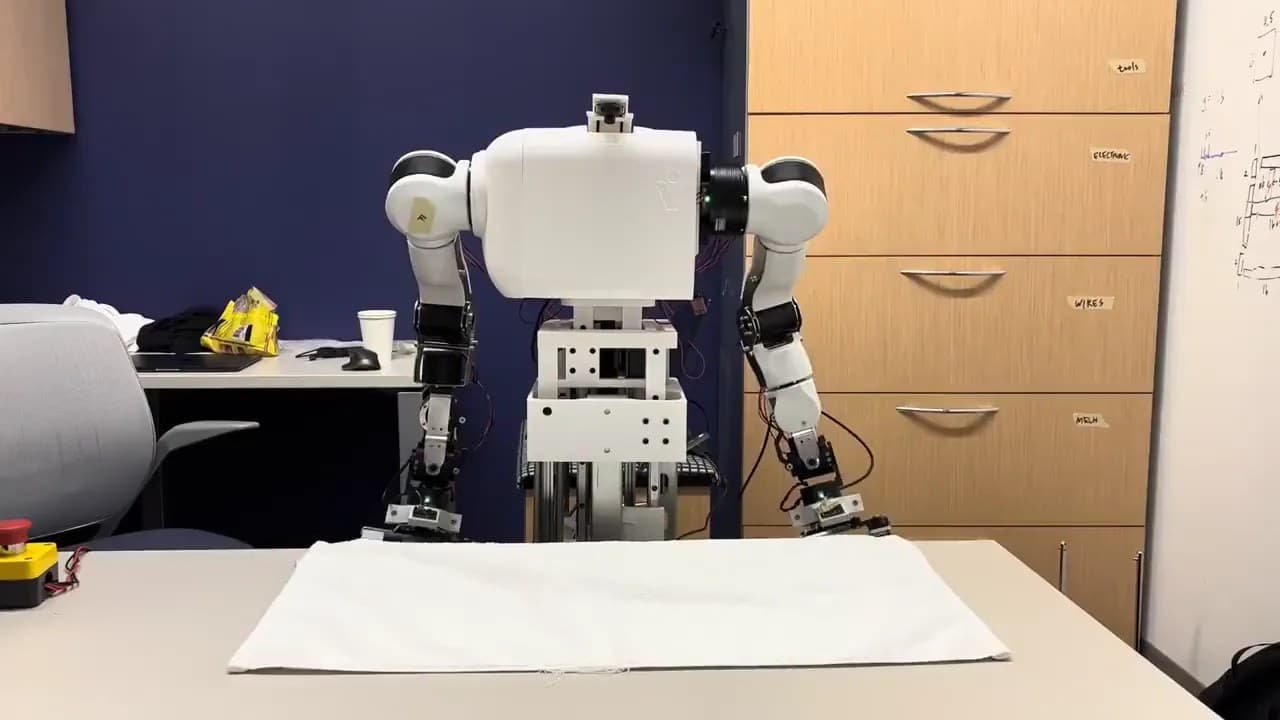
The clip on Vibe’s homepage is labeled real robot, real towel, fully autonomous. The brand film is a render, but the folding footage is not. Vibe shows two runs: one tuned for quality, which takes 41.1 seconds, and one tuned for speed, which takes 23.8 seconds. Both are played at twice real speed.
What you’ll see: The real Vibe 01 prototype at work in Vibe’s October 2026 update: towel runs labeled autonomous and filmed in one take, then folding at a table, carrying a box and riding an elevator.
Video: Vibe Robotics, 2026. Plays from YouTube.
A towel looks simple until a robot has to do it. Cloth has no fixed shape. It crumples differently every time, edges hide under folds, and a grip that is too tight drags the whole piece along. The robot has to see the towel, decide where to grab, plan the fold and adjust as the fabric moves. Roboticists call this deformable object manipulation, and it is a long-standing hard problem.
Vibe has not published how it trained the folding behavior, so we will not guess. What the footage does show is a deliberate trade-off between neatness and speed, and that is the kind of choice a hotel laundry shift will care about.
Safety and the Human Backstop
Vibe’s design rules are specific:
- No guest-room entry: the robot waits at a privacy-safe distance outside the door and never enters an occupied room.
- Sanitation transition: it never goes straight from dirty linens to guest deliveries. Contact surfaces are cleaned or swapped in between.
- Remote operator on call: navigation is fully autonomous, but during the pilot a remote operator can take over manipulation at any time.
- Restricted items: staff sign in before opening the basket.
The remote operator detail shows where the hard part still is: the hands.
Vibe A1 and the Open-Source Side
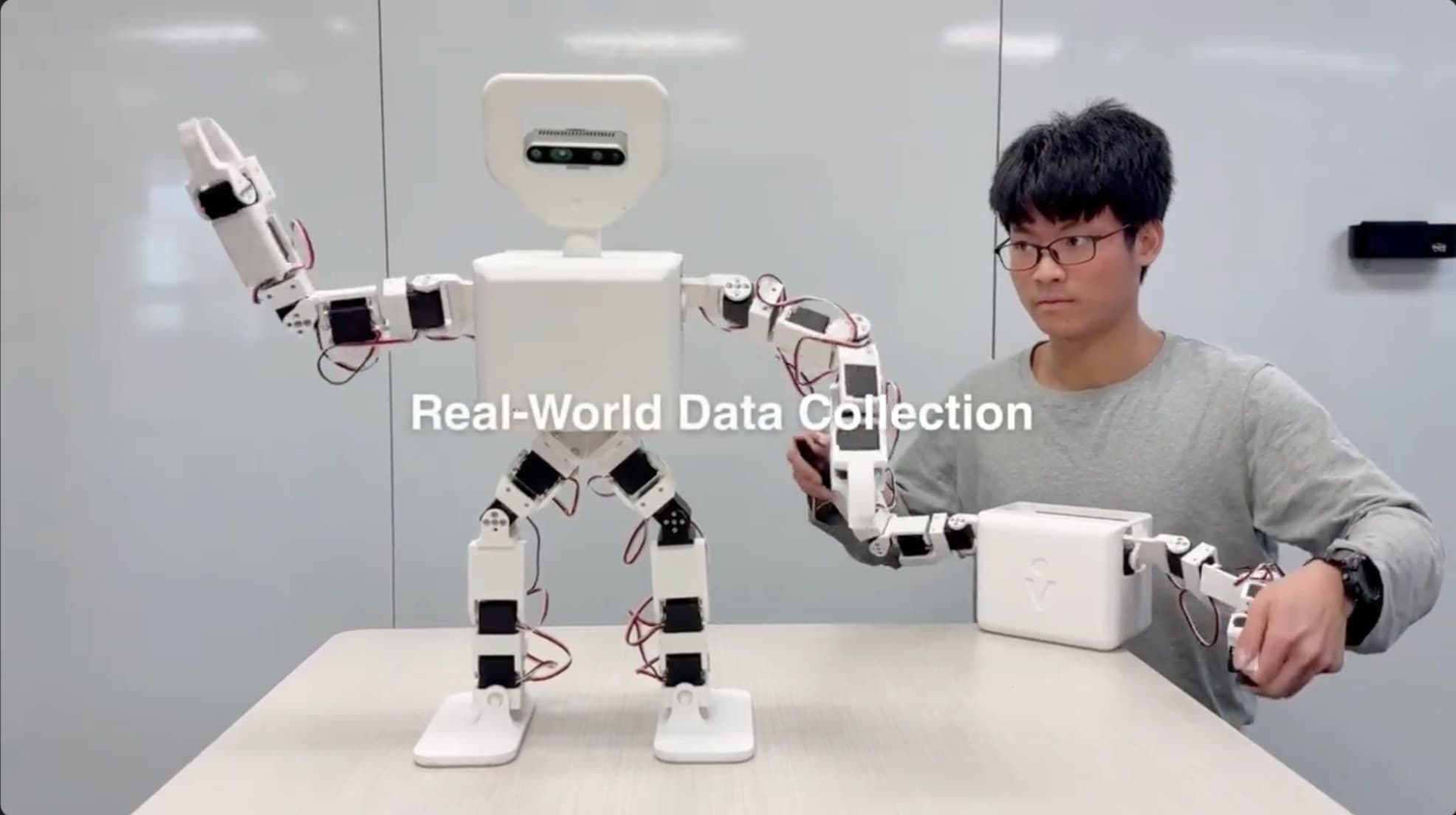
Vibe also sells Vibe A1, described as the academic version of Vibe 01. It is an open-source humanoid platform for students, researchers and hobbyists, and its demo covers walking, teleoperation, manipulation and balancing. It is a different-looking machine from the wheeled Vibe 01, so treat it as a sibling platform rather than a smaller copy.
Around it sits an open-source toolkit: the Vibe Manual for setup and programming, Vibe Gym for reinforcement learning with PPO and SAC, and Vibe Assets with URDF and MJCF models. Docs for Gym and Assets are marked as coming soon.
Business Model and Strategy
Vibe runs two tracks that feed each other.
The first is hotel pilots. Vibe 01 is offered through a pilot request form, starting with guest delivery. Pricing for pilots is not public. The company is betting that one well-solved, repeated task earns trust faster than a robot that does a little of everything.
The second is Vibe A1, sold online to labs, classrooms and makers. Vibe lists research labs such as TRACE Lab, MARS Lab and AIMS Lab among the teams building with it, plus college courses and K-12 curriculums. Researchers get an affordable platform, and Vibe gets a community that tests its software.
Put together, the strategy is to land in a narrow, paid use case and let each deployment teach the platform something new. In the Purdue write-up, Lin called this the real-world data flywheel behind the company’s AI models. It is an ambitious plan, and a pilot is still a pilot. Reliability over many shifts is what will decide it.
The Data Challenge
A robot that folds one towel on camera has cleared the first bar. A robot that folds hundreds of towels a night, in different fabrics and states, has to clear a much higher one.
The inputs are messy. Wet, dry, striped, thick, bunched or half-inside-out: each towel arrives differently. A usable robotics dataset needs that variety, along with consistent labels.
Success needs a definition. Vibe’s two runs already show the tension. Is a fold good when the edges align, when it fits the shelf, or when it finishes fast enough? A clear test design spells out the standard before anyone counts successes.
Interventions are signal. During a pilot, a remote operator may take over manipulation. Each takeover marks a moment the robot could not handle alone. Logged with timestamps and reasons, those moments show which towels, grips or lighting conditions cause trouble.
Failures need sorting. A dropped towel, a misfold and a stalled grasp look the same in a success rate. Failure analysis separates them, and searching video for suspected failures makes the review manageable at scale.
None of this is unique to Vibe. It applies to any robot working with soft, unpredictable objects.
Labelix.ai’s Notes
Vibe Robotics chose a job people actually need done. Linen runs and laundry folding are repetitive, physical and constant, which makes them a fair place to test Physical AI.
The design is explicit about its limits. Autonomous navigation, human help on manipulation, and a published list of guardrails: that reads like a team planning for real hotels, not just a launch video.
Our two cents: the next milestone to watch is not another clean fold. It is how Vibe reports reliability, meaning how many towels, how many interventions, and what went wrong when it did. A fold that works once is a demo. A fold that is measured across thousands of attempts is a product.
That is where careful labeling helps. Labelix.ai’s robotics data annotation work structures robot recordings so teams can label task steps, interventions and outcomes against their own criteria, and our Physical AI data collection service supports teams that need that footage in the first place.
Have robot recordings that need labeling? Contact Labelix.ai to discuss a representative sample and your review criteria.
Have robot recordings that need labeling?
Send a representative sample: one task, a few episodes, your hardest cases. A dedicated Labelix.ai team labels steps, interventions, outcomes and failures against your criteria and shows you how the close calls were decided.
FAQs
What is Vibe 01?
Vibe 01 is a wheeled, two-armed robot designed for hotel service work. It is planned to deliver items to guests, support housekeeping and fold laundry overnight.
Can Vibe 01 really fold towels on its own?
Vibe's homepage shows a prototype folding a towel, and the company describes the clip as fully autonomous. The brand film, by contrast, is a render. Vibe has not published detailed performance numbers beyond the clip timings.
Can you buy Vibe 01?
Not directly. Hotels can request a pilot through Vibe's website, and the pilot is planned to begin with guest delivery.
How much does Vibe A1 cost?
At launch pricing, Vibe A1 Mini is $799, Vibe A1 is $1,499 and Vibe A1 Pro is $1,999. Regular prices are listed at $999, $1,999 and $2,599, so check the current page before ordering.
Is Vibe Robotics open source?
Partly. Vibe offers an open-source manual for Vibe A1 and lists Vibe Gym and Vibe Assets as open-source projects, though documentation for those two is marked as coming soon.

Cindy writes about Physical AI, robotics, and the human data that teaches models to perceive and act, for Labelix.ai, an independent data foundry for robotics and multimodal AI.
Get the next one first
One sharp read a month on Physical AI and the data behind it.